I wanted to push assignment 4 a little further after getting my tutor feedback. My tutor suggested that perhaps I do not need to add the magnifying glass to my arrangement. I initially put the mug and magnifying glass there as the brief had asked for, a collection of still life objects from around the home. However, I did feel that I put the objects there as I thought I should add to the skull and headphones, rather than because I really saw a big part for them. I recently had a study day with a student group of OCA students from a wide range of disciplines. This was lead by Diana Ali and Michelle Whiting. I showed a version of my assignment 4 piece to the group and the feedback I receive was that there was a strong enough message that everyone could relate to and that the skull and headphones alone was enough. They suggested I play with the background to see what I could do with this. Originally I had removed the background so that the image would be directly on the magazine page.
Background exploration
Research
I did a bit more research on the types of things I could do with PhotoShop backgrounds and came across a website that has downloadable templates to. I not use them, but had a look through to find out what kind of things were possible and decided to make my own. One I saw was a pattern with a word repeated over and over evenly spaced letters and another was rough vertical lines. This lead me to the idea of using words. I started to write down a list of words that related to Covid-19 and then asked other students and family members what words they associated with covid. This expanded my list to include ‘homeschooling’ amongst various other words, which, although aren’t applicable to my situation, it is something that is very relevant to a lot of people and other OCA students.
My process
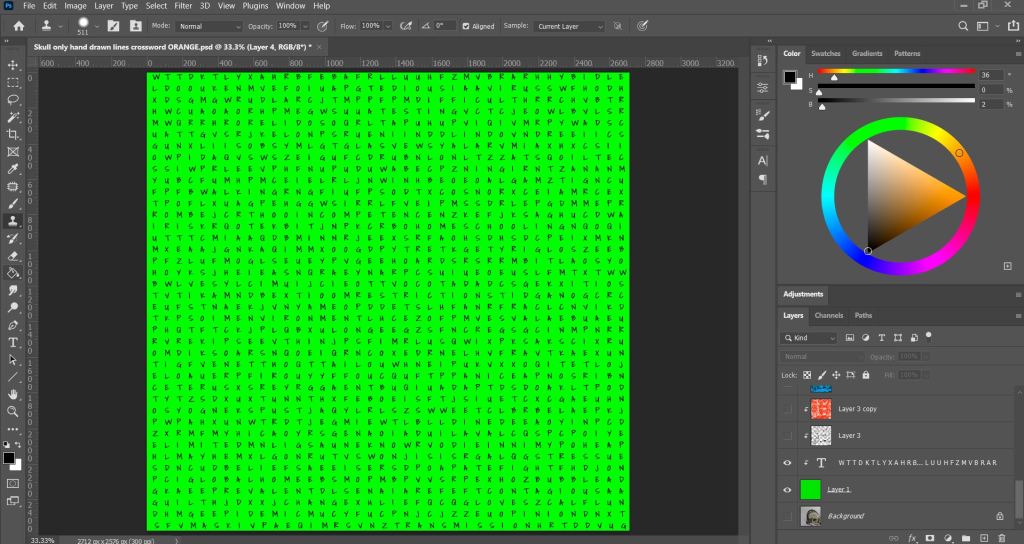
I found a wordsearch generator and created a 40 by 40 letter wordsearch with my list of words. Initially I had the words going in all directions, but then realised in order for this to be easily viewable they words needed to be easier to find.
I copied the letters over to photoshop and added them to my background.
Screen shot 1 – Working progress
I then marked off words to highlight the context, with the font I chose it was very hard to pick out any words and I was struggling to find them myself, so this took some time. However, I liked that the font become something more asthetic than just a regular wordsearch and helped this blend into overall image more.
Screenshot 2 – Working progress
I used various brushes in photoshop to add crossed out words, ink splatters and marks on the background to give it a grungy and more edgy feel. Taking inspiration from some of my mood boards and mark making practices from earlier in this module.
Finished background
I added more breakdown to the page to create more interest and make it less stark. I did do other colour tests as seen below, but decided after showing it to my fellow students for critique that the green worked the best. My intention was also that the bright green represents a hazardous/virus element. However, I do think that this could be achieved with most colours, providing they are bright, with also luminous, neon colours working best. These are the shades we mostly relate to toxic materials due to the popularity in comic books and film, such as the bright green slime in the original Ghostbusters movie and the bright green toxic chemicals Joker falls into in the DC Comics.
Colour variations
My final Image
Conclusion
I am much happier with my illustration now than my previous attempt. I am grateful to my tutor to keep pushing me to go further. This was really out of my comfort zone, but when I found a source of inspiration and an idea, I really had fun putting this together and just trying things and seeing what worked. This also makes me appreciate how digital software can really enhance my work and give me the tools to try things that are easily undone. I could also do a hand drawn version of this now by using this as my blueprint, which would likely take far less time than if I tried to work this all out on paper and not use PhotoShop at all. I am keen to keep exploring digital software and find ways for this to use it to add to my work and use it more for preliminary sketches and colour tests in the future.
After receiving my tutor feedback for this assignment I wanted to implement some of the changes she had mentioned and push my illustrations a little further. I really enjoyed working on this assignment am quite keen to keep developing these characters and see how they evolve over time, as I learn more and more during the duration of my course.
Reflecting on my research
My tutor had asked me to take time to consider my research on comic strips and discuss what I had learned about this area. When I used to get the train in London, I would read the comic strips in the Metro Paper, my original layout idea was inspired by this. I was thinking of displaying my images in one continuous strip so that they could be intended for a space at the bottom of a page in a newspaper. However, when I tried this I realised I had too many images to work this way, as the images would end up too small in order to fit across the page. Therefore, I decided to place them in two rows instead, after looking at reference of comic layout.
My research lead me to look at and consider different types of layouts and think about how I could explore this further in my next modules. The comics I looked at, such as newspaper strips, Garfield and Beano tended to have evenly spaced lined boxes or could have no spacing at all. Some of the characters were drawn extending outside of the boxes. Boxes tend to be uniform or various sizes. However, they were always clearly defined and neat. This makes them easy to read. As this is the first comic strip I have done, I decided to keep mine to a simple, clean layout. This was a challenge in itself to get everything evenly spaced and lined up.
The comic strips I looked at, tended to have a simplicity in the visual information contained. They tend to be line drawings, some black and white and some with colour. Most contained backgrounds. My original images did not contain a background so I added this to see how it would look. My tutor had also mentioned this is something I should consider. I much prefer the versions with the background. It gives the strip more substance and context and adds more life and colour into the images. It also shows the cats being inside a house which helps give context, for example, if my comic strip was called, ‘Toby gets a new friend’ etc., which is the idea behind my narrative, it should be clear what is happening in the comic. I could have shown this within the illustrations by perhaps adding a bow to the neck on the first image to give the impression of the female cat being a present. When I showed my DSA study tutor, she had said that because they didn’t have a background, she pictured a background for herself and imagined the cats were in her home. I found this quite intriguing and that got me thinking about the audience and how much of their own imagination they contribute to illustrations they see. Before I re-worked these I did a lot of sketches to learn comic styles using two new books I bought. These are; Sha, B. (2015) Doodle Dogs and Sketchy Cats: fun and easy doodling for everyone. (First Edition) Ash, Ohio: North Light Books. and Hart, C. (2009) Humongous book of cartooning. New York : Lewes: Watson-Guptill Publications ; GMC Distribution [distributor]. From these I learned different head shapes, how to draw different expressions and emotions and I learned to be more confident and bold with my shapes and move away from realism. I did tests to see how different line styles would look, but decided to stick with the line style I had originally used as I liked the soft effect better for this particular set of images.
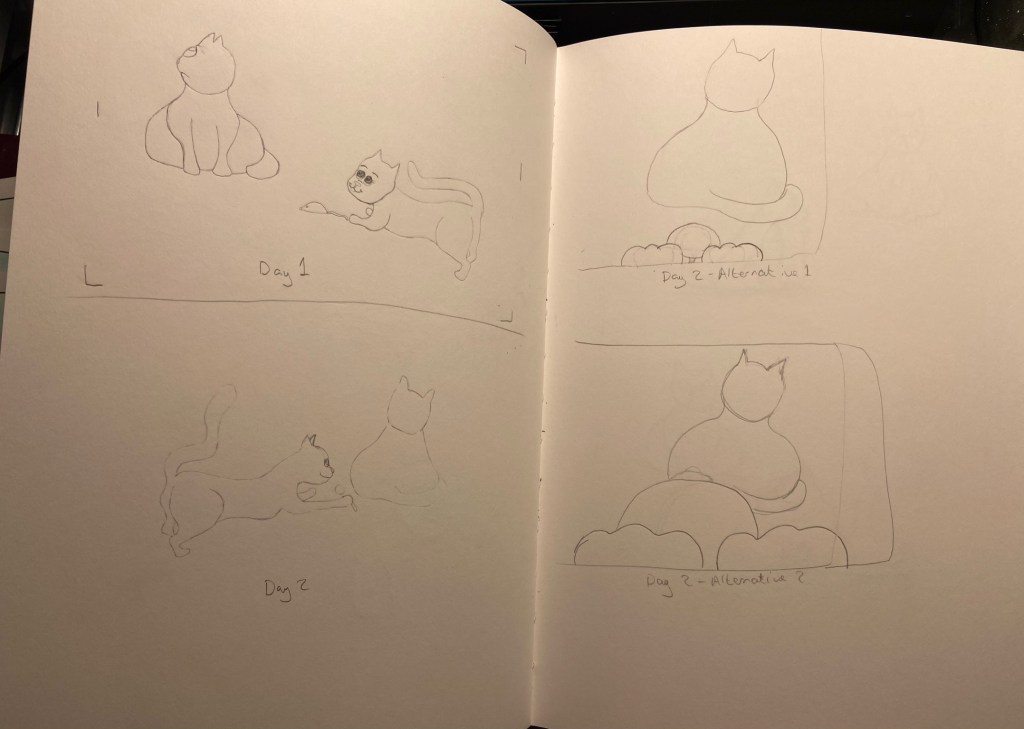
Another thing my tutor had mentioned was that all my images were from one view point. I looked at the examples she provided as well and revisiting my composition and viewpoint exercise and re-worked some of the drawings so that they included a more varied range of viewpoints. I think this made it harder to create clear context, however, I think as a whole the story can still be read as intended. I am glad I tried this as it has made me think differently and include another dimension to my illustrations.
Sketch book pages showing character development and visuals with new viewpoints
Line style and colour experiments
The stories in comic strips are told effectively without words by exaggerating expressions and keeping the images simple and not too busy to distract from the intended point of each frame. A comic strip is a continuation of an evolving story, that each image builds upon. I did show my images to other students and family to check that the message of my comic was well received and the feedback was positive.
I worked in watercolour and then finished the images in PhotoShop.
My Final Images – Photographed version – Layout variationFinal Version – Closer Spacing
I photographed my images to get them into photoshop, I do not have my camera and lighting set up with me at the moment and therefore had difficulty getting my photos clear enough with just my phone. The paper texture is very clear and the images have a grey hue that is not in the originals. Despite altering the colours in photoshop I could not find an effective way to correct the grey hue nor the texture, without losing the image quality. I therefore also did a second version where I scanned the images, however the scanner bleached the images. Even though this corrected the paper grain issue, like I had expected, it left the images with limited colour. I lowered the brightness, but still preferred the original painted version as I was unable to get the pink colour back in the images.
Final Images – Scanned version originalFinal Images – Scanned version Colour adjusted
Additional colour testsFinal Image with Title
Conclusion
I learned a lot by reworking this project. However, I can still see much room for improvement and space to push this further. Part of doing so would require me to learn and improve, as some of the things I would want to do, I do not know how yet or else cannot quite get my hand to do. I am overall pleased with the outcome and much prefer this version of my comic strip. I am grateful for my tutors advice and direction on how I could improve my work and am excited to take this knowledge onto my next module.
I started on assignment 5 today, which asks me to write myself a brief for a project entitled ‘Seven days’. It says;
‘These can be the seven days of the week or random days that tell a story. Your interpretation can be objective or subjective. You can produce seven separate, one large diagrammatic or a continuous strip illustration. You can decide on the media and methods you will use; the context – magazine, newspaper, book, brochure or poster; and the intended audience. You need to write yourself a brief that is clear and challenging but manageable.’
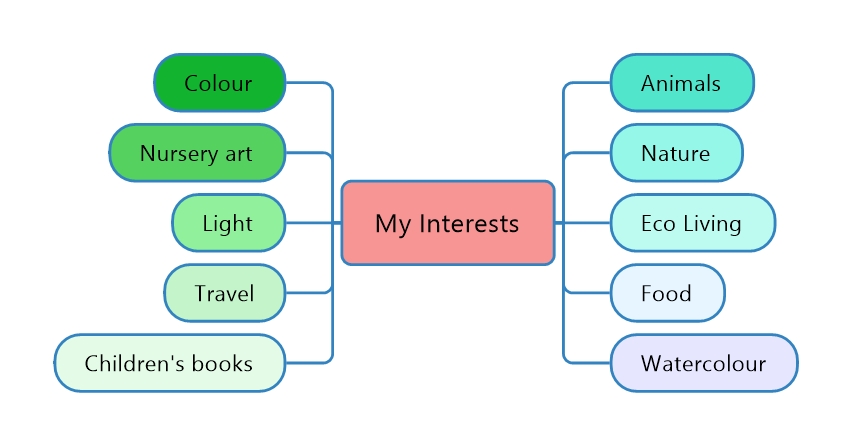
I started out by creating a mind map of my areas of interest to as the assignment brief says this assignment gives me a chance to explore the areas that interest me. I have been thinking alot about this recently, as I had started to realise what areas of illustration and which genres I am most passionate about.
Once I had done this I did another MindMap of ideas. I have just gone on holiday to Canada so have a range of ideas around that and my cat’s journey who is here with me for the winter. Also, perhaps her friendship with our other cat here. I am just about to compete my quarantine so that is a subject area that would be relevant to me and many others during this time which I could create illustrations around.
I typed ‘Seven DAYS’ into google IMgw search to see what come up. I found mainly illustrations for teaching children the days of the week, but also album covers and movie posters, which I can see working very well with the topic by doing a single illustration to go with the title of a film, song or album.
I made files on my computer of stock images of cats, sleeping, eating and playing etc and the did some loose sketches from these photos and of my own photos of my cats.
I then did some watercolour paintings, however, I did not like how these turned out. They were on a tiny scale so I found it difficult to do details and feel i ruined them when I did the eyes. I realised I needed to now do some research into other artists work and also do some tutorials an practice to improve my watercolour and find a style that will work for my illustrations.
I looked at work from Eve Farb who is an artist I love. She works digitally and she tends to draw animals in a cutsey way. They are really soft however, so they look like watercolour paintings to a degree. She also draws people in scenes and will sometimes distort them so that the characters are way too tall for the surroundings etc. She has a very soft and whimsical style and tends to use a soft colour palette. She has recently painted a cat so this was great for me to see how she approached this. https://www.instagram.com/eve_farb/?hl=en
After searching for general watercolour paintings of cats and not finding relevant images for the style I wanted to see, I searched for cat illustrations in children’s books. I found an artist called Jen Borror who’s style I liked for its simplicity. Technically, however, her work must be very time consuming as she uses micro dots in pen to produce illustrations. https://dribbble.com/shots/11224697-Cat-illustration-childrens-book
I looked at work from Anita Jeram who illustrated the popular giftware, card brand ‘Guess’ and children’s books, with the ‘Guess how much I love you’ being the most recognisable with the brown bunny with big lop-ears.’. I have always been a fan of these illustrations. Her illustrations look like they are done in watercolour and are lined in ink in strategic places to emphasis areas. I feel inspired by her work as one of the subjects I love to illustrate the most are animals and i like the simplicity to her work and the way she leaves out the backgrounds, sometimes in full or part. Her colours are soft as her audience is mainly children. https://anitajeram.com/
I stumbled across an artist called Birgitta Sif, I hadn’t heard of her before, but I instantly fell in love with her work. Her pretty ever so slightly limited colour palette and her mixed media techniques in which she produces some beautiful rough textured, expressive line work, which creates a lot of interest and depth in the images. https://www.birgittasif.com/
I researched comic strips as I though that this would work well for my images. I used to read comics as a child, but I have not looked at them since, therefore I collected reference images to compare layouts. Rather than a picture book, I wanted to do a short series of images. A short story.
I decided to use my cats as reference for my characters. I decided to do set of images, showing a cat attempting to play with the other household cat. Initially, I thought I could do 4 illustrations for each of the 7 days in order to show the story effectively. But after some thought and writing down the 4 images per day I realised I could condense this down to just 1 image per day and then present them as a sequence of 7 images telling a story with no words. I wrote out a brief to help guide me.
Brief:
To create illustrations for the title 7 days.
To create a set of 7 illustrations, one of each of the 7 days of the week.
Your subject matter can be of your choosing.
Create a continuous strip illustration to be published in a newspaper.
The medium is of your choosing.
Tell your story with pictures only and do not include any words.
The final images will be printed to fit a 25cm wide column for the strip of 7 illustrations altogether, With the maximum height being 7cms.
The illustrations are to be in colour and will be printed on a white background.
I decided to simplify this in to one illustration for each day.
Sketchbook pages
I did lots of tests and character development. This is the first time I have tried drawing characters with emotions of any kind, so I found this challenging. This is something I would like to spend more time on and develop as I found this assignment very enjoyable. I am unfortunately out of time for this module, so have to submit this today. I am happy with my illustrations as a starting point, but I feel there is much to be developed and more variations I would like to try over the next couple of weeks. I struggled with the female cat’s features and need to keep practicing how to draw a cartoon cat’s face. My cartoon strip shows a new female cat trying to make friends with the male cat.
My Final Illustrations in order of sequence
I did lots of tests for these to try to get the right colour combinations and to try to get the characters to feel more cohesive as a pair as I felt that they originally looked like they were from separate worlds. I feel like they are much more cohesive after reworking the female cat, but I still know I need to do a lot more to improve that character and also so that I can draw her easily from all angles. The male cat was much easier to draw due to him being round and not having an angular face. I am becoming much more confident with watercolours, so these illustrations were much quicker than usual and I did not have to repaint any of them due to errors or smudging so that is quite an achievement for me. I think this was helped that I did tests beforehand. I have had feedback from my tutor that I need to re-evaluate my final illustrations and re-do and re-think them in order to push myself further, which I now see how to do that and how much further I can push myself. Previously I have been struggling with my coursework due to not understanding assignments and not having a process. I would get stuck and take too long at the beginning stages. Since recently starting sessions with my study tutor I am managing to get going on exercises and assignments much easier. I now have methods of how to break down briefs and how to extract the important information so that I do not get lost in it. I am feeling much more confident going forwards with my studies and I am gutted that I ran out of time for this module. I have learned a lot of lessons from my poor time management and lack of study skills, which has been a big frustration for me my whole life and something I am keen to and trying to overcome. I feel like I will be able to tackle the next module with much less difficulty, now that I have support for my dyslexia. Because of this, however, my work has been rushed to meet timelines, to make up for the time I lost at the beginning. As they say ‘, ‘with hindsight’… which I have now to take forward on to my next module.
I am aware I could have pushed this assignment much further if I had more time. I would have really enjoyed doing so too. I am planning on doing some more character development and will find some tutorials that can help me gain some techniques that will help me improve. The two characters I created here I will continue to develop further and see how far I can push them and use them to learn how to portray different emotions and movement etc… I have really enjoyed Illustration Key Steps 1, as I have been tasked with many exercises for things I have never done before and would very likely never have done if I hadn’t have been doing this course. I am grateful for the opportunity to step put of my comfort zone and try new things, even if I have been overwhelmed at times and left my fear of failure get in my way. This first module has been a steep learning curve and I really had no idea of what to expect with doing a degree. This year has been a big wake up call and also has lead me to start finding my way in illustration and realising the areas and topics that are of interest to me and that I would like to develop further. Thank you to my OCA tutor for being so patient with me whilst I bumble around!
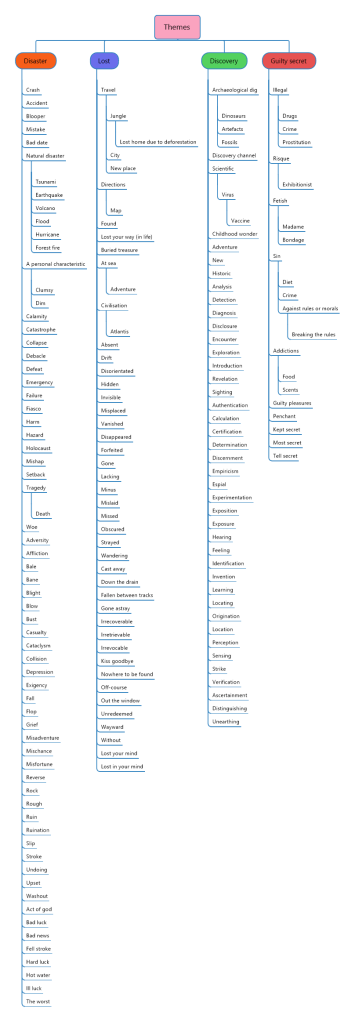
For this assignment I was asked to create an illustration for a magazine based on a still life for one of the following topics; Lost, Disaster, Discovery or Guilty Secret. The brief states that I ‘have the freedom to select the items for the still life and are given creative free rein. The rest of the content, the method you use to produce it and the colours you use are all for you to decide.’
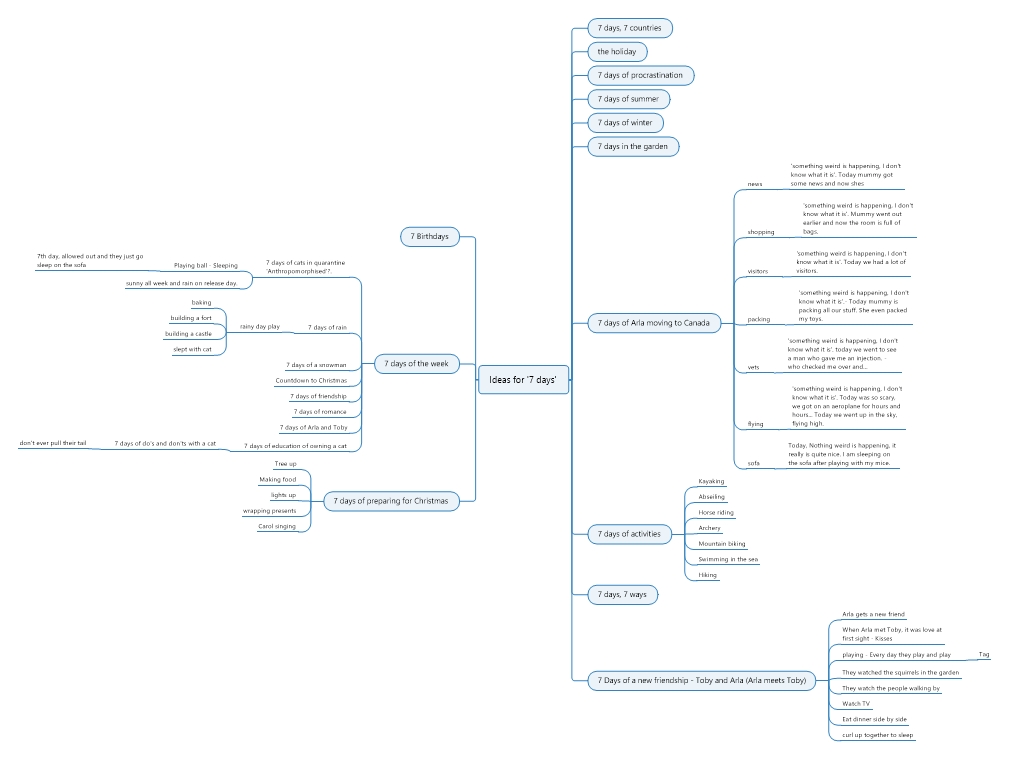
This brief is very much open to interpretation, therefore I started with a mind map to explore my options for each topic.
Research:
Mind Map
Aim: Create a mind map to explore the topic headings.
I started by thinking of words associated with each topic, and then I used a thesaurus and an image search for each of the topics to find additional words and associations.
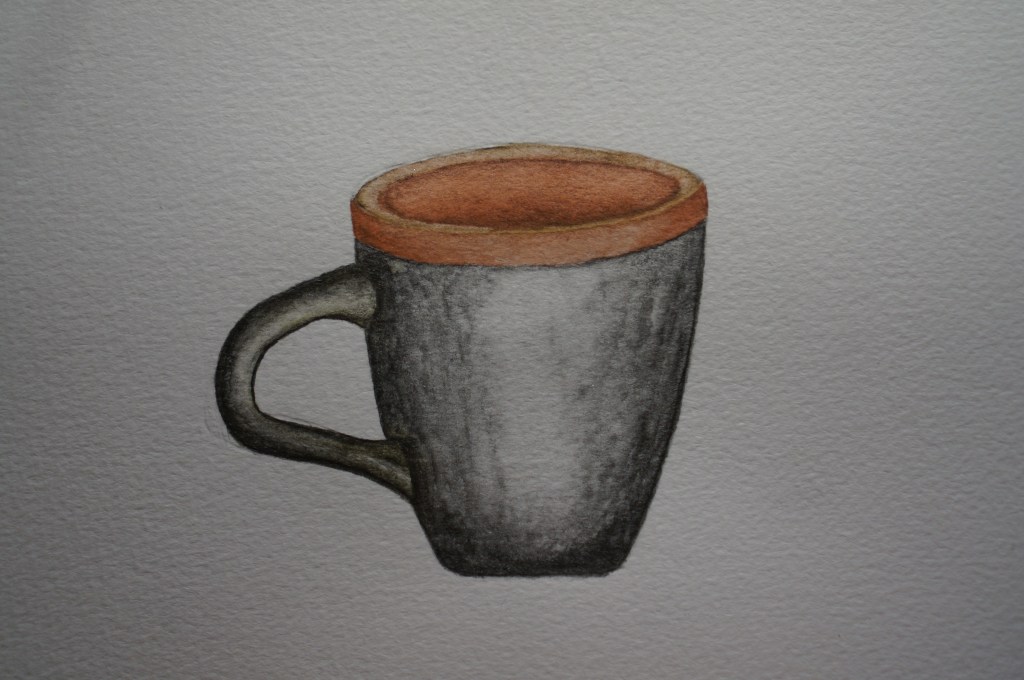
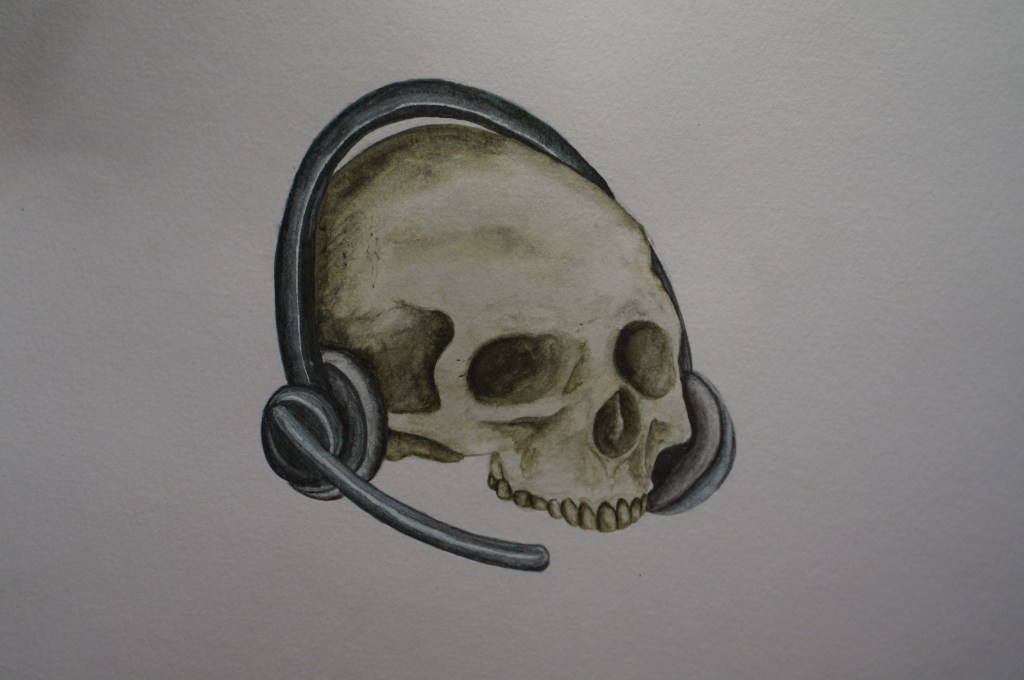
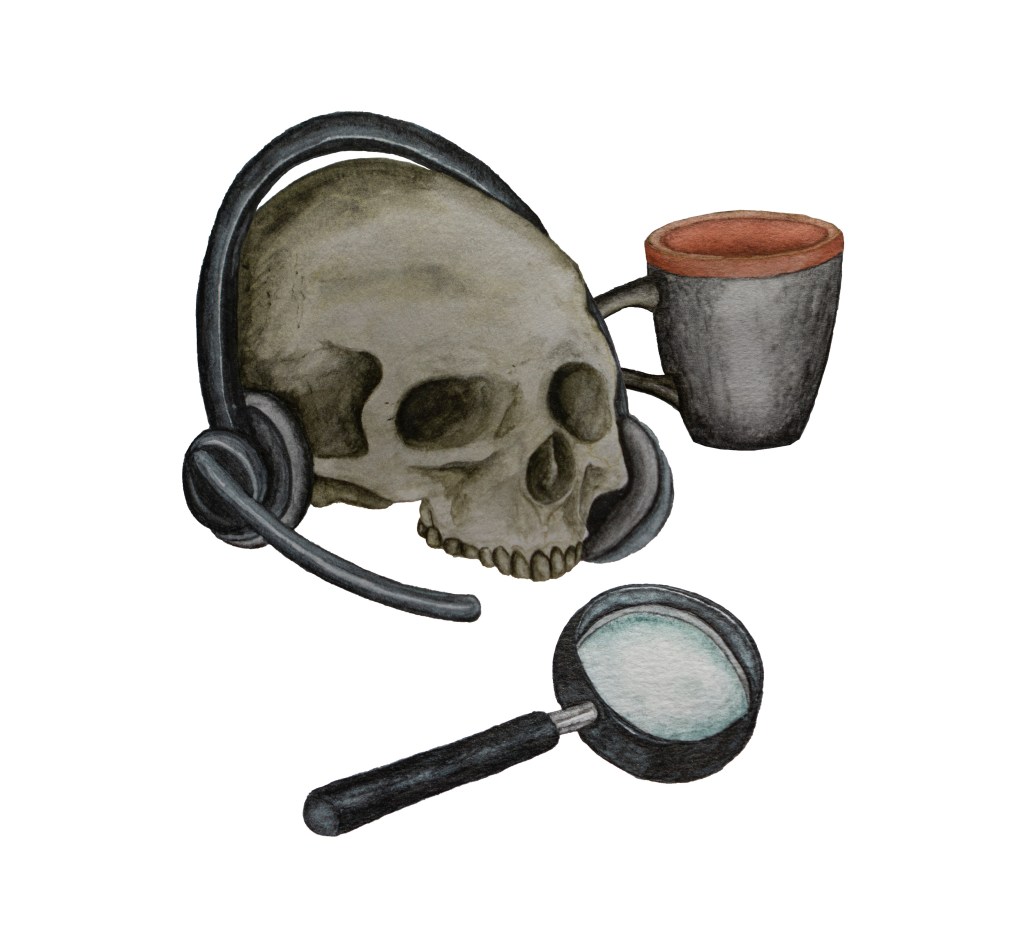
With the completed mind map as a guide, I looked around the house to find inspiration for my object selection and to see which category I felt I was able to undertake best. In my studio I found a skull and my headset from work. I found items for my still life that were most interesting to me. The skull was one that I cast from an old mould at the SFX studio that I worked at a few years back. The headset is mine from my current job where I work from home. I thought it may be amusing to have the skull wearing the headset and it made me think of how I feel at work sometimes, being ‘worked to the bone’. With the impact of Covid-19 it has created many challenges around working from home. We have come up with many effective solutions to overcome these, but overall I am finding my job increasingly difficult. Processes which were more straightforward, have become more in depth and tricky, with lots of new additional tasks being added to the processes for each process. This has meant that my work load has increased tremendously and that without the social aspect of going into the office and working directly with my colleagues, I feel very much like a cog in the machine, a robot and a hamster on a wheel etc. I chose the magnifying glass as a symbol for discovery and the mug was to create a sense of ‘normality’ by using a commonplace object amongst the more unusual.
Outcome: I used the mind map to inform my brief and create associations for each topic. This helped me explore ideas and find options that I otherwise would not have considered, which gave me a larger range of ideas. I found associations by visualising concepts. I visualised an idea of the skull wearing the headset and decided to make my illustration for the topic of discovery. I thought about ideas and headings for this selection of objects and the idea of working from home and the effects of this on your health. This was the narrative I chose for my brief.
Researching Magazine Layouts
Aim: To look at different layout options to help inform my choices.
I looked at a range of magazine layouts which helped inform my brief and discover layout choices. Below is a small selection of layouts which I thought were effective and seemed typical of most of the magazine layouts I looked at. I also feel that these are most effective and would work well for an illustration that is to go alongside a piece of writing. I like the way that the image is placed so that it is clear but does not detract or take over from the text. This is different to the illustrations/photographs seen in fashion magazines that are more likely to take up a whole page as a focus point, with the text being on the opposite page. I found that the images that took up the most space were those used to advertise a product or a service.
Outcome: I decided that my image would be intended to be placed on the upper left hand side as my image is to accentuate a piece of writing and is not the main focus.
Makeup Artist Magazine
Makeup Artist Magazine
Makeup Artist Magazine
Tesco Magazine
Examples of magazine layouts
Extending the Brief:
Aim: To create a more in depth brief to help guide me and create more of a framework to refer back to whilst I worked.
Usually questions would arise from reading the brief, that would be discussed with the art director etc. I therefore had to answer these questions myself. Below is a result of that process and is intended for self-clarification purposes.
My brief:
To create an illustration for a health and wellbeing magazine that explores the idea of the discovery of the effects working from home has on your health.
Your illustration is to fit within an A4 format, which is to include text, including a header and a body of text (the article).
Create your image so that it can be positioned on one side of the page at either the top, middle or bottom.
Your image can be in any colour, bearing in mind it will be on a white background.
Your image is to be a set of objects in a still life.
Feel free to interpret these and distort the image as you wish.
Outcome: I created a brief that I could refer back to and that clarified and laid out rules that I set for myself for this project. This helped me to stay on track and I could check that I had a clear intent for my illustration.
Layout
Viewpoints
Aim: To experiment with view points to find which layout would work best for my illustration.
I experimented with composition by taking photographs of my still life, testing different layout variations and camera angles.
My composition layouts
It was difficult to achieve an interesting layout or view of the objects. I ended up raising up the skull so that it was not directly laying on the desk as it was causing the skull to be in a flat position which made it hard to draw. This is partly due to the jawbone of the skull being missing.
I decided to start working on my drawings and the visual aspects of the project. I have found that working globally and visually helps me to better generate ideas and visualise a concept and decide what type of image and mediums would be most appropriate.
Studies
My Line visual drawing from my still life
Once I had found a setup that I liked, I drew my still life as a line visual. I liked the impact of the negative space around the objects and tried to place them so that I created depth in the illustration., to make sure it was visually appealing. I wondered what impact this image would have on the audience and about how it would be received. My colleagues did comment on this piece of work when I showed it to them and asked ‘is that us?’ I believe this was a positive indication of the illustrations success.
Outcome: I created a line visual to work from after experimenting with different layouts and camera angles to see which worked best. I chose what I felt was the most visually appealing setup to me and then moved on to painting.
My final piece
Aim: To create individual paintings of each of my objects that I could then photograph and edit in photoshop to create my final piece.
I traced each object from my line visual and painted each item on a separate sheet of watercolour paper. I used Derivan Liquid Pencil Paints in Blue, Yellow and Grey as my main colour palette and used my Derwent Graphitint Paint pans for subtle pops of colour where needed to stop the image from looking flat, to create more contrast and to make the image visually appealing. I decided upon this medium as I thought it would lend to a magazine illustration and wanted to explore these paints as they are new materials that I have just purchased. I really enjoyed using them and felt more free with my marks and was not so precious as I am usually with my paintings. This was due to the unique texture of the paints that lend itself well to natural forms such as skulls. They were more difficult to use to create the smooth textures of the mug and magnifying glass due to the texture of the paint. However, I think the overall look is effective. I really enjoyed this process and the outcome.
My final paintings
I did each object separately so that I could edit them in photoshop and play around with the composition more if needed. Also so that I could remove the background ready for printing in the magazine.
The objects with the background removed, ready for layering.
Once I had removed the backgrounds of the images individually, I then layered the images. I choose to move the objects slightly from my original line visual, placing the mug slightly behind the skull so, that I created more depth and interest to the image. This is because I realised that by placing the objects with negative space around each one, I was not using the objects to their full advantage by creating a sense of relationships between the objects. They all seemed like separate objects before I moved them rather than one illustration. I showed this illustration to a few people and was happy to hear the meanings that they took from the image. It was slightly different from person to person depending on their circumstances, but overall the responses read the image as it was intended. I note that my image could also read as being related to death with to the current situation with Covid and death and loss being a big part of life that everyone is dealing with and we are all very aware of at this time.
Outcome: I am happy with my final image and that feel that I have captured what I had intended. My paintings worked well and were easy to edit in photoshop and prepare for a printed format.
Finished image in Photoshop
Finished Image as a JPEG
Wider advantages of completing this project
I have enjoyed this assignment and feel like I am starting to develop my process into an effective way of working. I am finding this is making it easier to start and complete projects and is preventing me from getting stuck.
I am happy with how my illustration turned out. I managed to let go of my self-placed restrictions on the technical aspects and therefore created an illustration that was more free and expressive when compared to my previous work, without compromising on the standard. This is something I have been struggling with, as I felt the quality of my work recently has not been to my full potential. This is mainly due to the tasks being outside of my usual remit and these have pushed my boundaries considerably. This has, however, lead to some realisations about my work and caused me to grow as an artist.
I realised that for different genres of illustration, sometimes a different style or medium is needed, therefore it is difficult to find my style when completing such a wide range of projects. I found this particularly evident in the exercises in part 3. I have found that my style is not as well suited to posters, editorial illustration. I was pleasantly surprised with this particular exercise as I feel I was able to pull off a convincing magazine illustration. I have gained a new confidence from this assignment and feel more able to tackle such a brief in the future. I believe that by completing more exercises and assignments, my styles will start to develop further until they are more consistent. I also have been observing my current strengths and weaknesses and have been actively doing regular tutorials to try to improve these areas. The exercises from my course are giving me the skills to make better judgements and act more quickly and effectively now when approaching a brief. This has made a huge difference to my process and development as an artist. I now feel like I have a good foundation of knowledge, tools and structure to allow me to experiment more freely.
Research and referencing – I have become curious about other processes and have found that looking at and enquiring about the work and processes of professional artists and fellow students has fostered an exploration phase, that has helped me to develop my own preferences and this has caused me to feel excited about my work and more engaged with my work and my process. This has also expanded my view of the possibilities in all aspects of my work. The process has shifted my mental boundaries and introduced the possibilities when I have looked at others work or have done the exercises. My process has helped me to notice my responses, bringing a more conscious awareness of subconscious processes and impulses. This is evident in my selection of objects for this assignment as I noticed my background in film influenced the objects I was drawn to and the narrative that I developed. Choosing a cartoon type style and pushing away from the hyper-realistic style I am used to trying to achieve during my film career has caused me to explore and experiment with many aspects of my work and has caused me to develop a lot in my processes and style.
Overall I am finding that the more I integrate with the art community and my fellow students, I am finding new ways to communicate, analyse and be inspired by the work of others and in interpreting my own work. I am looking forwards to expanding and building upon all I have learnt in the final section of this module.
Reflection of the brief:
I am satisfied that I met the requirements of my brief. I feel that the illustration would fit well into a lifestyle magazine and fits its intended purpose and my intended audience. I initially thought I would struggle to come up with an idea, with such a loose brief, however from using the various techniques that I have learned so far during my coursework, such as mind maps, I was able to generate ideas and felt confident with my process. The final image as shown here on the blog is not on a background therefore the white of the webpage is showing through. However, this image is intended for a magazine page, which tend not to be stark white and the image is able to be layered on to any colour background.
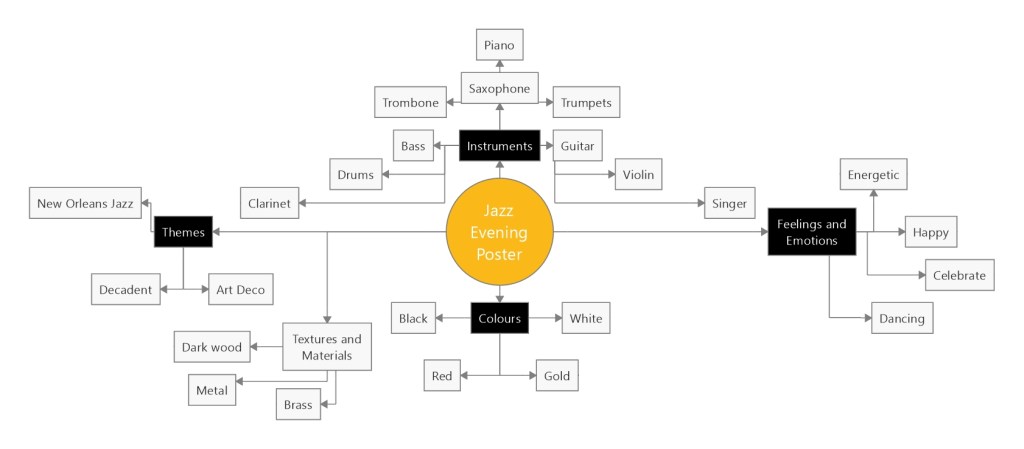
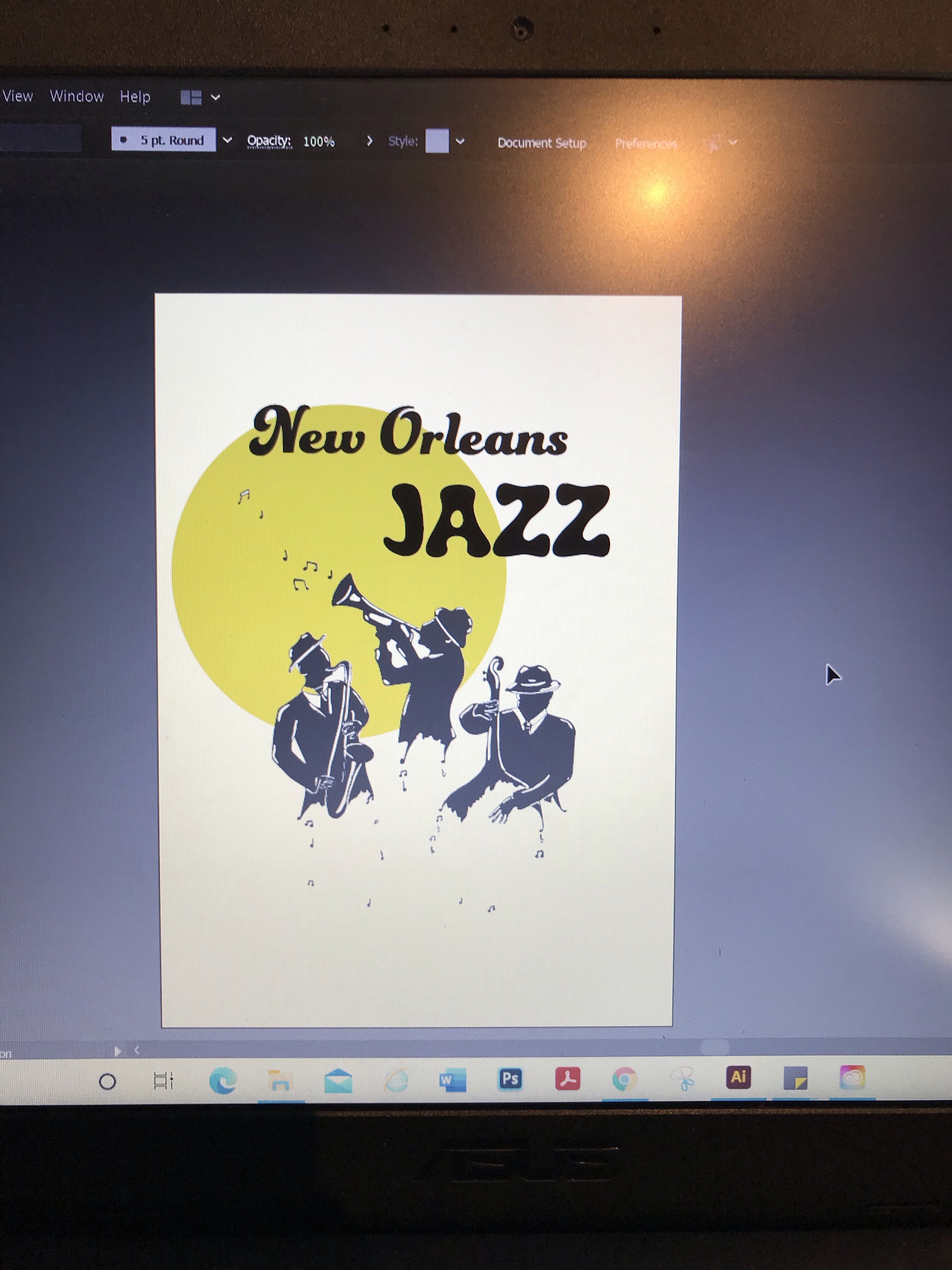
For my third assignment I chose the title ‘Jazz Evening’ for my poster. I started by doing a mind map of the things that I associate with jazz, which helped to give me a basis to start to trigger ideas. I really love the idea of going to new New Orleans and experiencing the culture there; of which music is a big part of. I decided to use New Orleans jazz as my concept and started to collect reference images. One of the first images I came across was a black-and-white image (as below), which had ink drip marks coming from the characters. I was inspired to try my own version of this and see where I could take it.
My moodboard
I collected images for my moodboard and realised that I really liked a simple colour palette. I wanted to have my poster combine old jazz vibes, but have the poster modern and crisp looking. For this reason I decided I would use modern text to make sure that my poster did not look dated. I collected images to use to for the poses of my characters from Adobe stock images. Quite a few of the ones I had found on my Google search were also on there.
Thumbnails
I started working on some thumbnails to develop my ideas. I was drawn to the thumbnails that included a group of individuals the most and selected my two favourites to try out as visuals.
Visual 1
Visual 2
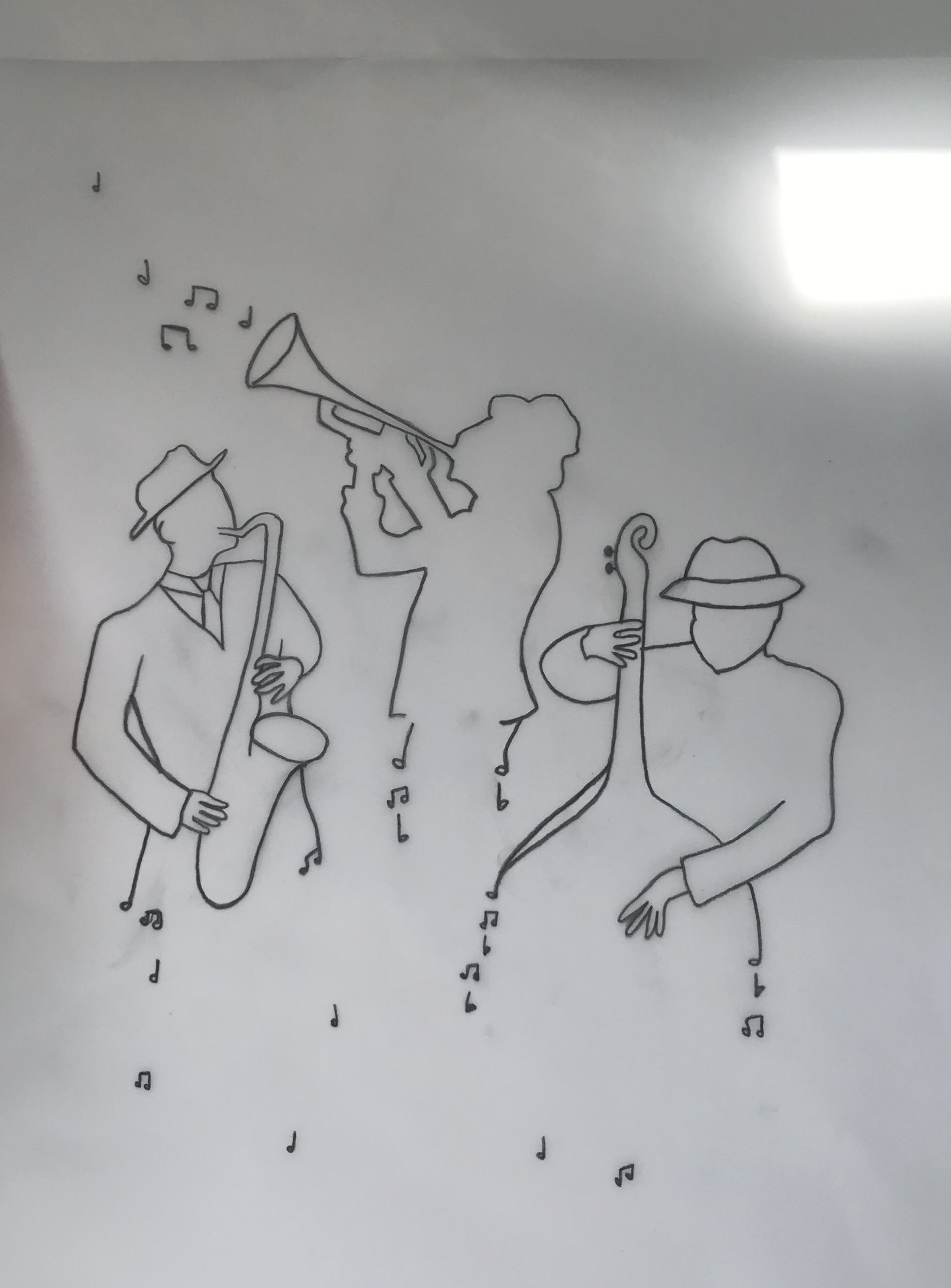
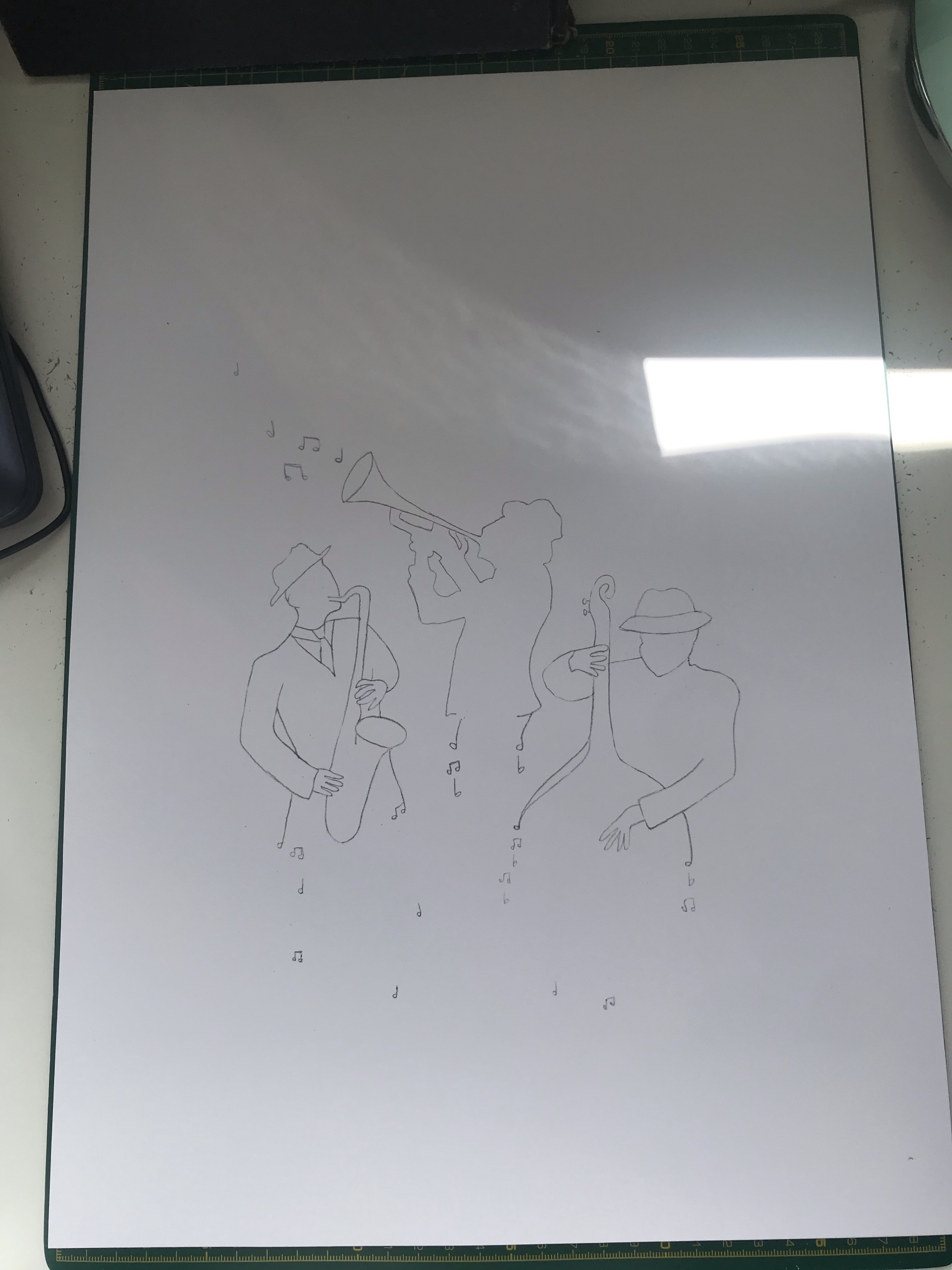
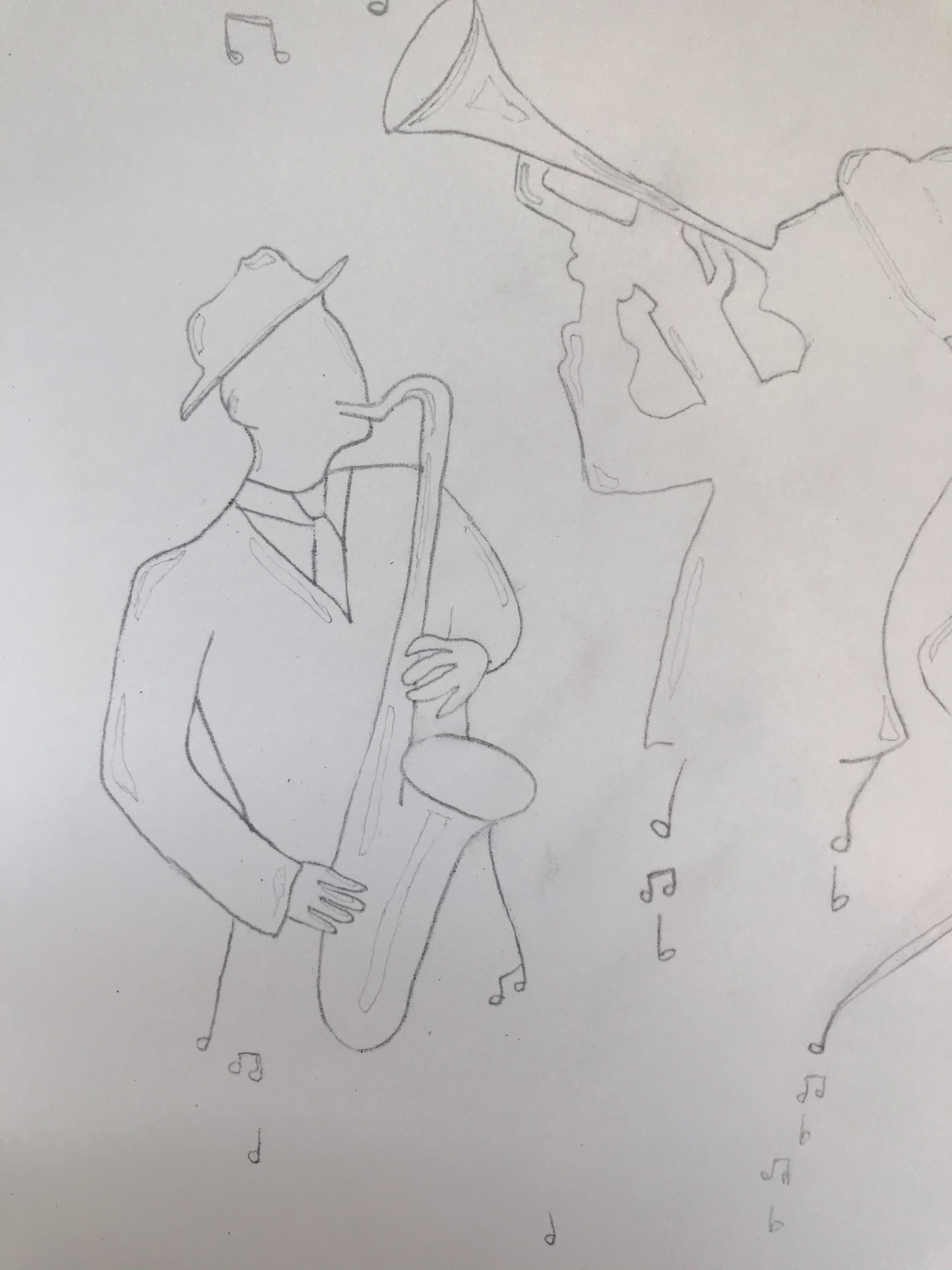
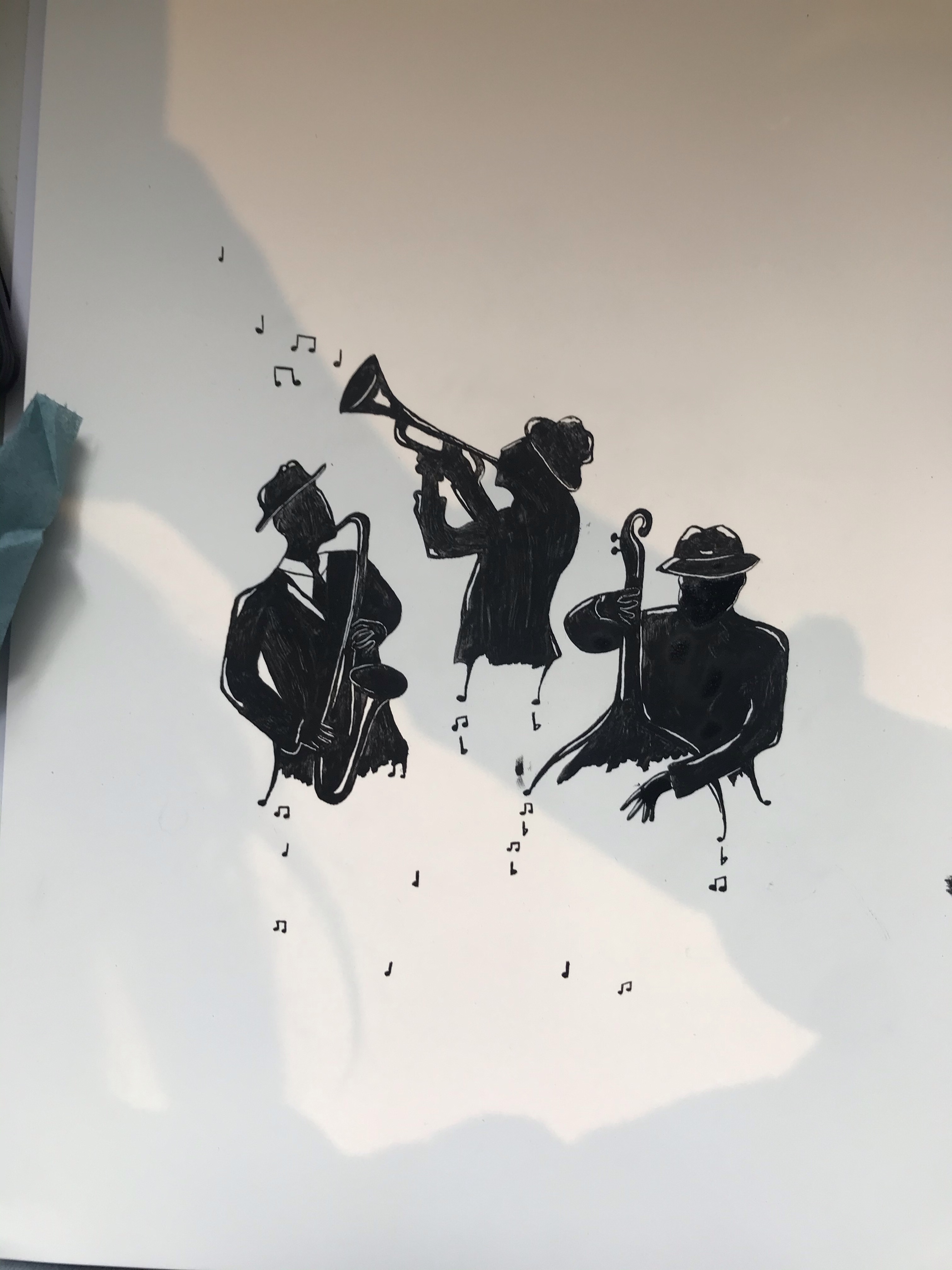
Though I liked the idea of having a pianist in my drawing for visual no.1, I did not feel that this would work for a poster and that the drawing had too much detail and too much going on. However, I really liked visual no.2. The design is more simplistic and stylised. I had done my visuals on A3 paper so was able to do a tracing of my chosen visual and used this to place my image onto fresh paper. I ended up doing three attempts of my final artwork. Originally I was trying to do this in India ink with dip pens on Bristol board, but the paper surface was disturbed when inking. Therefore, it was not working and I did not like the texture. On my second I switched to cotton watercolour paper to see if that worked any better. However, I was still not happy with the results. I ended up using acrylic ink on watercolour paper, using dip pens for smaller details and a paintbrush for the rest. I did ink the outline first in a technical ink pen. Before I got to my third attempt I kept making mistakes and this led me to think about my technique and process and rethink how I was working. I ended up going back and sketching in all of the areas that I needed to leave white so that I was not making decisions as I went and I had a clear guide of where to colour, and when not to. This lead me to think about the black and white exercise I had done previously and how much that also needed planning. I also worked from the left side of the page down and then across to the right so that I did not smudge my work. These were such simple things that I could have done from the beginning, but I guess not having done any illustrations like this before. I was not aware of these rookie mistakes. I have definitely learnt some good lessons from this assignment that have led to a more structured approach and forward planning.
Work in progress
My Final Illustration
I am really happy with my final illustration. Although there are a few things that I would possibly tweak now looking back and did try to tweak once I had put them in photoshop. However, I did not want to spend any more time on the ink drawing as it was a very tricky process and I was going to be putting it into Adobe Illustrator anyway where I could edit it further if need be.
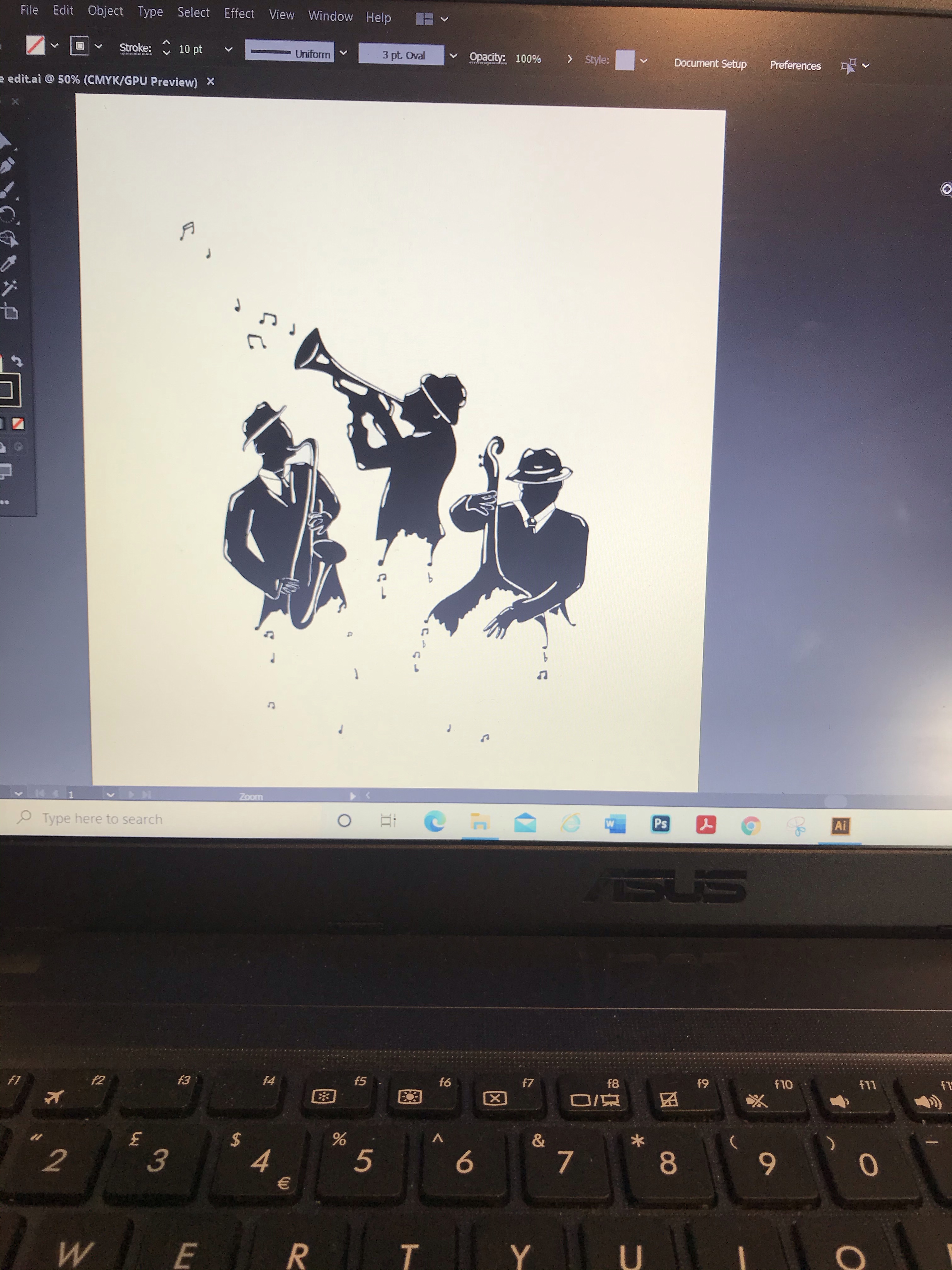
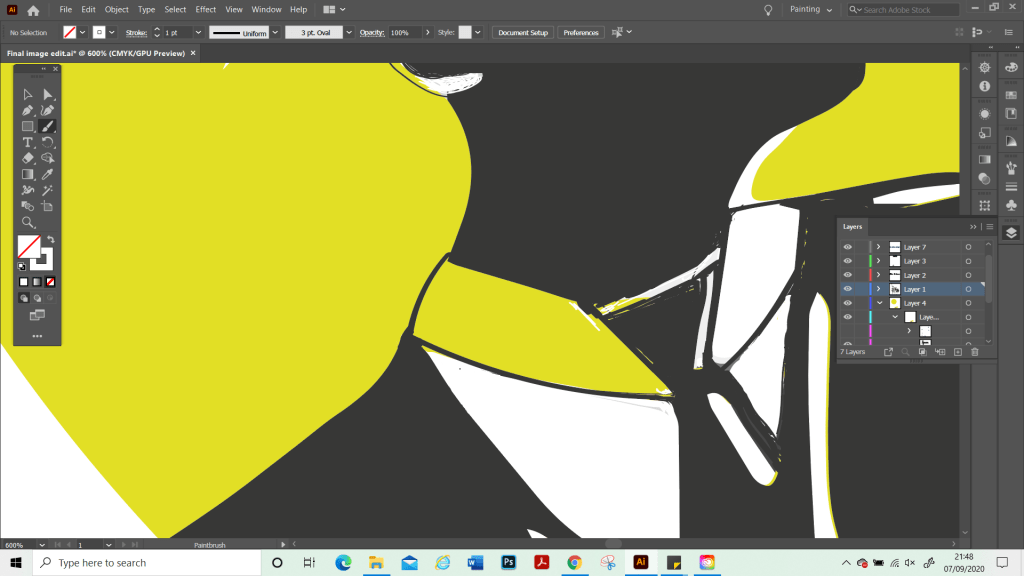
Screenshot from working in Illustrator.
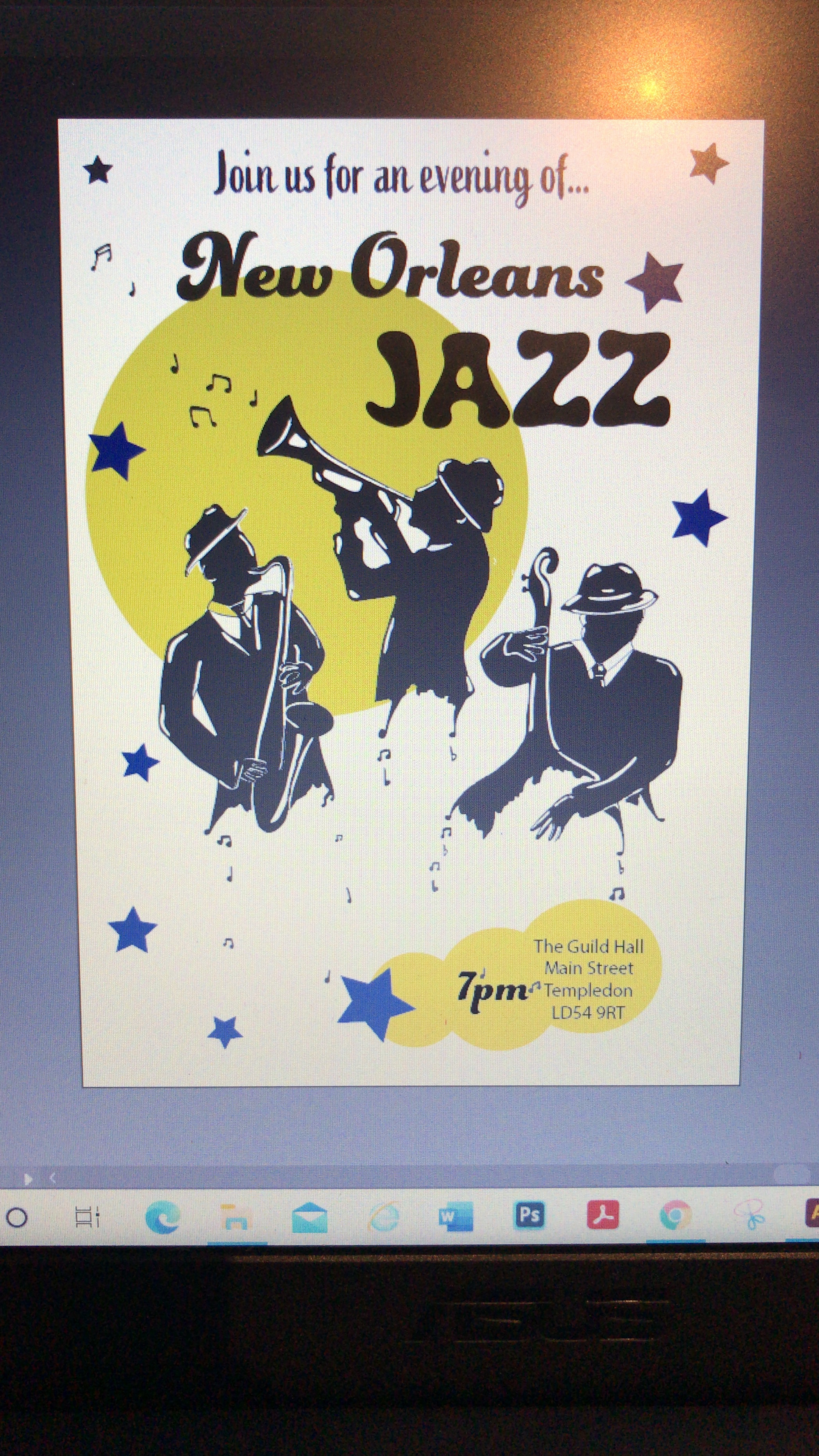
Once on Illustrator. I cleaned up the image as it did not scan very well and I pretty much had to redraw over the top of the whole thing to put some of the details and edges back in and recolour it as I went. At this point, I realise that although I had a strong plan and idea for my main illustration I did not actually have a plan as to how the poster would look as a final piece nor had I included these in my thumbnails. Partly this was due to my limited software knowledge and I wanted to just have a play with Illustrator to see what the possibilities were for me and to go from there. However, as I become more skilled with software programs, I know that this is something I will be able to plan more thoroughly at the beginning. I played around with different shapes such as stars. However, I felt that this made the image too busy and detracted from my illustration which I wanted to be the focus, and to make sure that the notes that are part of the image were clear and visible. Therefore, I decided to keep the poster more simple. Once I had found my final composition, I zoomed in again and did my final edit. Such as cleaning up the black-and-white sections and correcting where the background had come through on my illustration.
My Final Poster
In Summary
I am really proud of what I achieved with this assignment. A poster is not something I have done before. I also managed to master the basics of Adobe Illustrator, which I’ve been trying to learn. I did this by using short tutorials to learn different techniques and just played around with the different elements and fonts from the online library. I was unsure at first if my poster was too plain, or if a white background was the right way to go, but I had tried using different colour backgrounds also, and it did not look good.
Through doing this assignment, I feel it has given me more confidence. Although illustration part three has given me very valuable skills to carry on with, it did not lead me to produce any work that I was particularly proud of. It was also quite challenging for me as a lot of the exercises were more commercial types of artwork which I did not quite have all the skills to pull off successful illustrations in the style needed. I’m still working on developing a style and recognise that this is still early days. Sometimes this makes me feel a bit lost when it comes to some exercises as I have not developed my ways of ‘working’ yet. I am looking forward to moving on now to part four and continuing to develop my skills. Part three has made me feel more prepared for what is to come and that I am starting to develop processes and a way of working. Therefore, I am excited to see what is next.
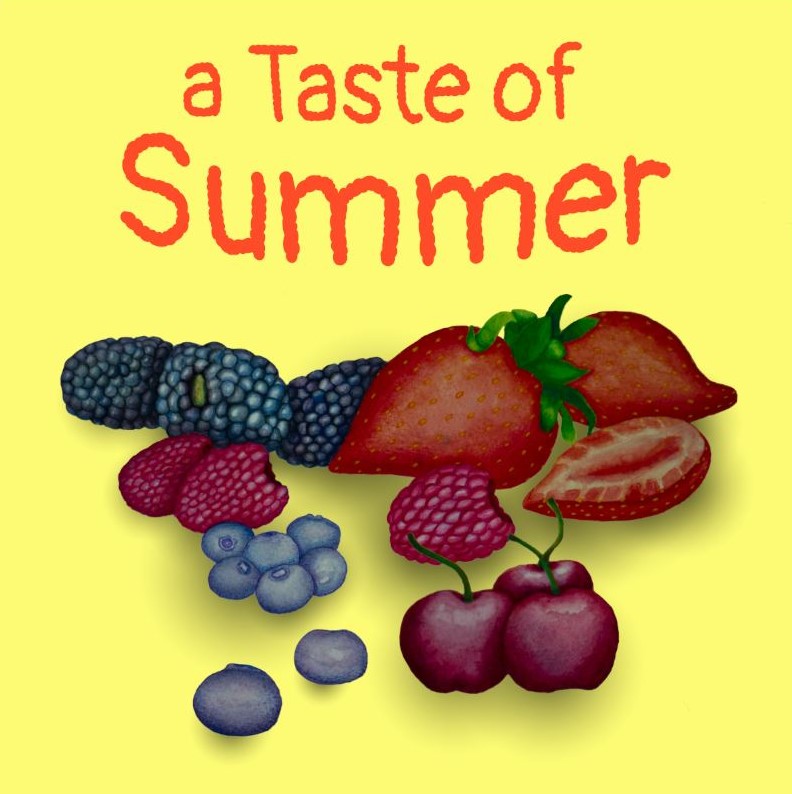
The brief for this assignment was to create images which will be used within a campaign for a supermarket to package and promote a range of seasonal foods.
We had to create an illustration of fruit or vegetables. One illustration for each of the ranges; summer and autumn.
These images were to be objective and based upon direct observation. The brief asked us to consider putting ourselves in the place of the customer and asking, ‘does this look edible?’, ‘Would I like to eat it?’ They asked us to be especially conscious of the way we use colour to describe tone, shadow and surface marks as poor colour choices can result in good-looking, mouldy, battered or ultimately unappetising.
I considered these questions and remember reading or hearing about this topic before with making sure that colour and texture are considered in food illustration to make sure look appetising.
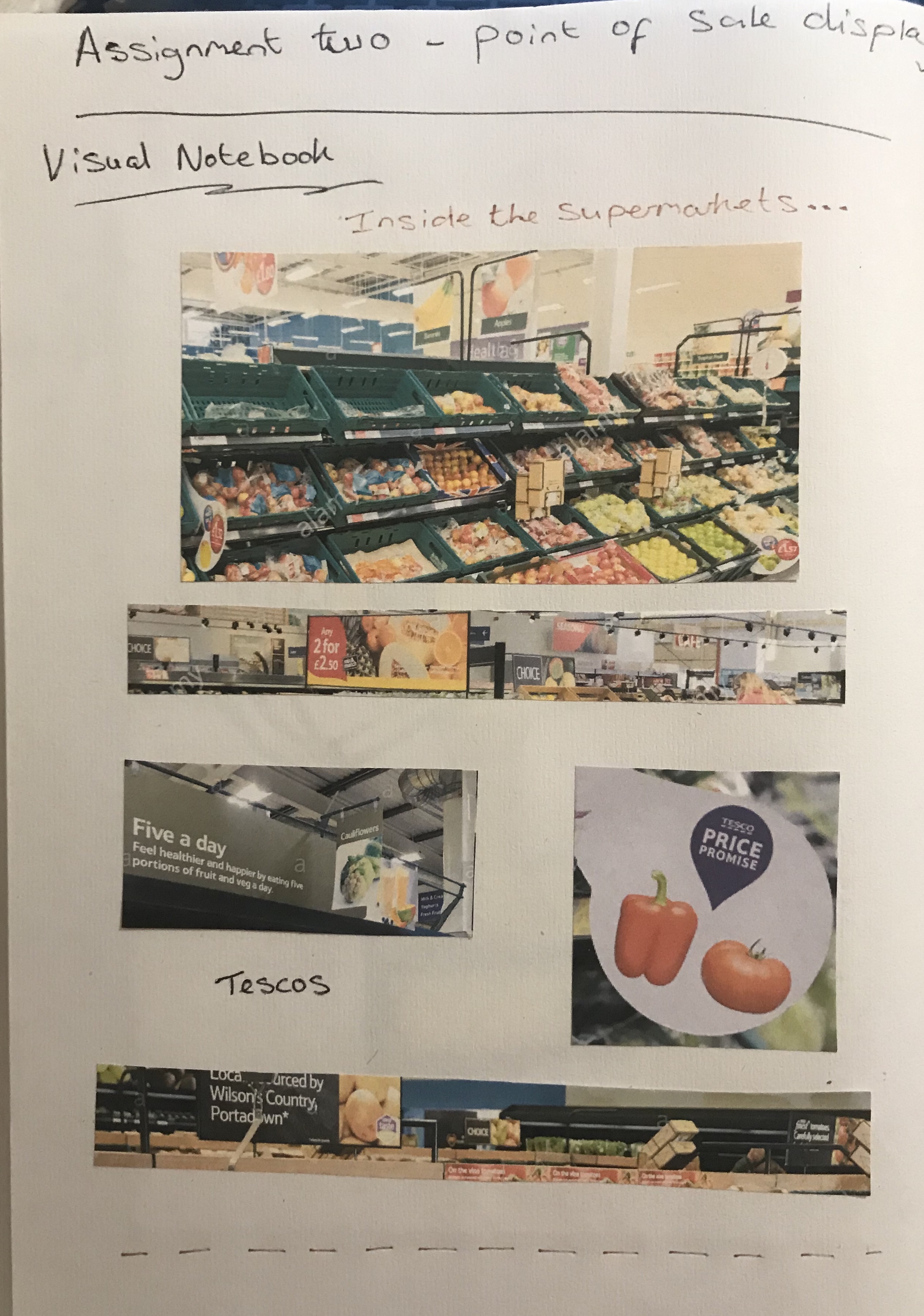
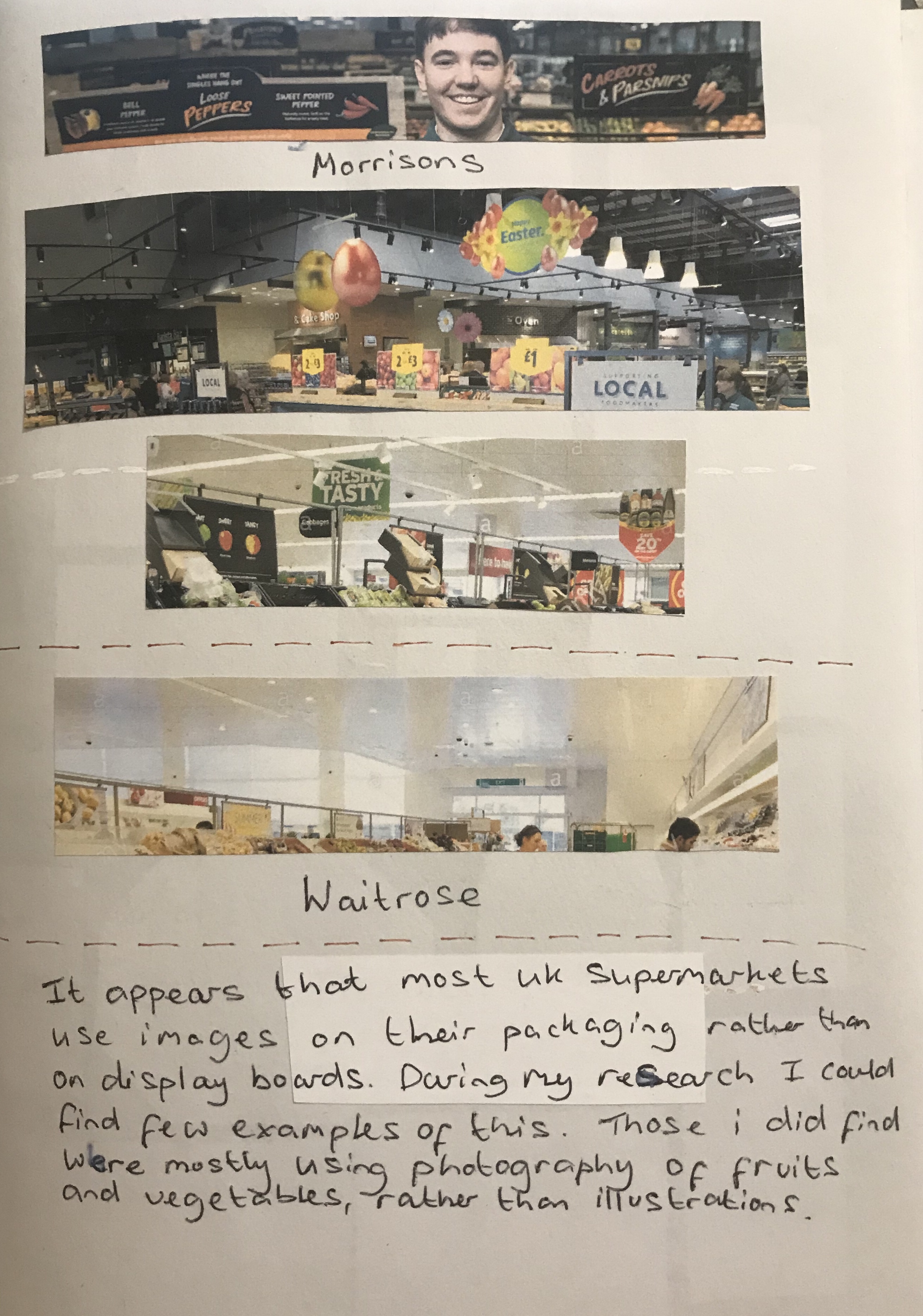
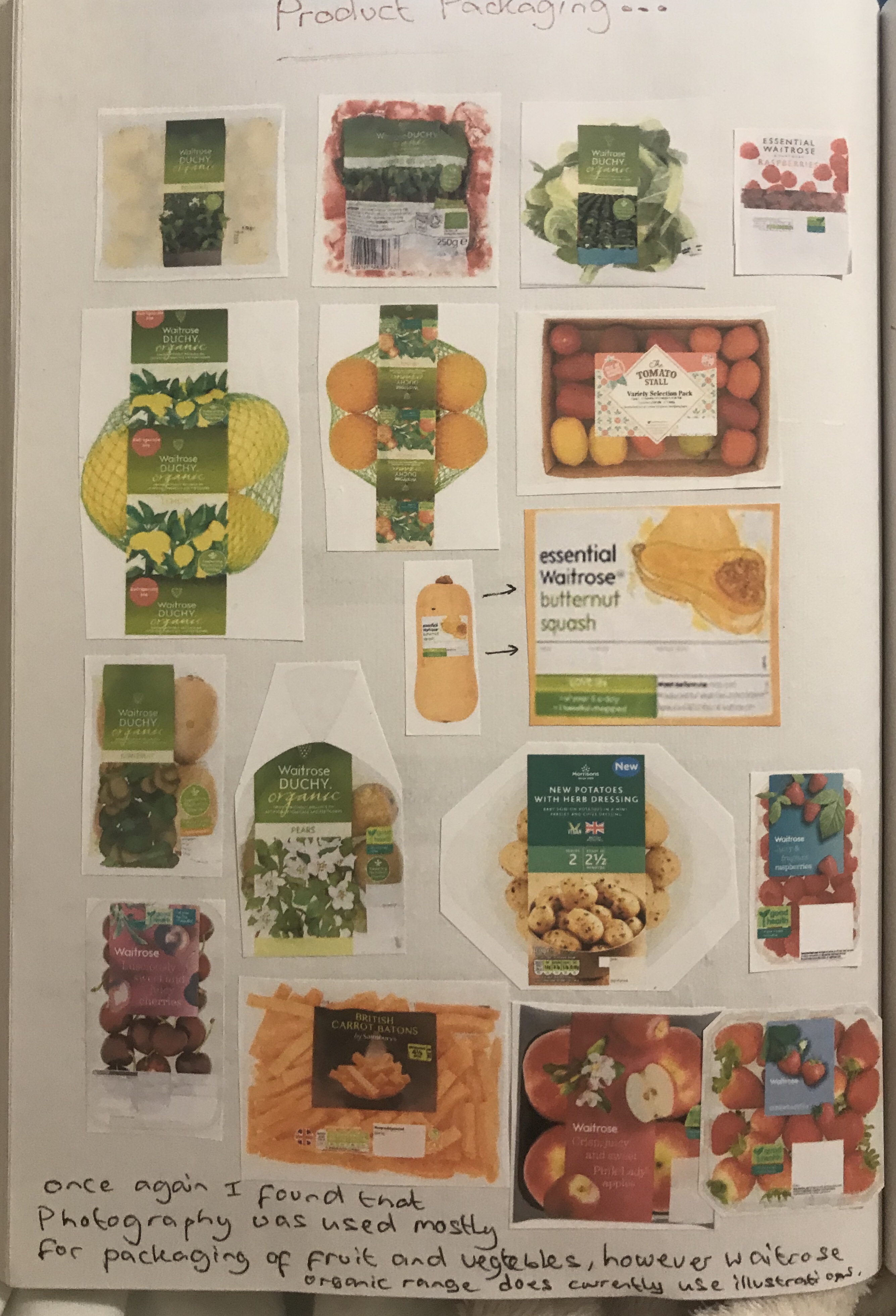
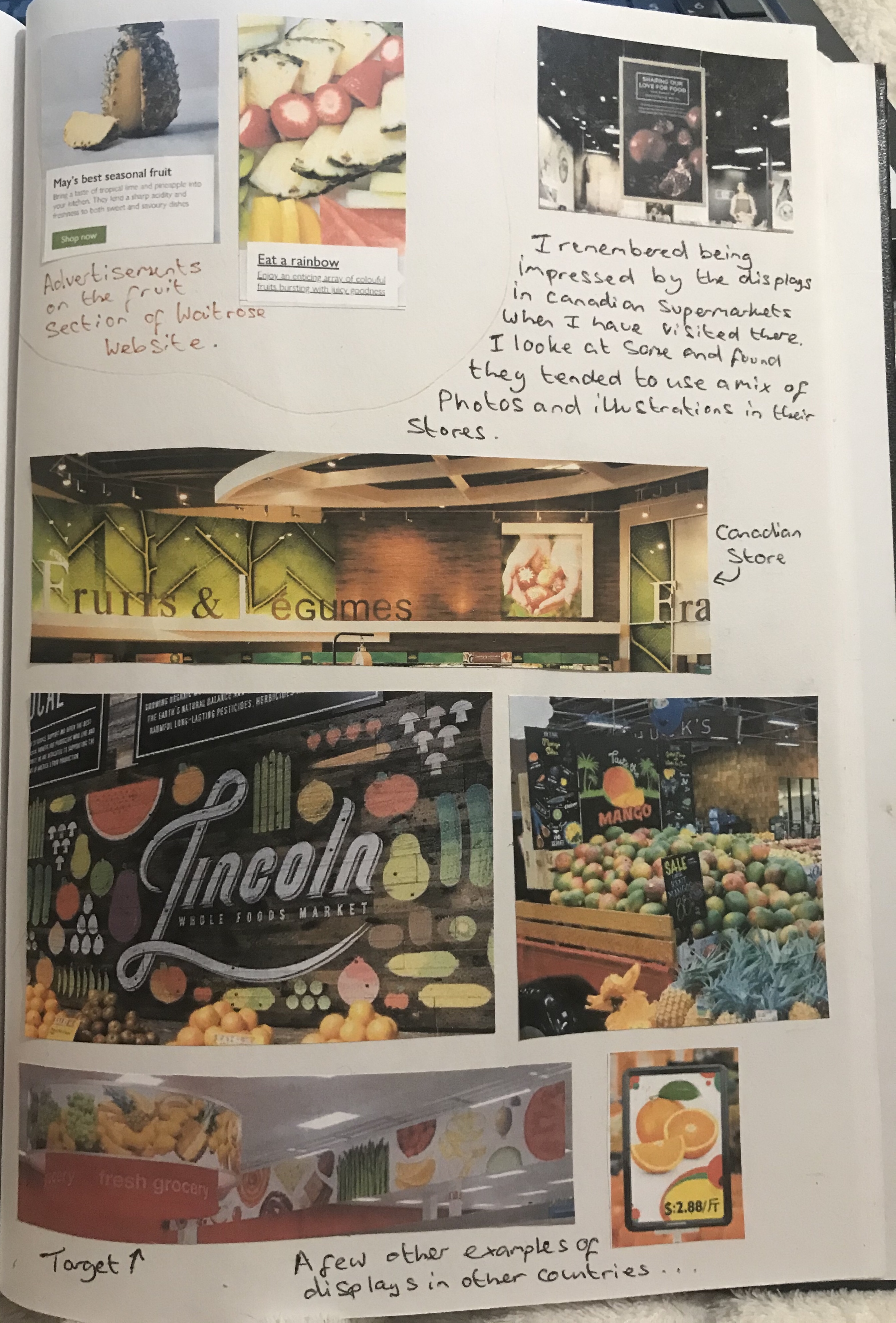
With a visual notebook and used the Internet to find photographs from inside supermarkets. I would have gone to visit some stores, but due to Covid this was not going to be practical and I was definitely not able to take photographs in store. I did struggle to find examples of display boards and illustrations on fruit and veg packaging in the supermarkets. Partly this was due to the fact that most of the supermarkets actually use photographs rather than illustrations for their display boards and illustrations in hand display boards are generally used for other items in store and other sections more than the fruit and veg aisles.
I did however find a few examples and found that Waitrose in particular does use illustrations on the packaging and I looked at the artist’s work on her agents website which showed these illustrations. The majority of examples of more elaborate display boards using illustration, I actually found in other countries such as Canada and America.
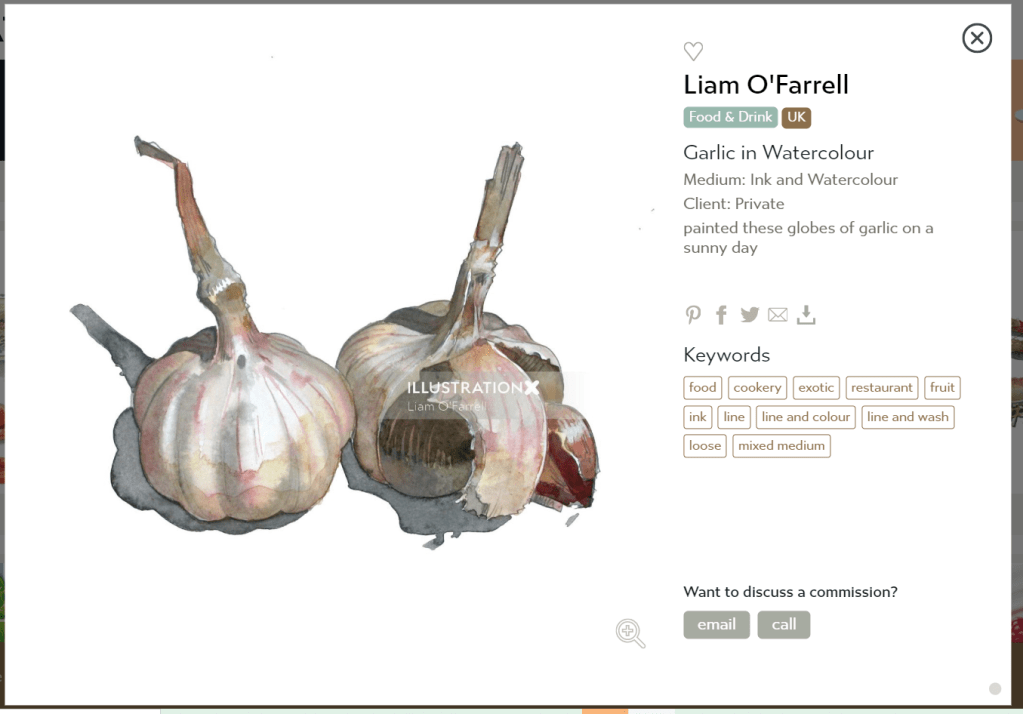
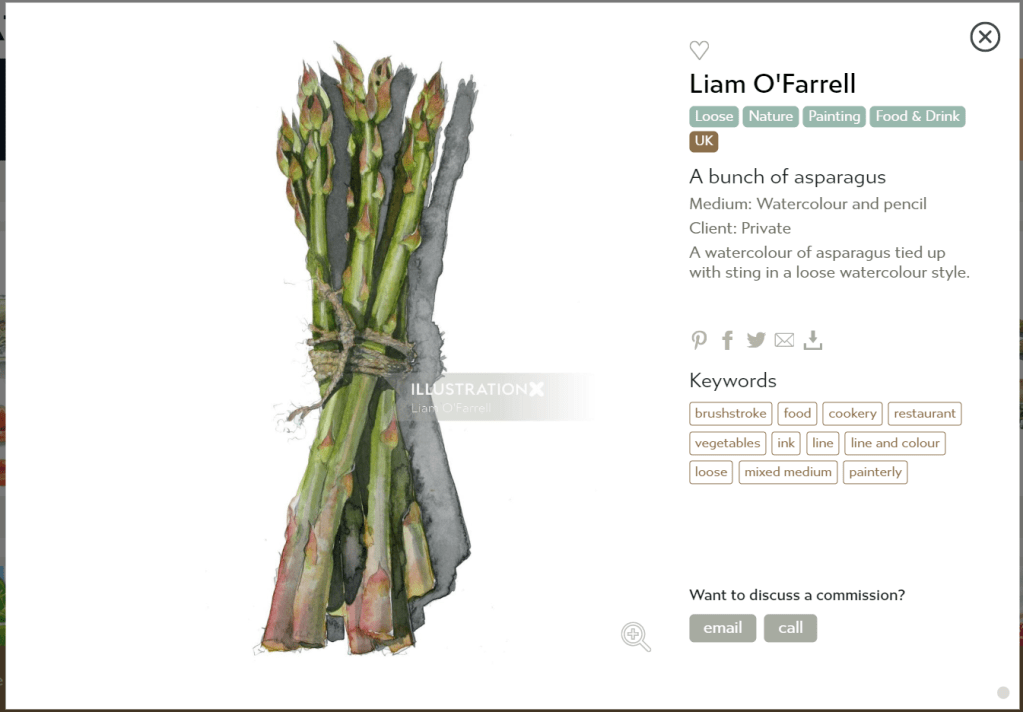
I looked at food illustrators work and found varying styles, some of which I did not like so much and some of which I really loved such as Liz Pepperell. Her colour palette is really rich and I love the way she makes food look tasty, particularly the one she did with the orange pieces that look really juicy. Another artist’s work that I loved is Liam O’Farrell. I really love the colour palette uses and the style of his illustrations. They remind me of another artist named Holly Exley that I have seen do food illustration, amongst other types of illustration. She tends to use lots of blues and purples in her shading, so her images are not realistic, but the colour palette is very beautiful and interesting.
I had a go at copying a couple of the artists illustrations or illustration style. However, this did not go well. I found it extremely difficult to decipher what it was they were doing with their paint and realised it was better that I did not try this and just tried my own being inspired by their colour pallets rather than trying to use too much of their styles.
My failed attempt at studies of the artists work.
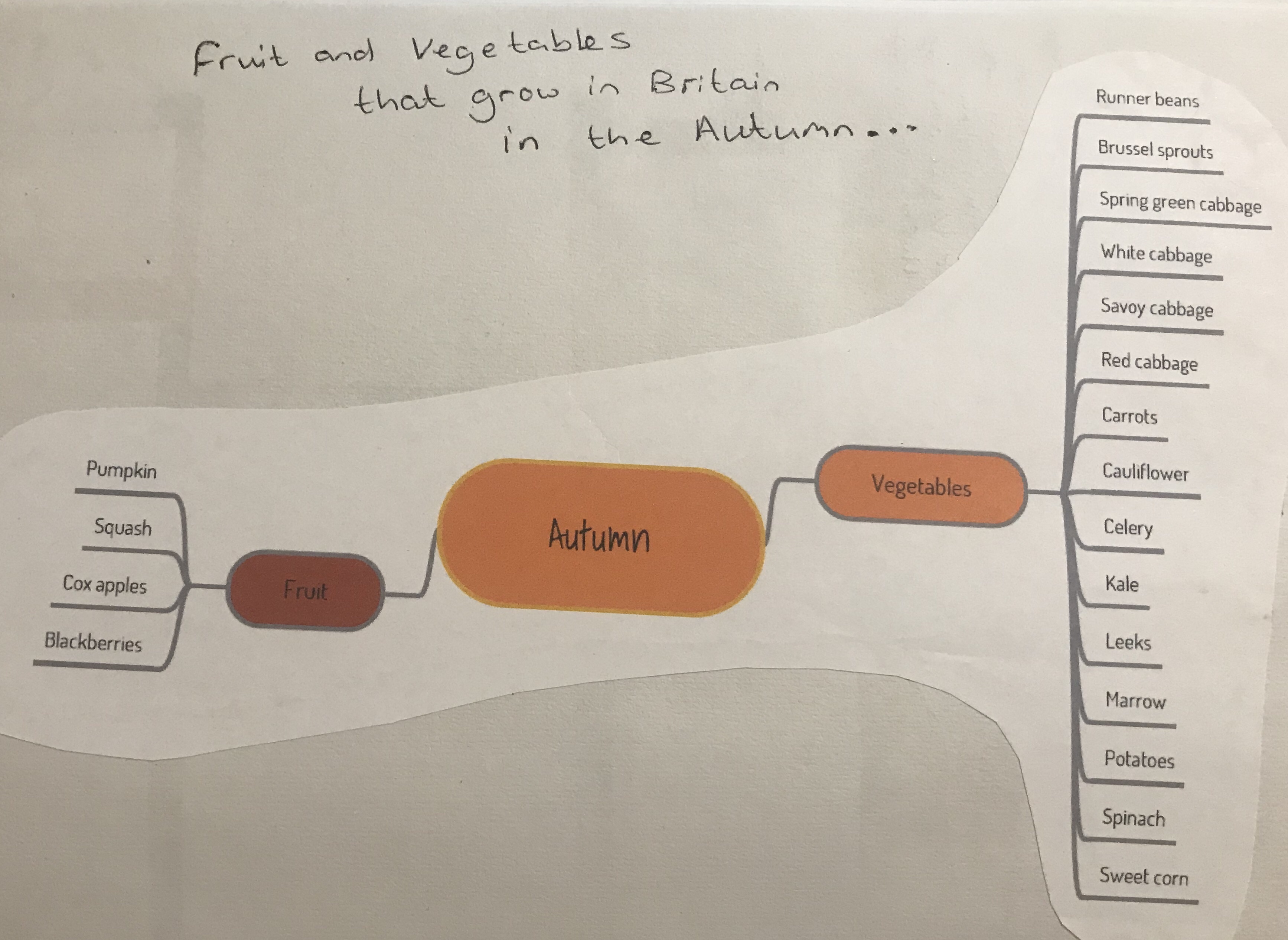
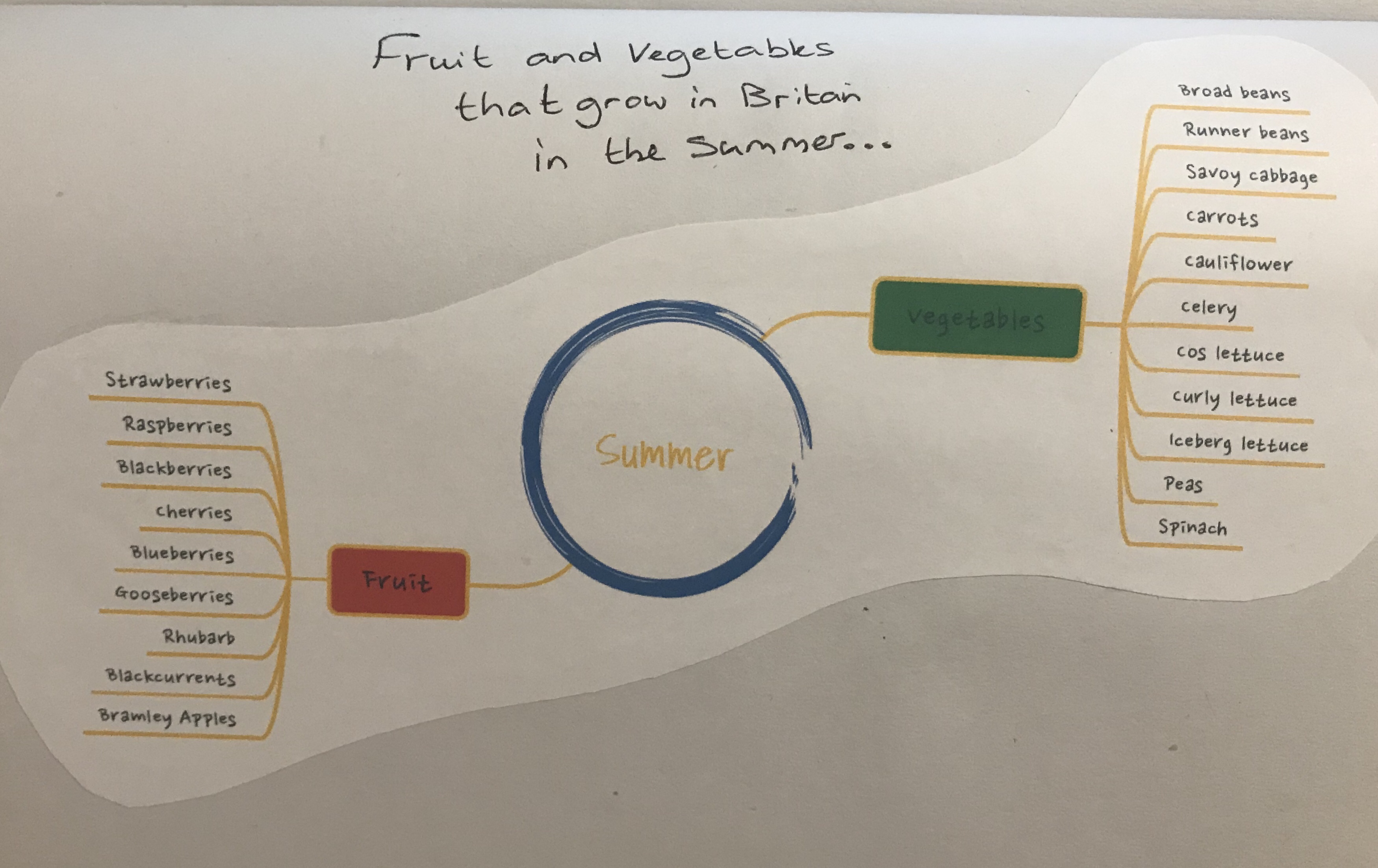
I did some mind maps of both autumn and summer fruits and vegetables to find out what grows in Britain during each season. From this I selected the fruits and vegetables to include in my mood board. I decided to go with summer fruits and autumn vegetables. This is because the autumn fruits list is a little sparse, whereas the autumn vegetable list is very long and therefore it made more sense to do it that way round. I was also quite keen to do fruit for my summer illustration.
Moodboard for Summer Fruit
Moodboard for Autumn Vegetables
My tests of painting autumn vegetables – Watercolour and Gouache.
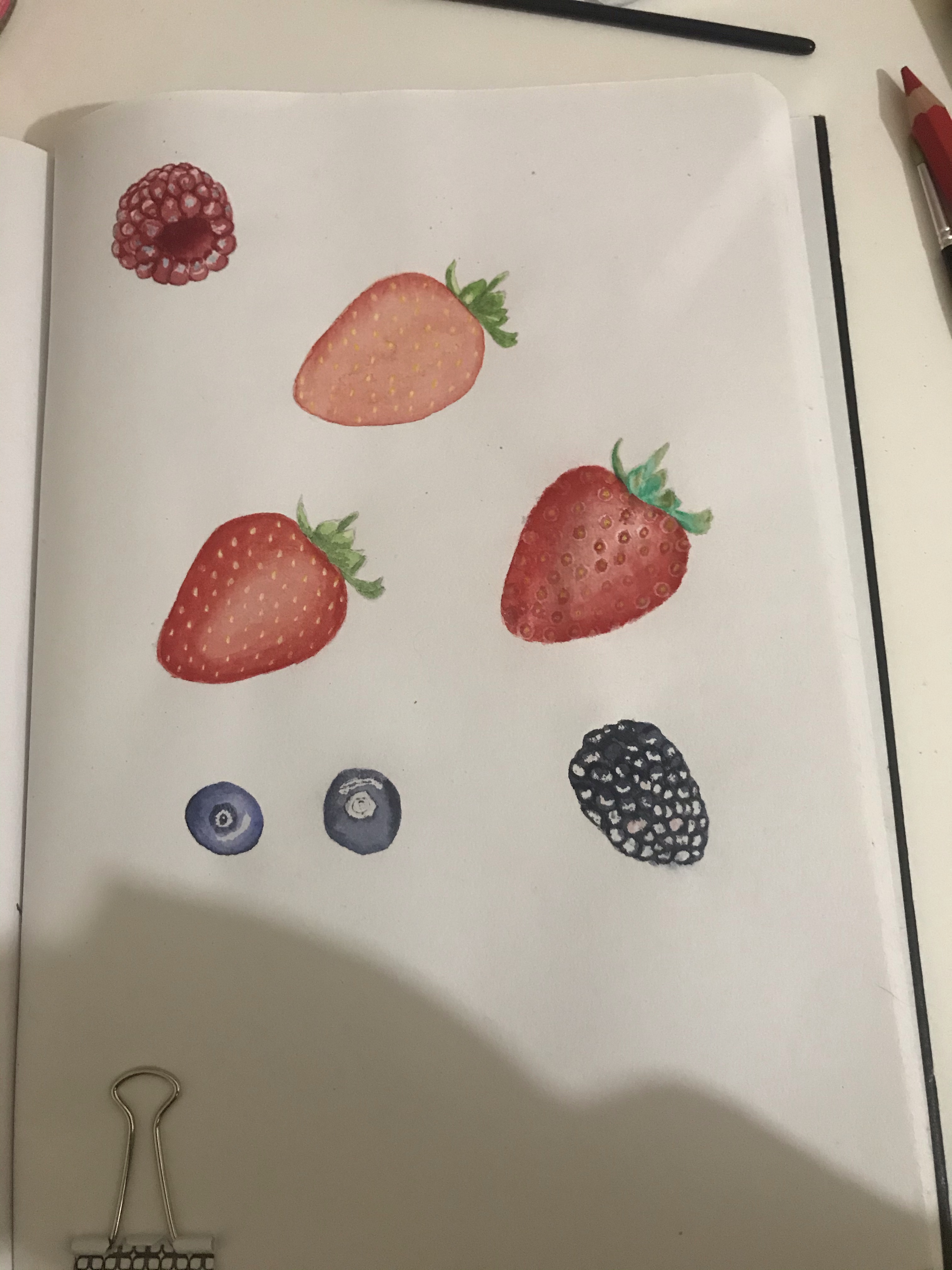
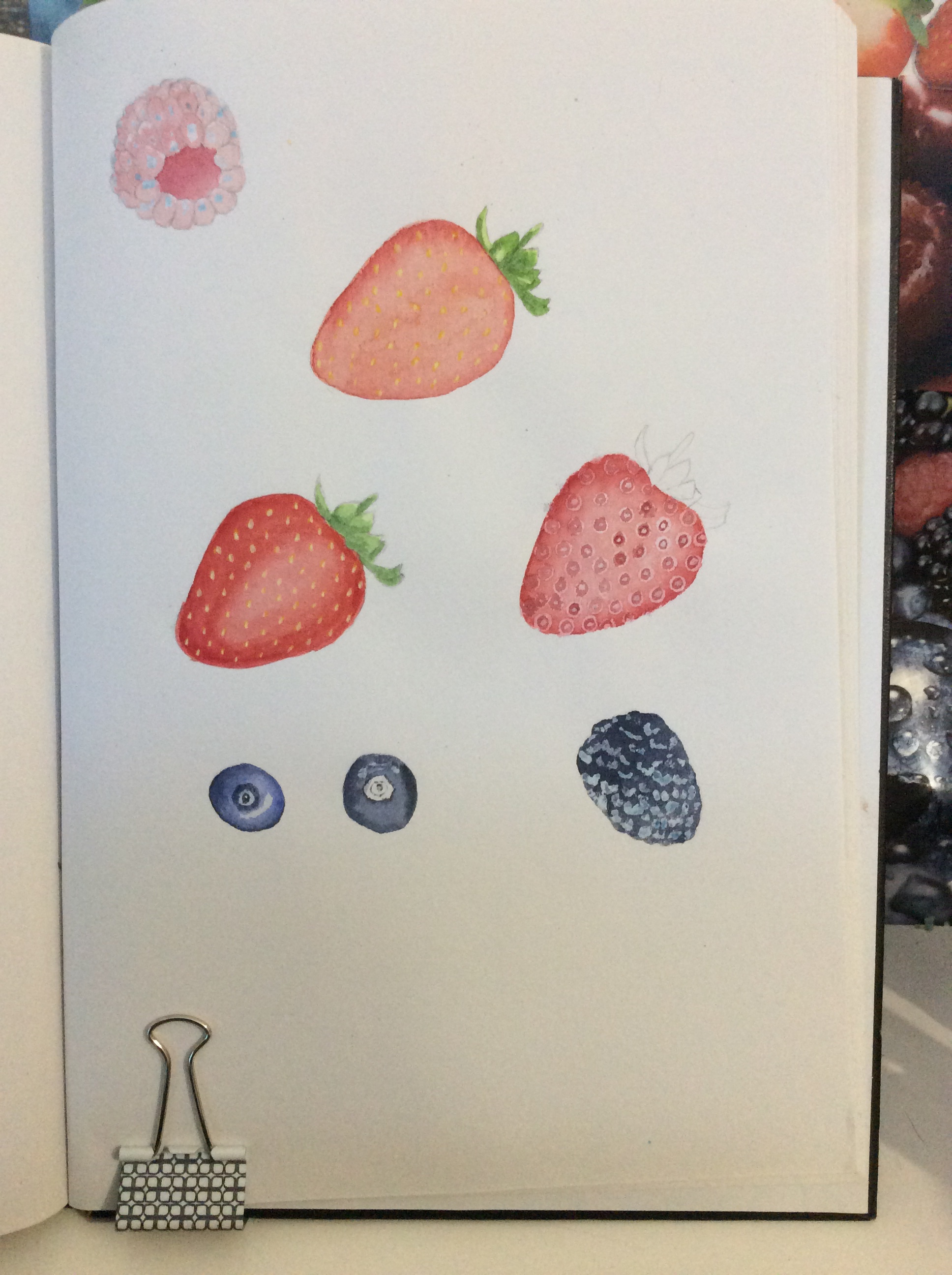
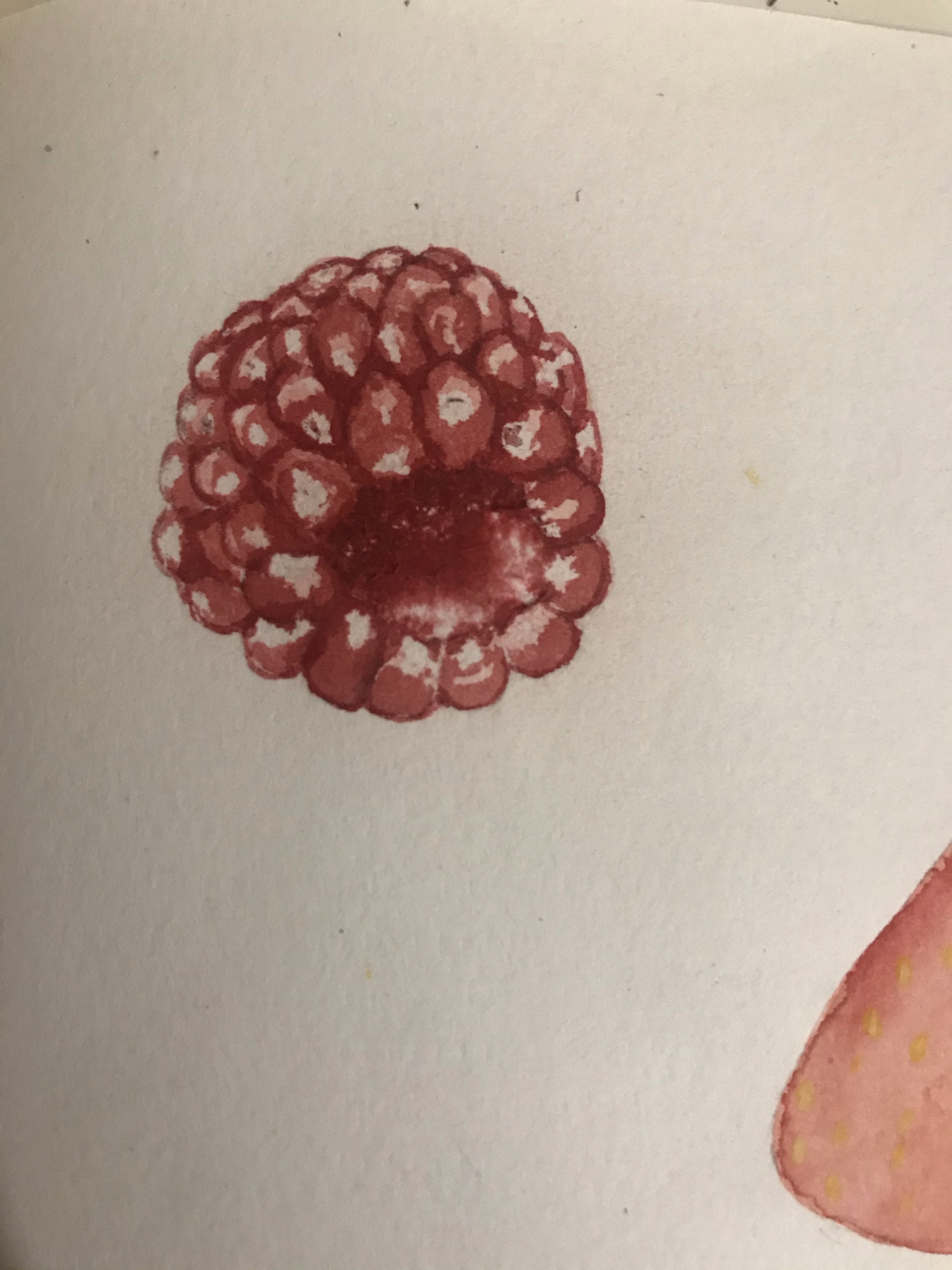
My test paintings of the autumn vegetables went quite well. I was happy with how they came out. I participated in a group session with OCA tutor Bee Willey and after showing her these images and discussing with her. She suggested that I work a lot larger so that I am able to create fine details easier and also to try acrylic inks to paint as I mentioned that I was concerned with watercolour and gouache that it will sometimes struggle to get the paint colours as bright as I want them to be. I said that I do have a tendency to work very small and that this is a habit that I would like to get out of, but also that I really would like to experiment with working on a bigger scale to see how that affects my work. For my test paintings. I used masking fluid on some of them to keep the highlights and then painted over the top. I did a few different versions of the strawberries until I found one I liked the look of. However, I did quite like my Rasberry, but I wasn’t sure about how strong the highlights were. I decided that I would work on a large scale for my final piece, so I would not use masking fluid. I would just leave out the highlights.
My tests of painting summer fruits – Watercolour and Gouache.
Small test painting with FW acrylic inks.
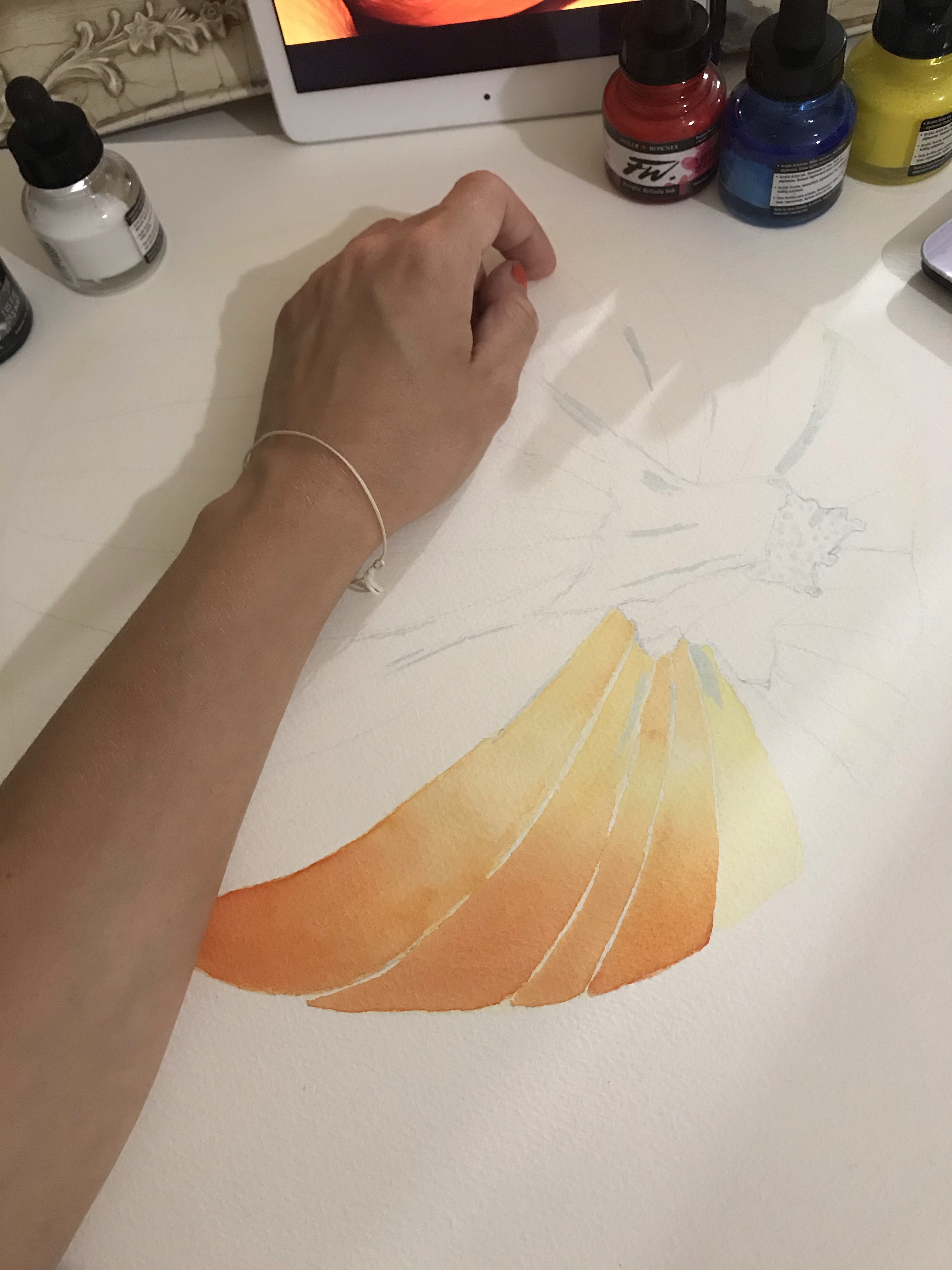
I have acrylic inks in my supplies, but I have only used them to paint on a very small scale. I hadn’t considered them as an option for this project until it was mentioned by Bee. I therefore did a small test with them before I started painting my final piece, and I found them to paint very smoothly and will easily blendable. After my test I was very happy with how it looked and was now confident that acrylic inks would work for my painting.
To show the scale
Failed attempt
2nd attempt
2nd attempt
Testing the composition
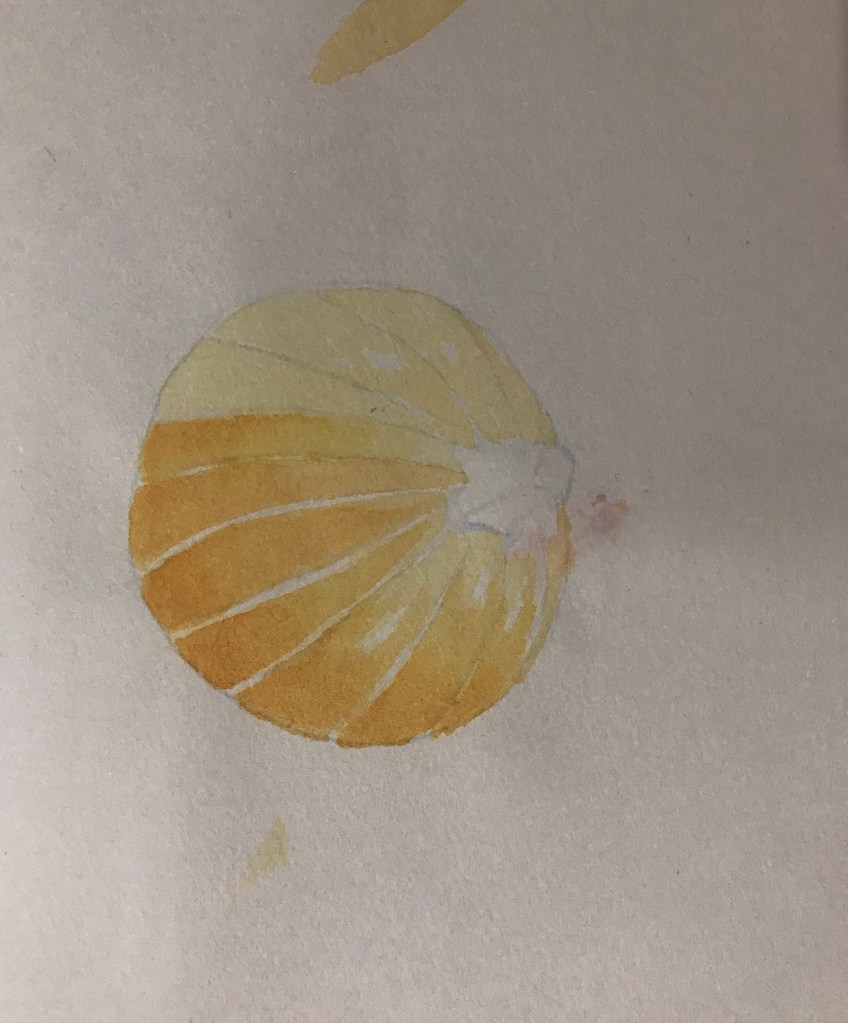
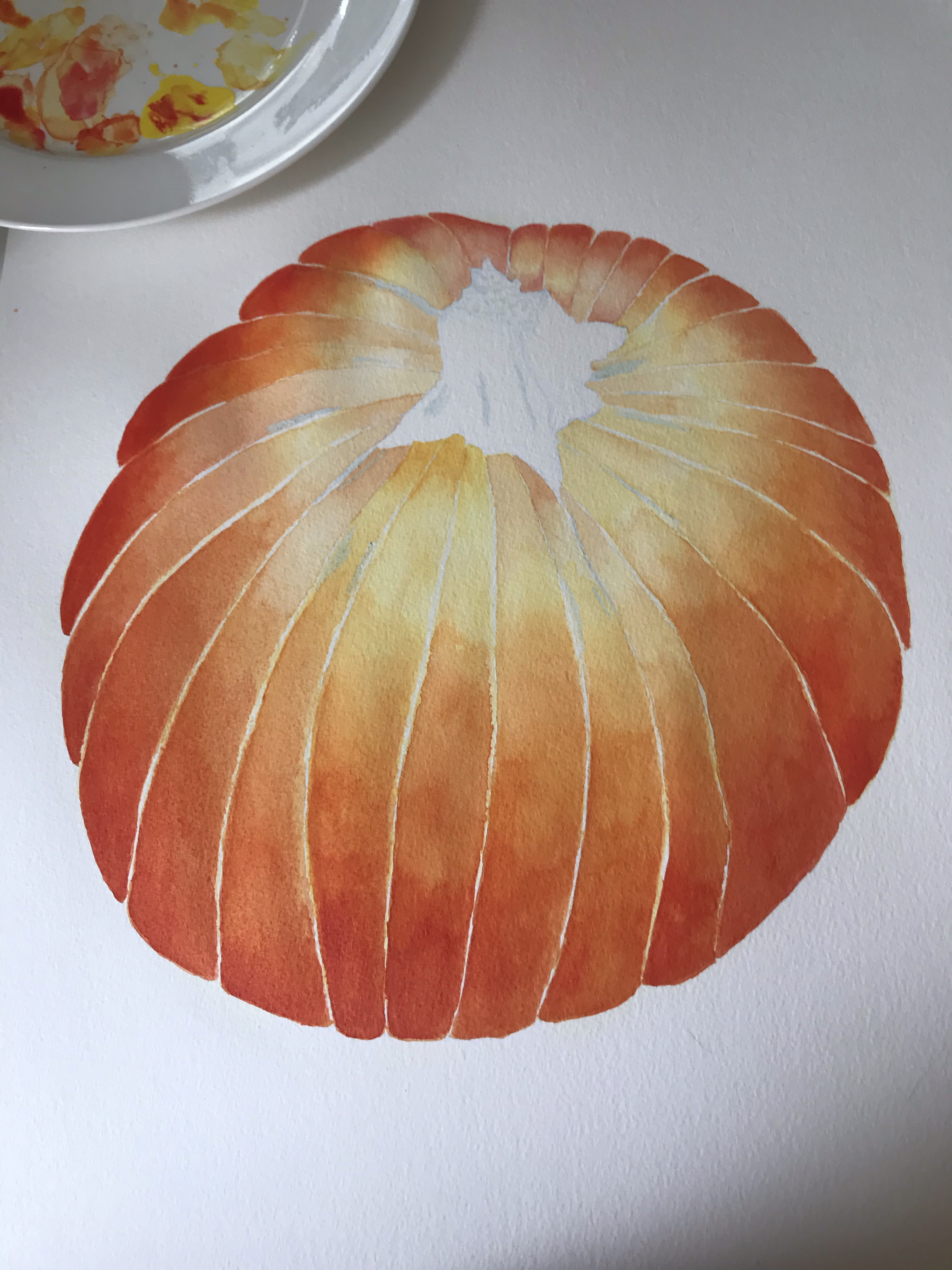
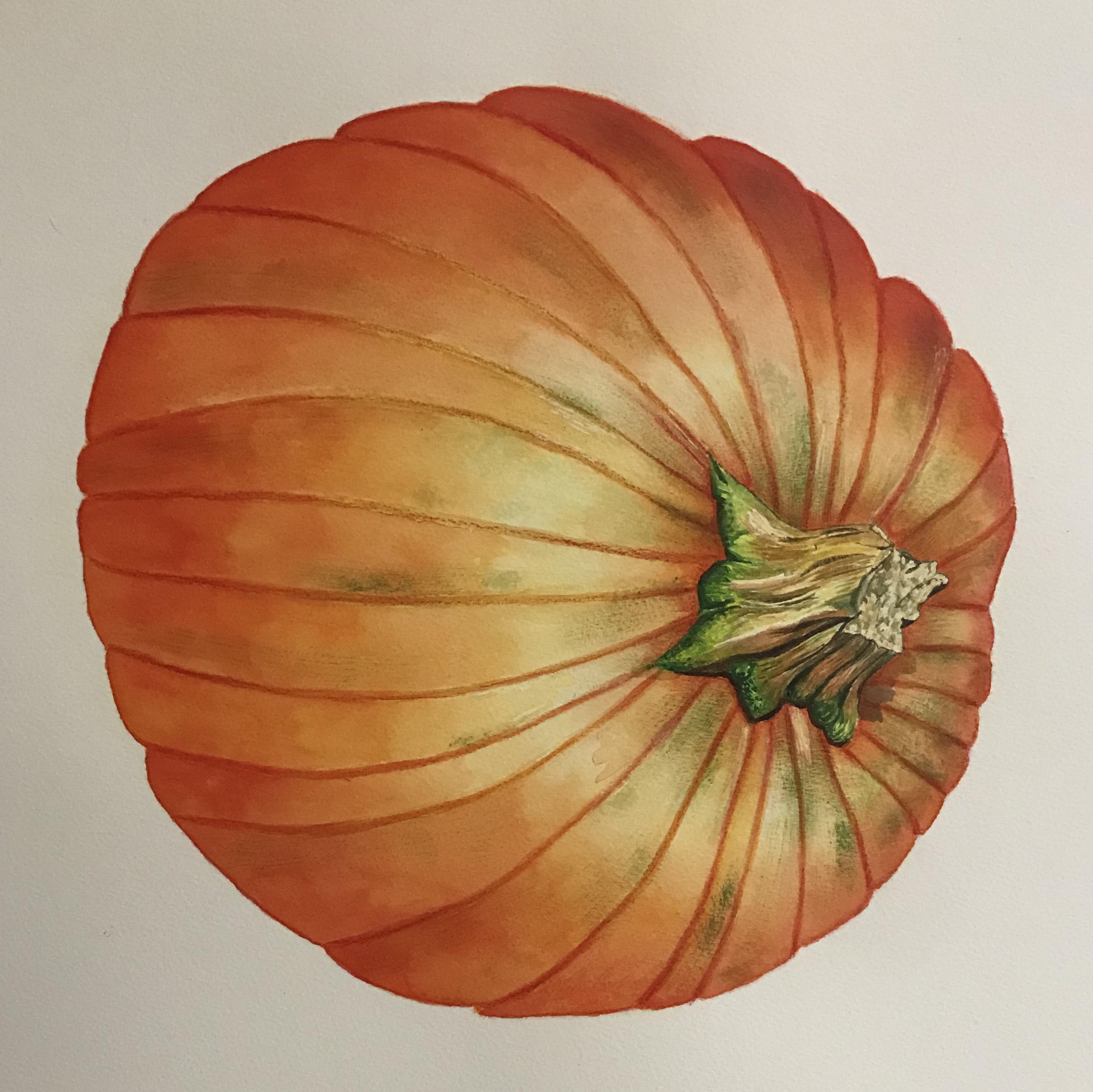
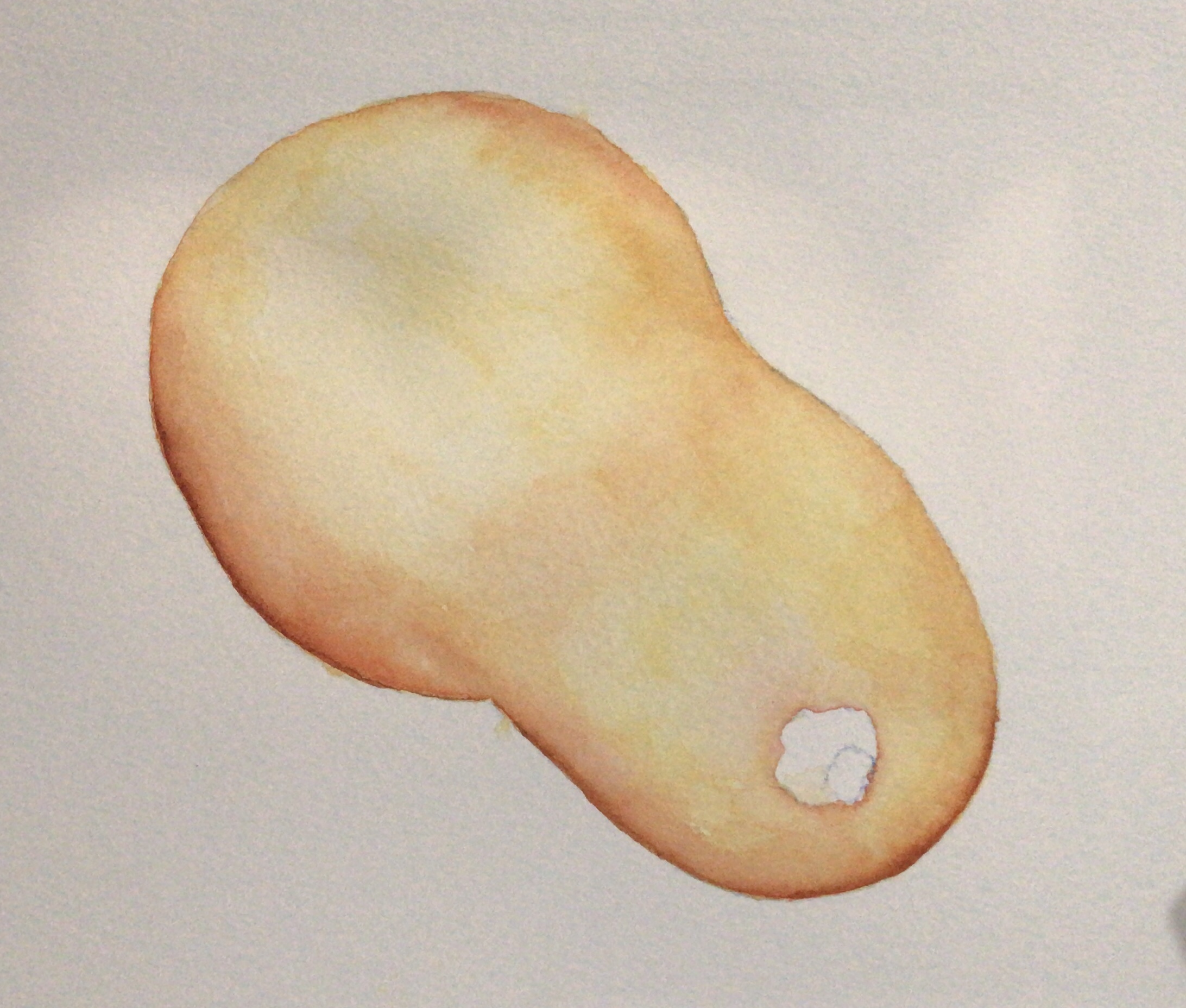
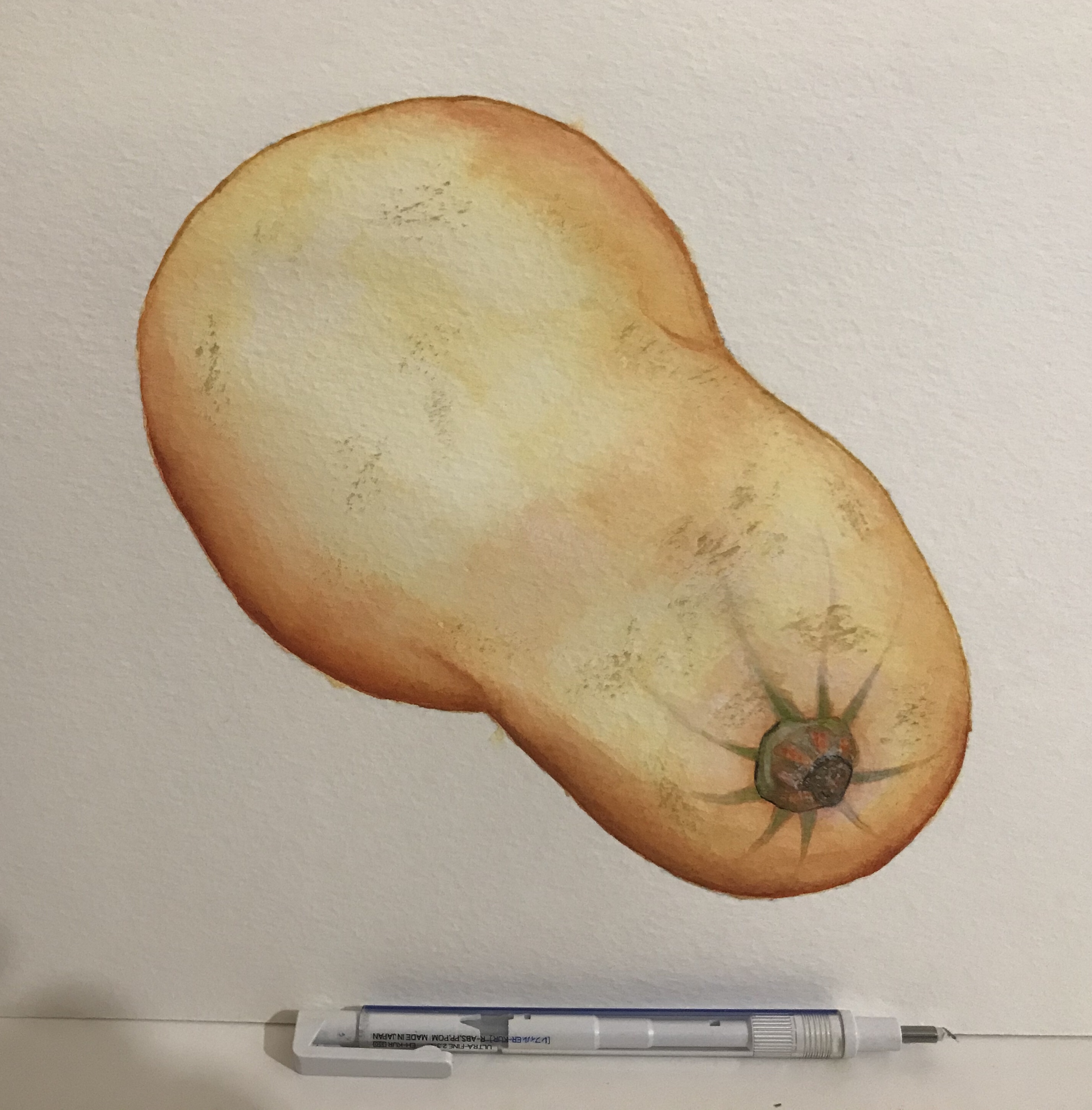
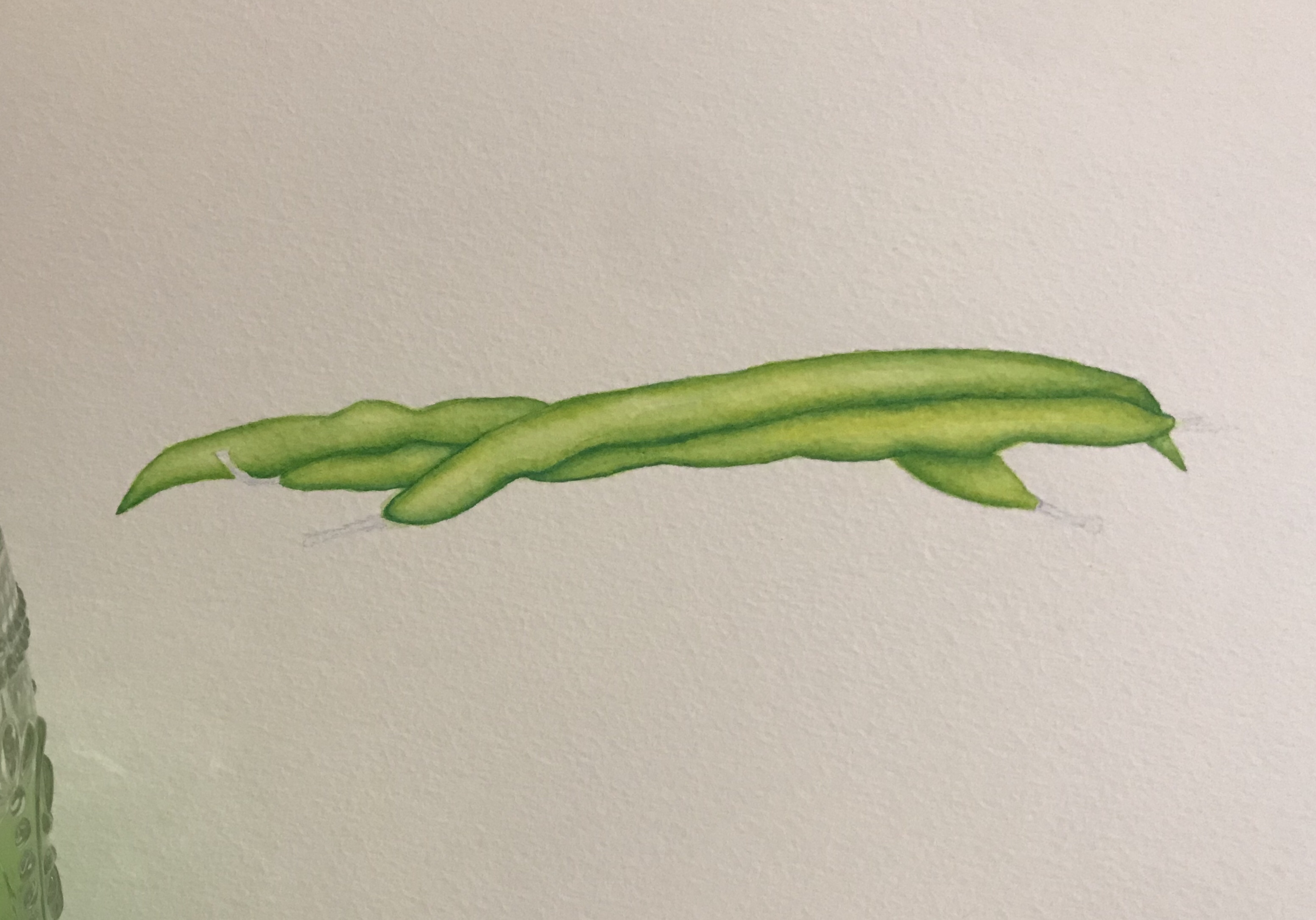
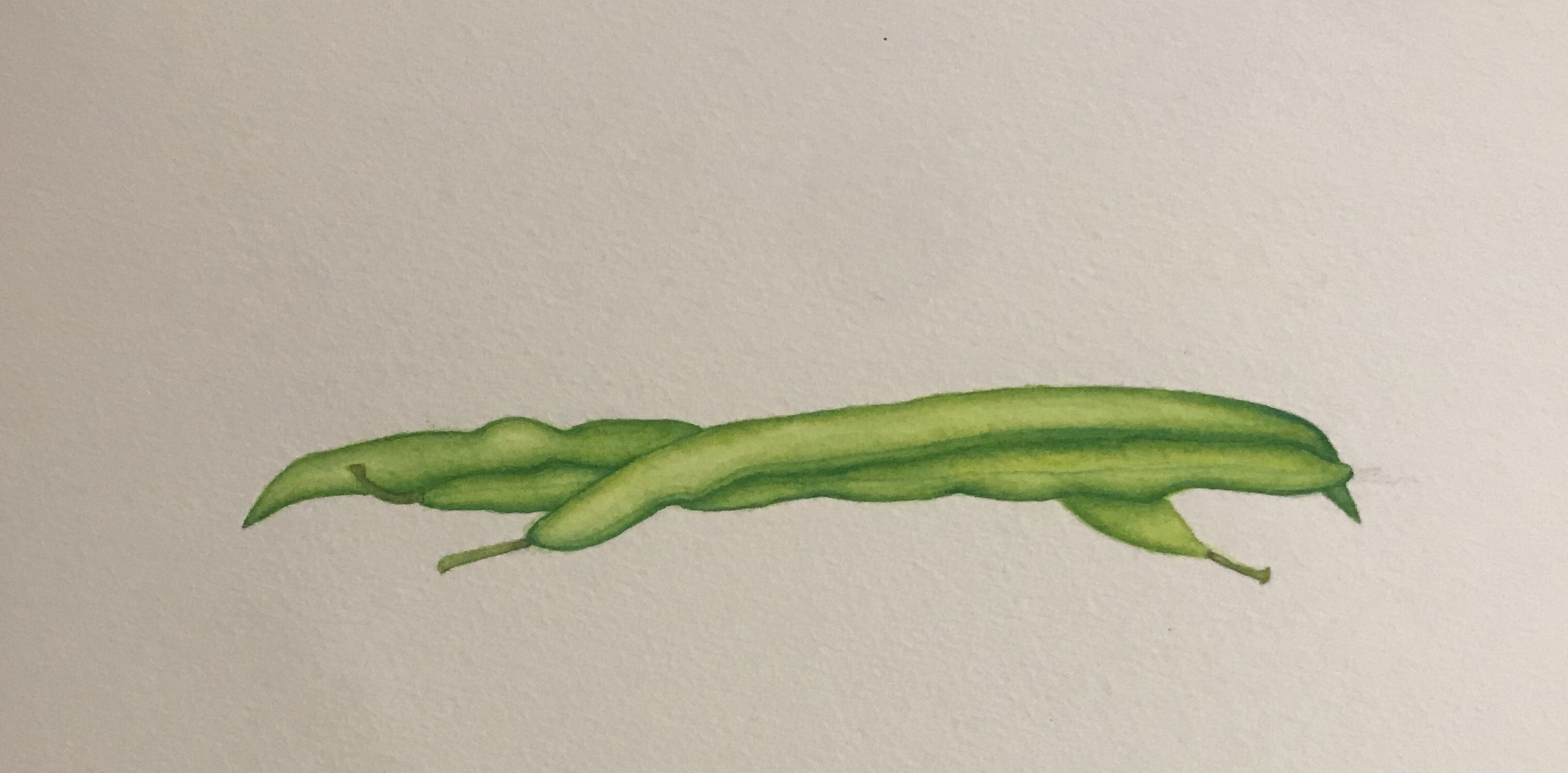
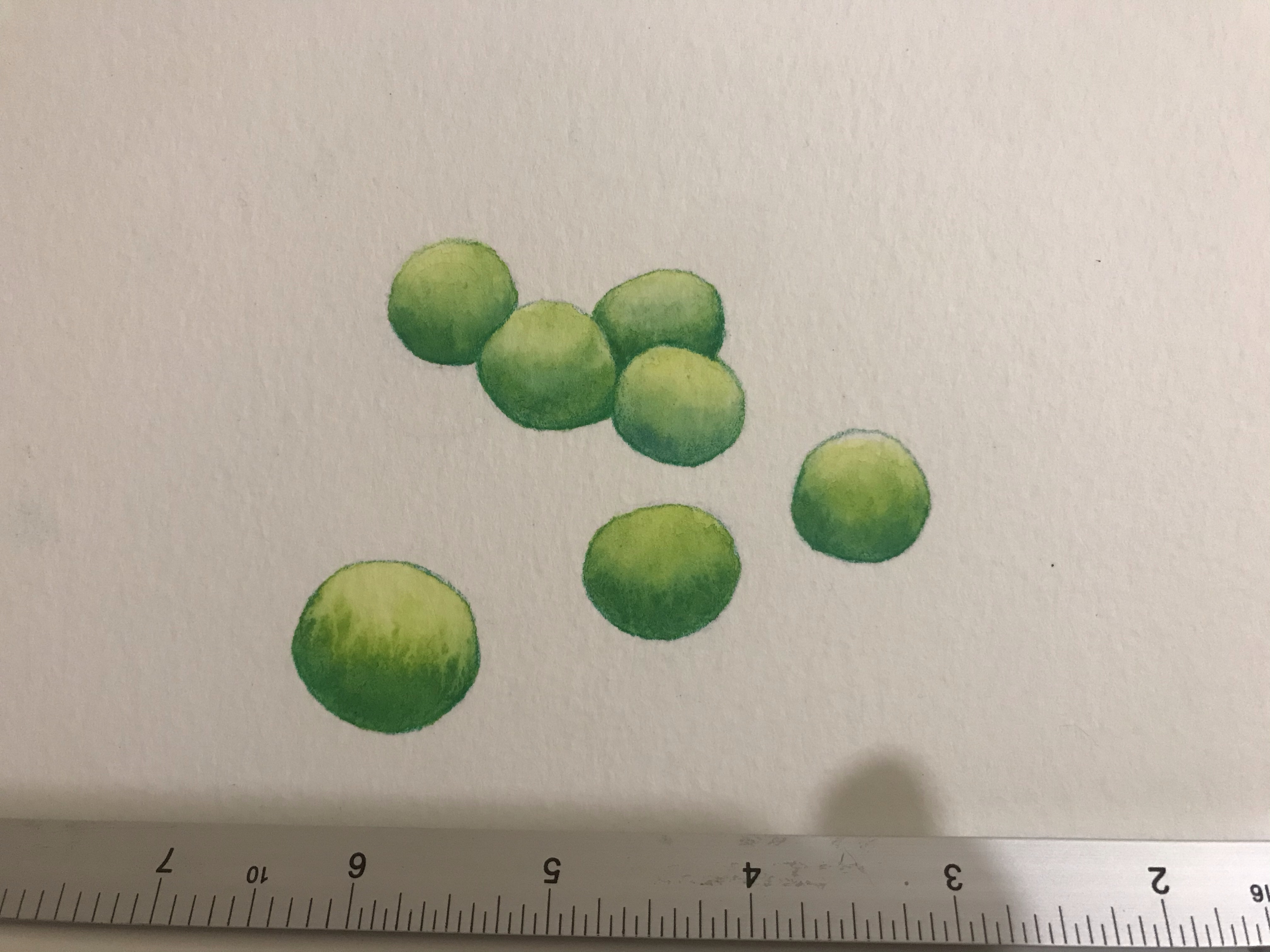
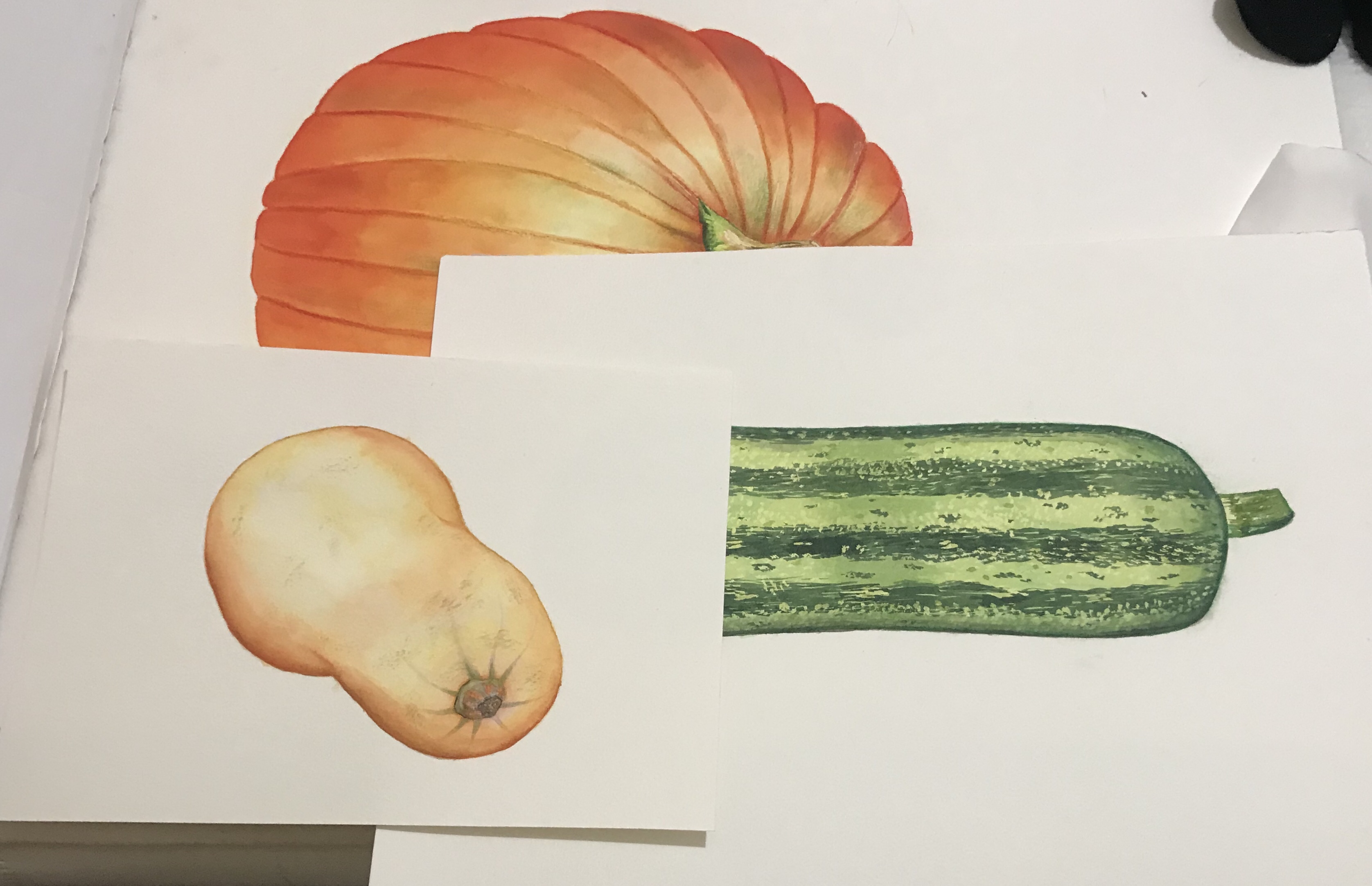
I decided to work on each vegetable as an individual painting rather than altogether, so that I could work on a larger scale and because if I was to make a mistake on one of them. I would be able to redo them without having to redo all of them. I only had to redo one of them, which was the butternut squash that was because I was not happy with how it was coming out and messed up with the shading. This resulted in the image looking muddy and the shading harsh and not blended well. This took quite a long time to paint, but I did enjoy painting them. I was happy with how they turned out, especially as apart from my practice pieces. This was the first time I’ve ever painted vegetables and I was using acrylic inks, which are not particularly familiar with. I do really like the vibrant colours and was sure to not use black unless I really had to, to darken the colour so that they did not become muddy and caused the food to look mouldy or unappetising.
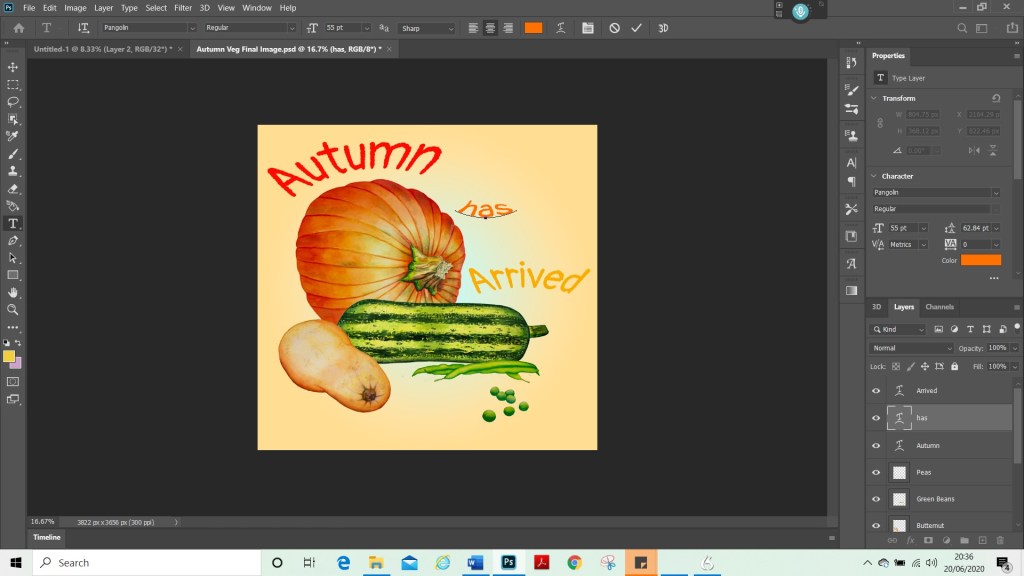
Once I had painted each of the vegetables. I then layered them to test roughly how they would look to see if it was going to work. I then started to photograph them and put them into photoshop as raw files. At this point I was mainly just removing the backgrounds and correcting the colours so that they matched the original colours. I edited each of the paintings individually 1st to remove the backgrounds and then I compiled them onto a 12 x 12 image and move them around to find a composition that I liked. I did struggle with this a little bit as I realise that perhaps I should have done the marrow on a slight angle as it looks a bit flat just being on the side. However, I found a composition that was not too bad and that is what you see below.
I then started to play around with background colour to try to find one that would not overpower my paintings. It took a little while as the colours I would associate with autumn that I would ordinarily have used were already in my painting. When I used a green or an orange, for instance, it did not enhance the image and I could not seem to find a contrasting colour that worked for this image. I eventually settled on the light peachy colour as this did not overwhelm the image.
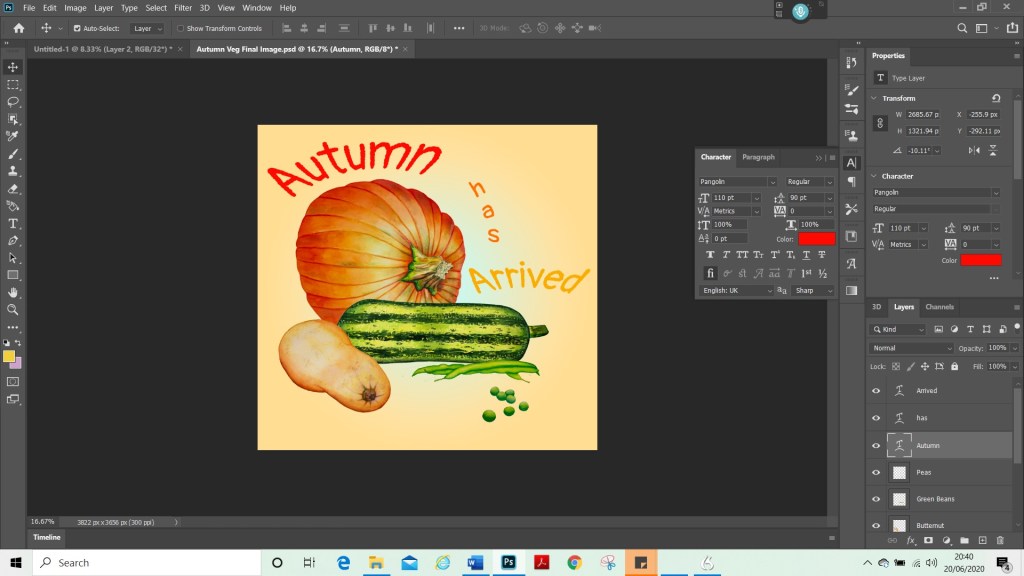
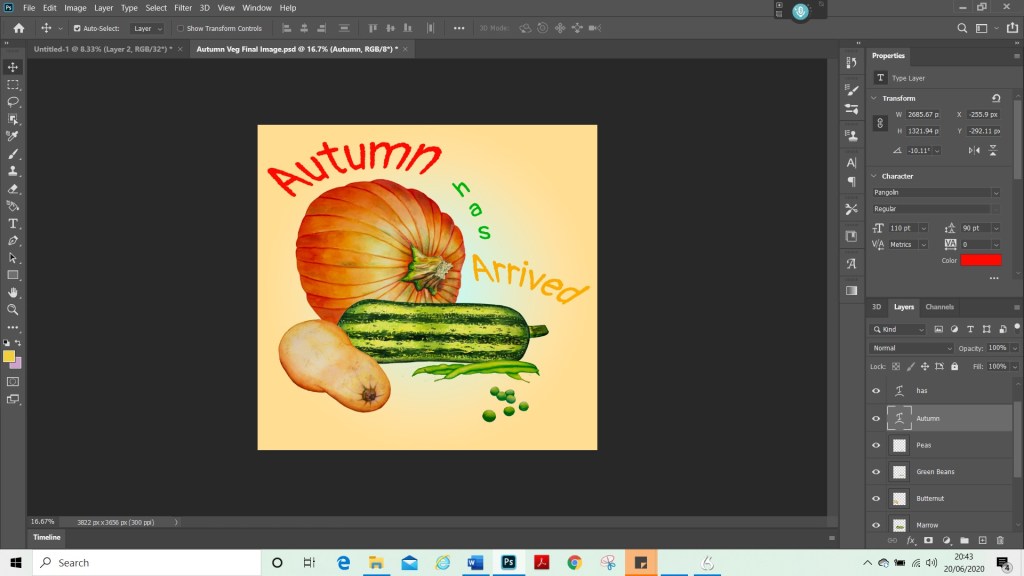
I needed to find a way to fit some text into the empty space. There wasn’t quite enough space to have the text horizontally as this would have resulted in it being quite small. Therefore, I decided to try carving the text so that it fit with the shapes of the vegetables. I also wanted it to be clear and readable, so I did not want to go too elaborate.
My Final Image
For my final image above. I learned how to add shading on Photoshop, although I’m not entirely sure how successful that was, for this particular image, it is now a new technique that I have in my skill set that I can use for later projects.
Composition Sketch for my fruit painting
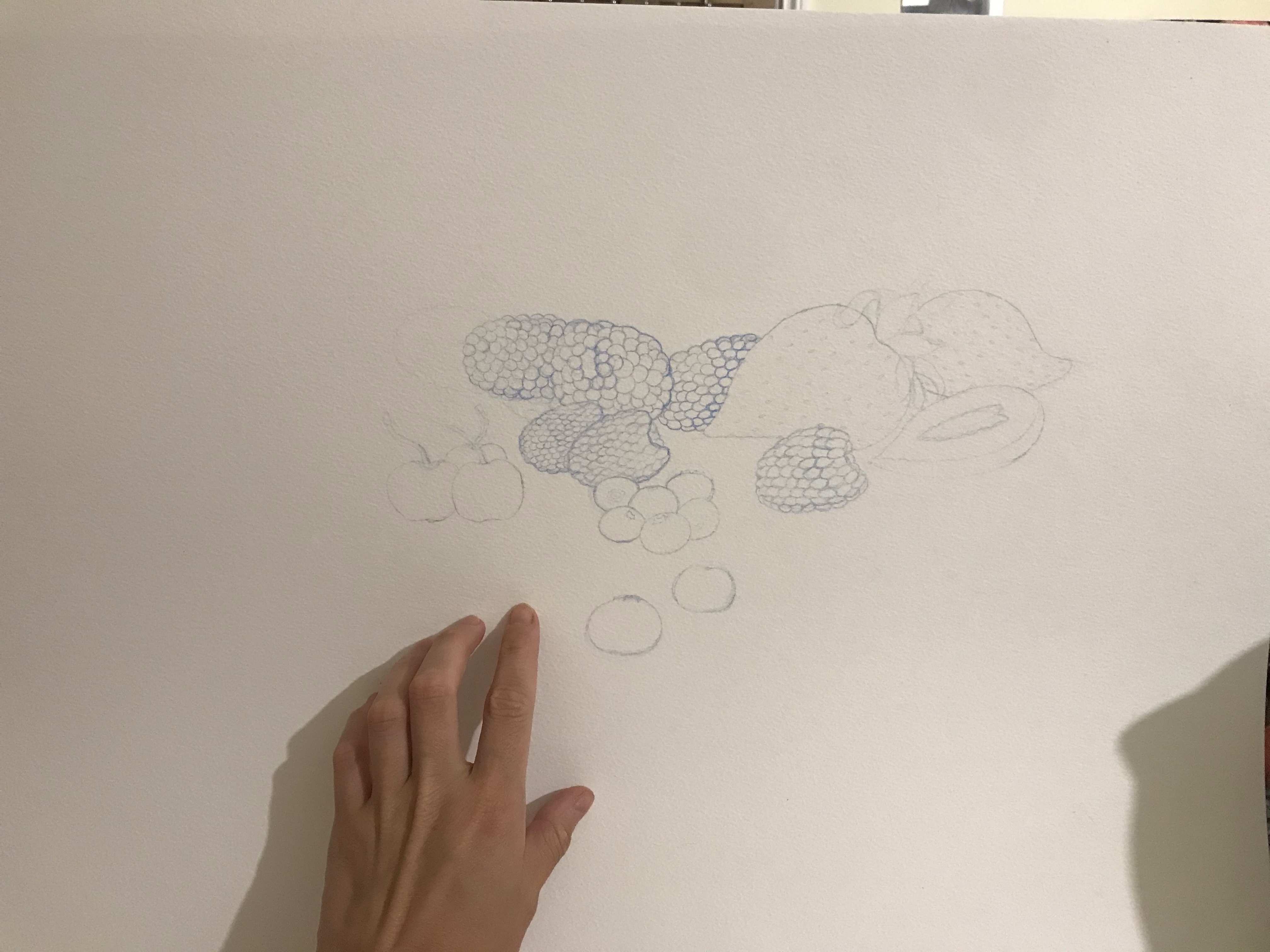
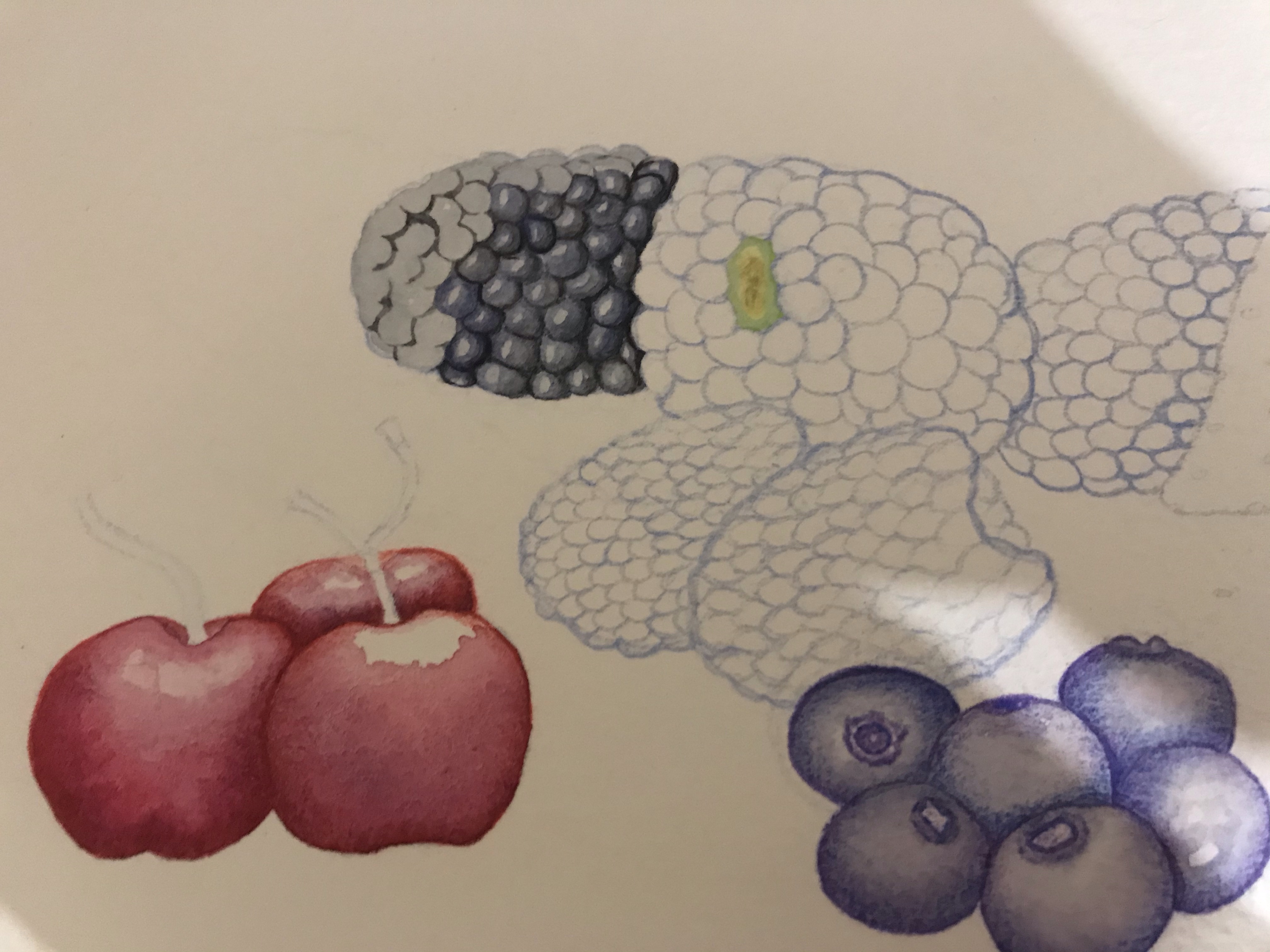
To get started on my Summer Fruits project, once I had collected all my research and did some tests, I started to sketch out a loose composition sketch to try to plan how my painting should look. Once I had done this, I used the reference material and moodboard. I had collected and begun a fresh sketch on A3 watercolour paper. For this I used a watercolour pencil, so that my colours did not become grey or muddy. Once this was done, I started to paint with acrylic inks as I had done with my vegetable paintings.
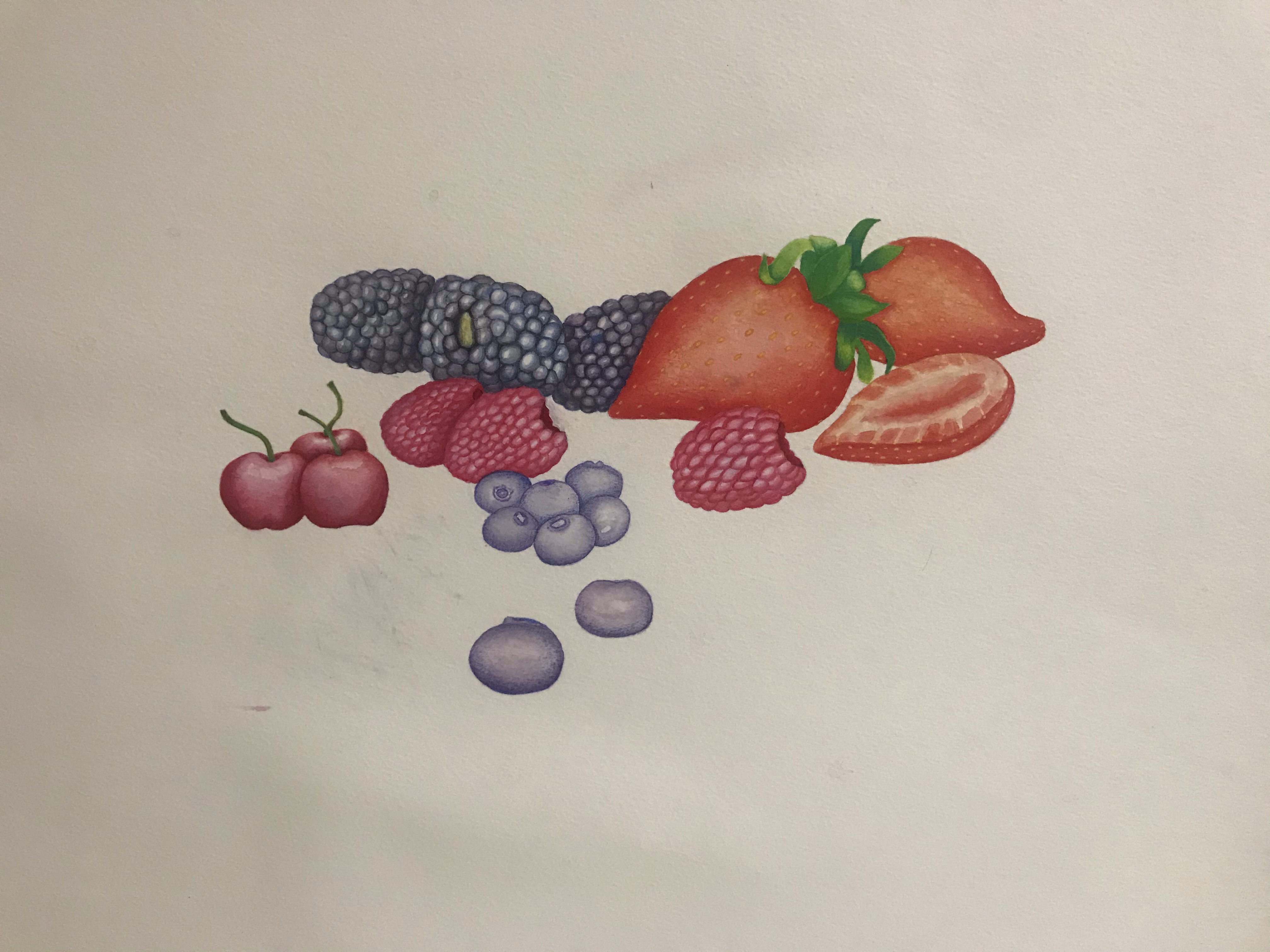
I decided to paint the fruit as one piece, rather than individually. I had hoped that this would save time, however, in the end, I think it took just as long as the vegetables did. Maybe even longer due to the fact that the objects were smaller, so the details were trickier to paint. The berries were generally much more time-consuming and difficult to paint and the vegetables, as it took some time to paint the blackberries, for instance, due to the nature of their make-up. I was trying to give them a 3D effect, however, I was not aiming for them to be realistic and was trying to strike a nice balance.
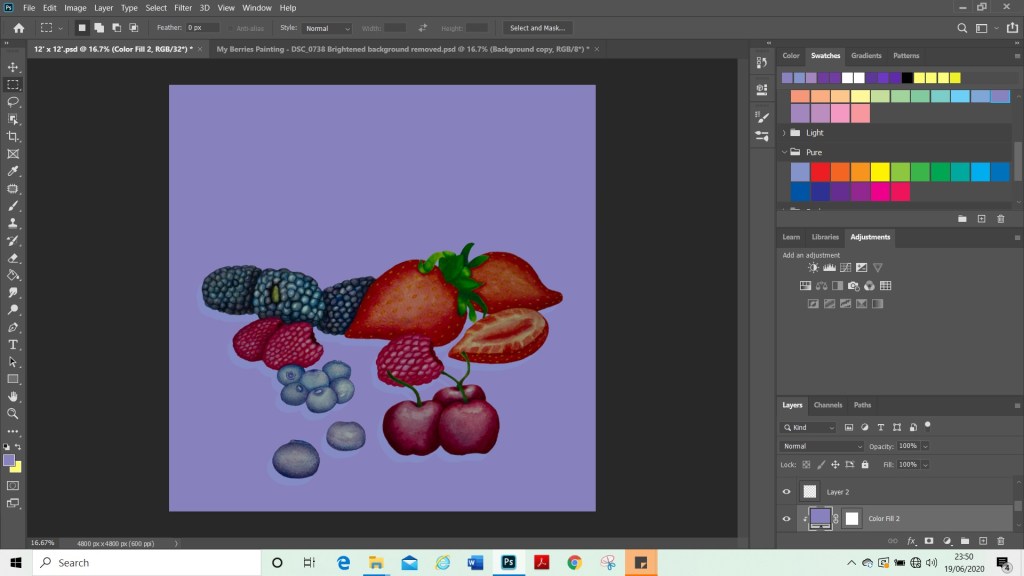
I had to change my composition a little bit once I had put it onto Photoshop because it was not going to work with the square, 12 x 12 format. I therefore moved the cherries so that they were in a different place. This also gave me the chance to resize them as I felt that they were a little small on my original painting.
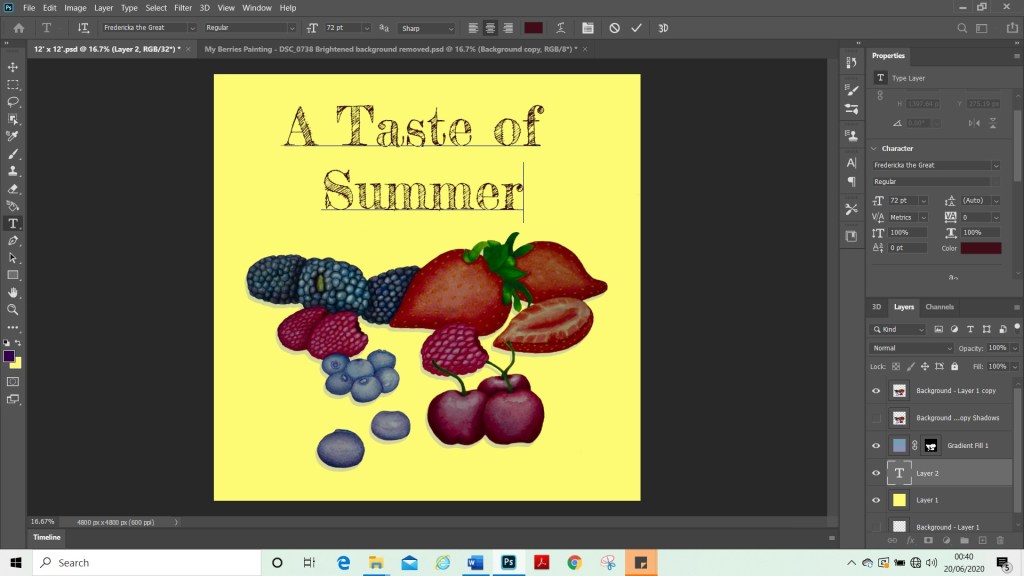
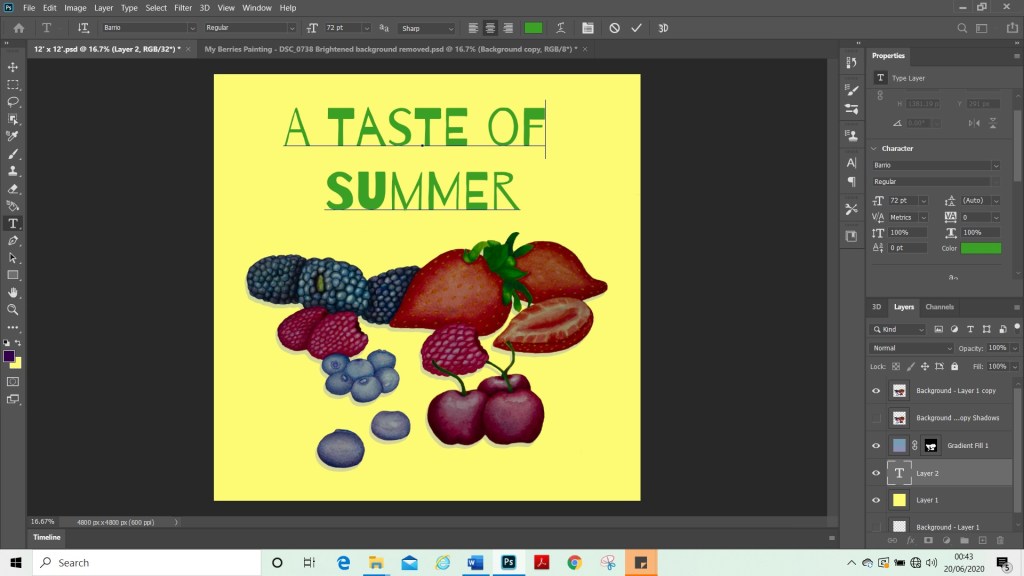
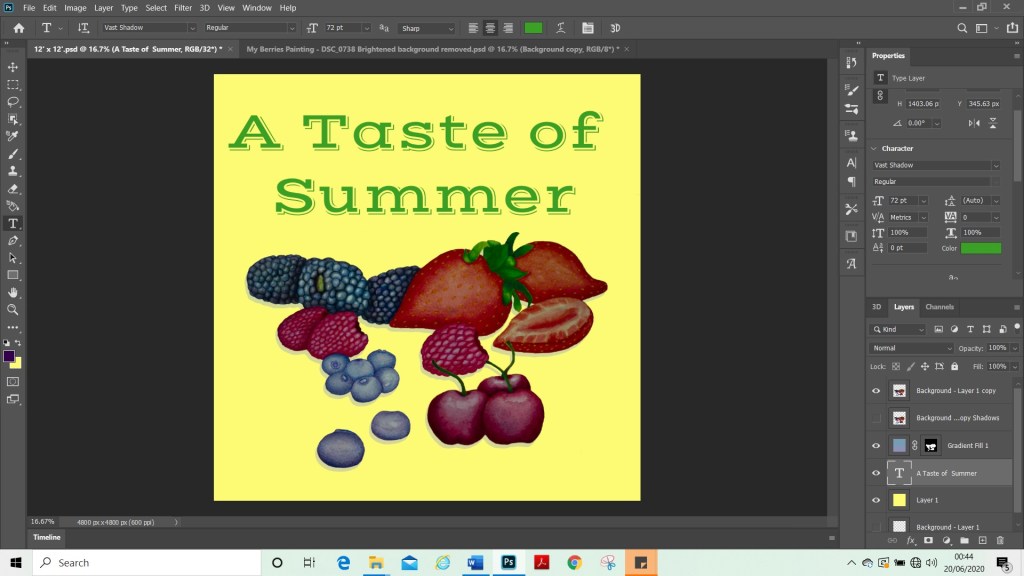
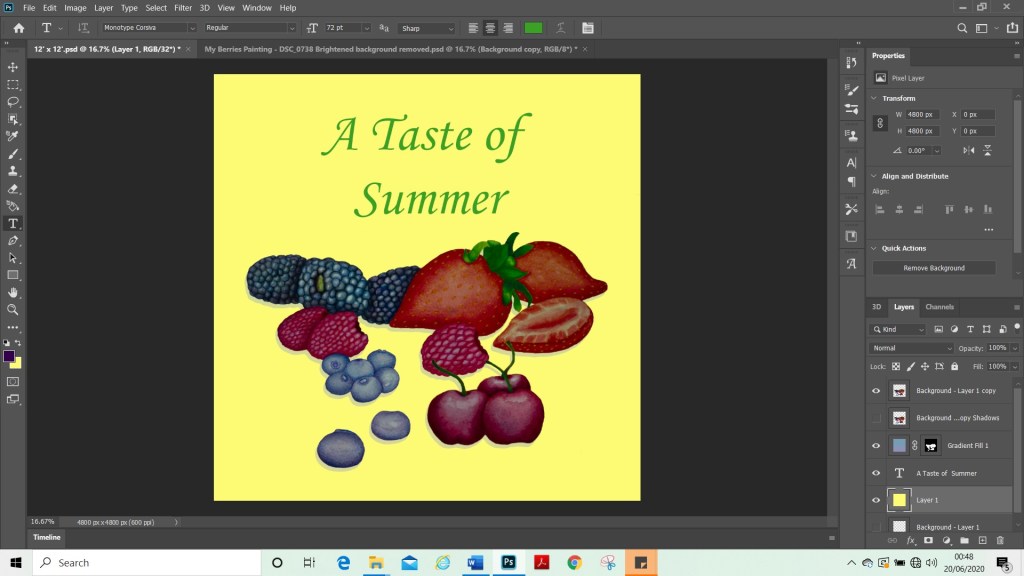
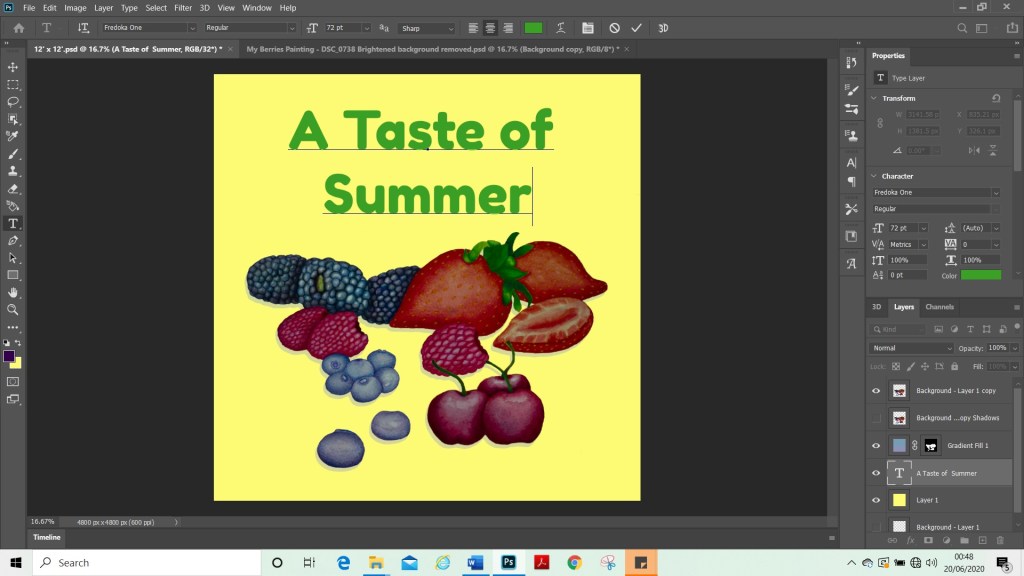
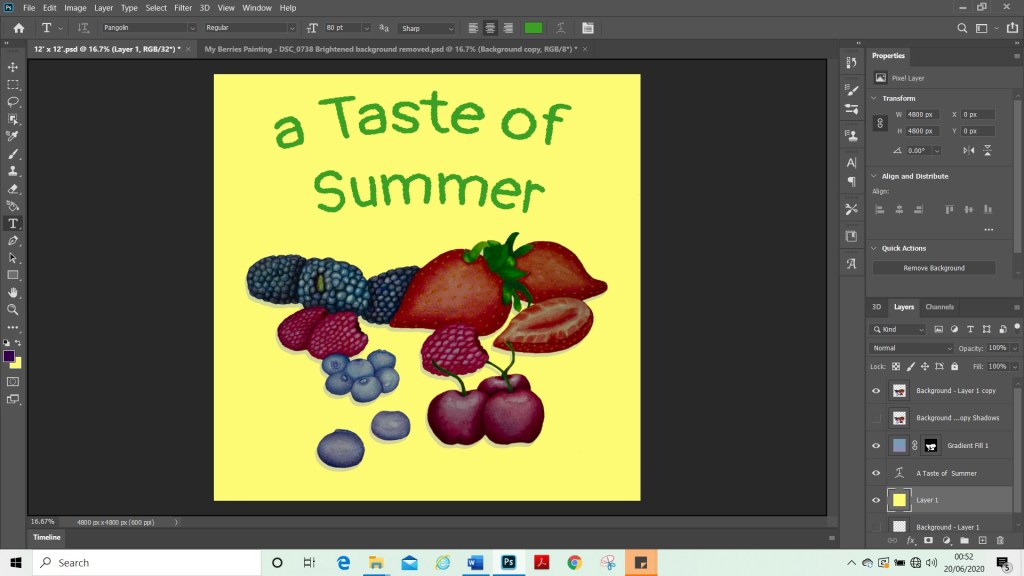
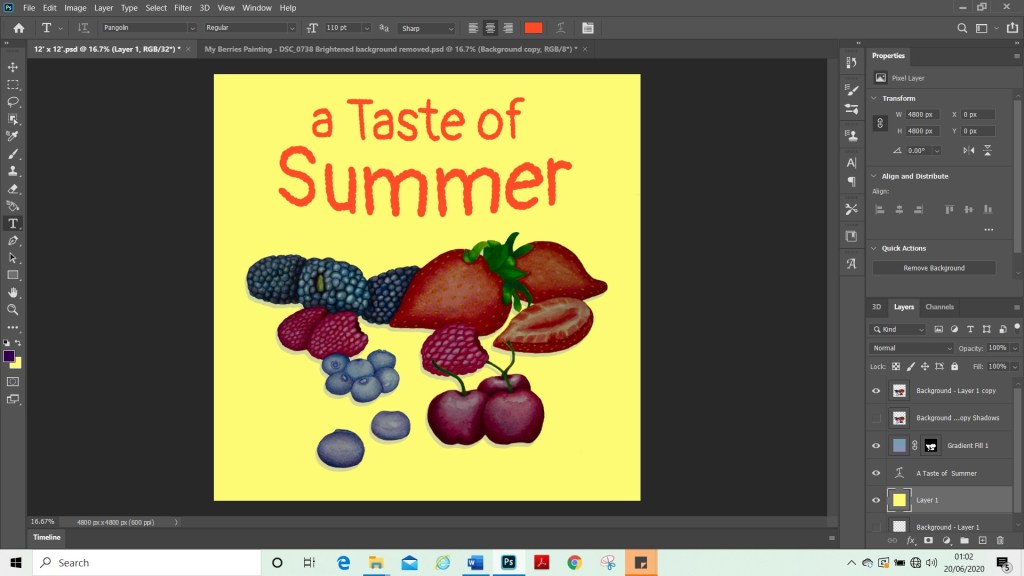
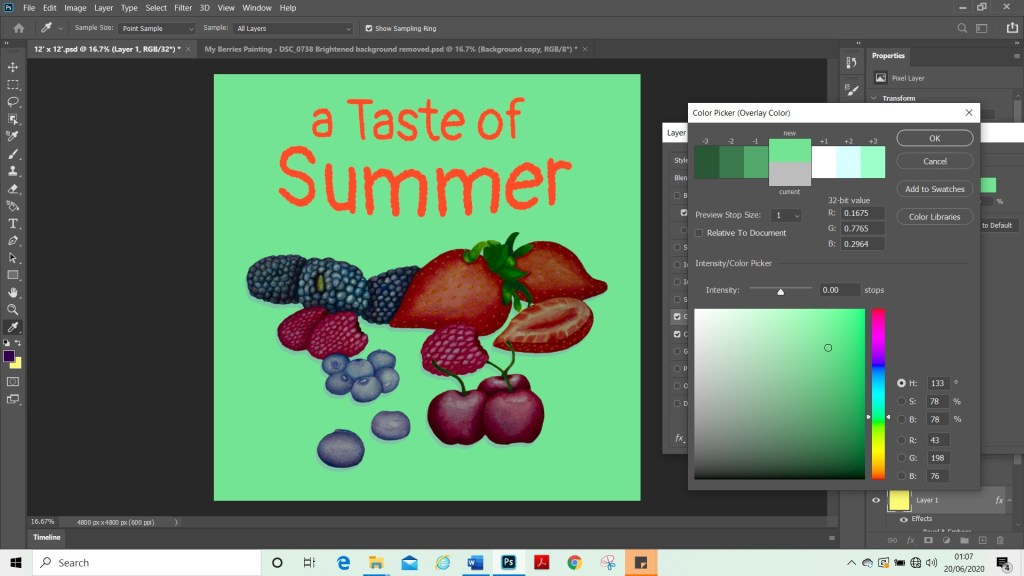
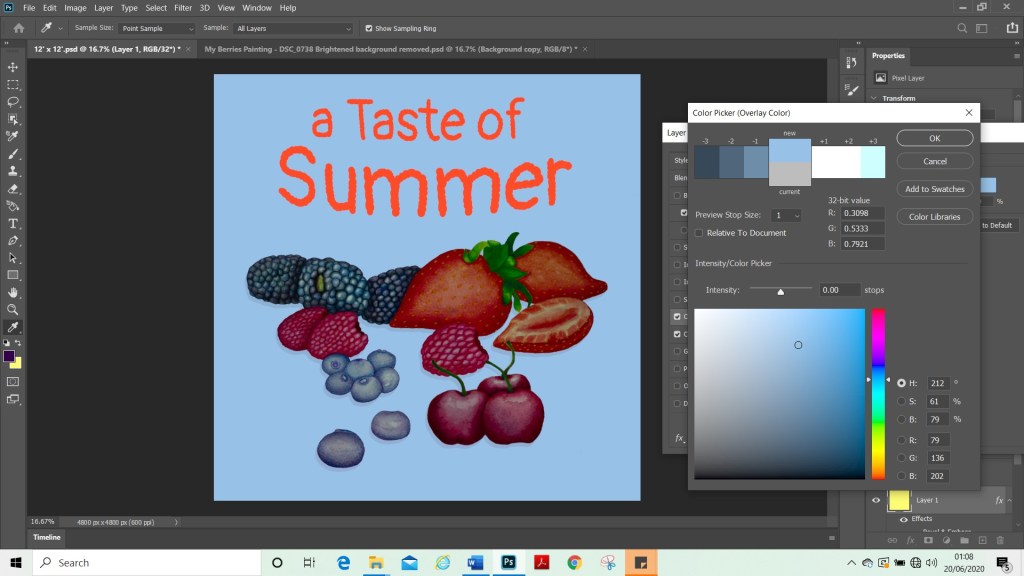
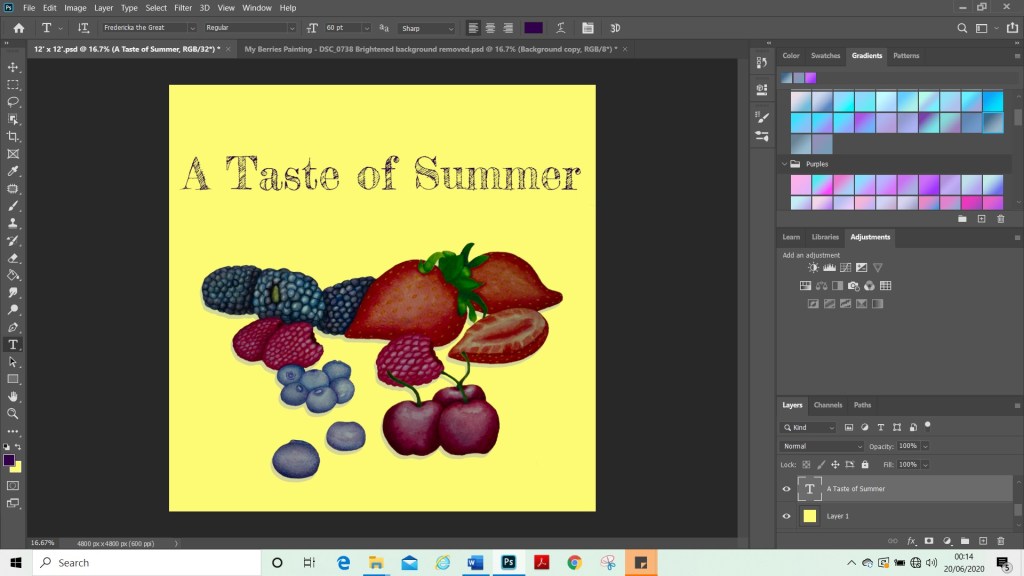
Once I was happy with my composition and had adjusted the colours to how I wanted them. I started to add a background layer and try out colours. I added the text and tried different fonts and sizes to see what would work alongside my image. I tried various colours and fonts until I found one that I was happy with. Above are some examples of these.
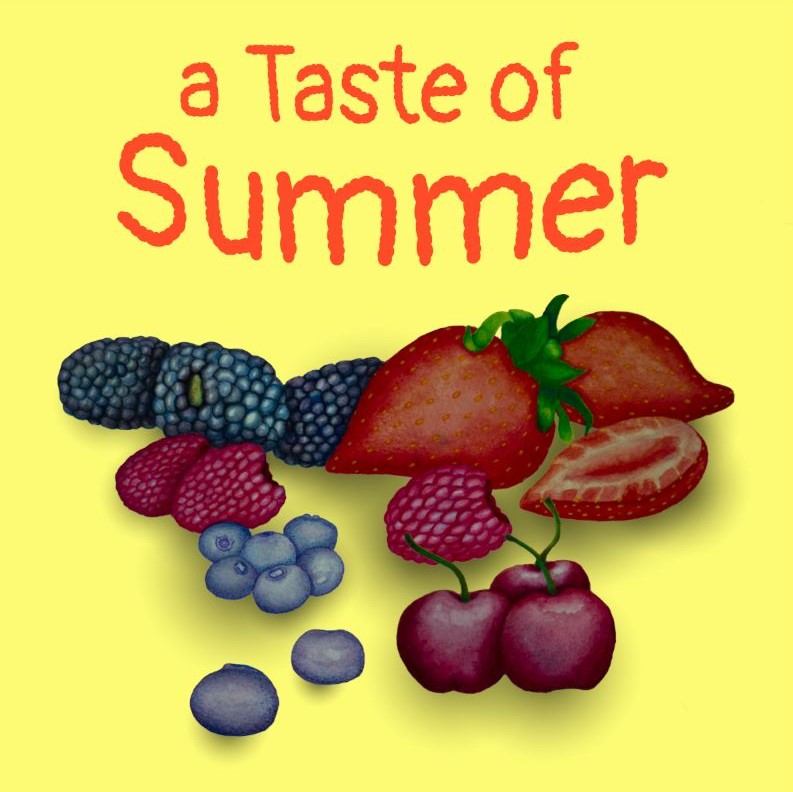
Final Image
Final Image with lighter shadows
Reflection
For my final image. I added shadows in the same way I had with vegetables. This was to try to ground my painting so the berries did not like they were floating. I wonder if they would have looked better if they were a blue or purple colour rather than black shadows. I would have done this if I was painting them, but as I was following instructions and learning how to do them for the first time, I did not change the colour. I realised during this assignment that my computer does not have a good screen as I really struggled to see the shadows as I was adding them. And yet when I viewed them from another angle, they looked very heavy. Also, once I had transported my final image into another format and viewed it on my phone, the image background was a lot brighter than it had shown in Photoshop.
Overall, I am happy with my images and I feel that I met the brief. I did find this assignment challenging, as I am still new to Photoshop. Therefore, once I had put my images into Photoshop, I found that my skills limited my possibilities for what could be done with the final pieces. I am happy that I learnt some new techniques. I also learned my current limits (or some of them) for using Photoshop. I did try to use the 3D tool to create more interesting text. However, I was unable to do so as my computer could not run it and unfortunately just froze. On looking at my paintings. I am happy with how they look, in particular with the fruit. I really liked the biggest strawberry and I liked the way the blackberries came out. I did not manage to capture the juiciness of the berries which is something, perhaps, that is lacking in my image and could have improved it. This is something I could explore further with my painting and perhaps do some tutorials to learn how to do this.
Key Steps Part Two – In Summary
Key steps part two has been quite a challenge and I have enjoyed the exercises and doing this assignment. I have learnt many new skills and techniques, that I can now take on to other projects. I finally feel like I have found a pace for my course and feel like I am progressing. When I look back over the past two months I have done a lot of work in a short space of time and feel quite a sense of achievement about this. This makes me excited to continue on to part three and I am looking forward to the next set of challenges and opportunities for growth in my learning.
Key steps part two has been quite a challenge and I have enjoyed the exercises and doing this assignment. I have learned many new skills and techniques, that I can now take on to other projects. I finally feel like I have found a pace for my course and feel like I am progressing. When I look back over the past two months I have done a lot of work in a short space of time and feel quite a sense of achievement about this. This makes me excited to continue on to part three and I am looking forward to the next set of challenges and opportunities for growth in my learning.
This year and especially since my study trip to Lisbon. I have really immersed myself in my course and in OCA life. I have really enjoyed having a group of peers that I can talk to. This gives me a sense of community and support, and I do not feel isolated in my studies anymore. We keep in contact via a WhatsApp group and have a second Lisbon catch up session coming up with the tutors in August, which I’m looking forward to. The Lisbon students are from a mixed range of disciplines and I am the only illustration student amongst the group. I have been very inspired by their work and they have helped me to view art from different perspectives and not be scared to try new techniques and make a mess. I have also been participating in group sessions with OCA tutors, which have been very helpful and once again build a sense of community and help me connect with fellow students. I have been connecting with my fellow illustration students a lot more, this past month, which is very helpful and nice to feel like part of the OCA community and no longer just an impostor. (Now that I am actively studying.) I do struggle a lot with self-motivation and communicating with my fellow students and tutors has really helped me find motivation and purpose.
I do tend to struggle at first understanding the briefs and have to re-read some of them over and over and ask others how they interpret them, to see if I am understanding them correctly. This does cause me to hesitate on starting a project and I really have to push past my fear of failure and perfectionist tendencies. Although helpful in some instances, it does tend to hold me back. I am finding, however, that now that I have processes in place. I find it easier to start projects, as I have steps that I can follow i.e. Research, moodboards and mind maps. These steps, stop me getting stuck procrastinating and mean that I know what I need to do to get started. Once I have started, I have no trouble continuing. It is just the initial starting of a project. I am happy that I am finding a way around this and I hope that this will continue to improve as time goes on.
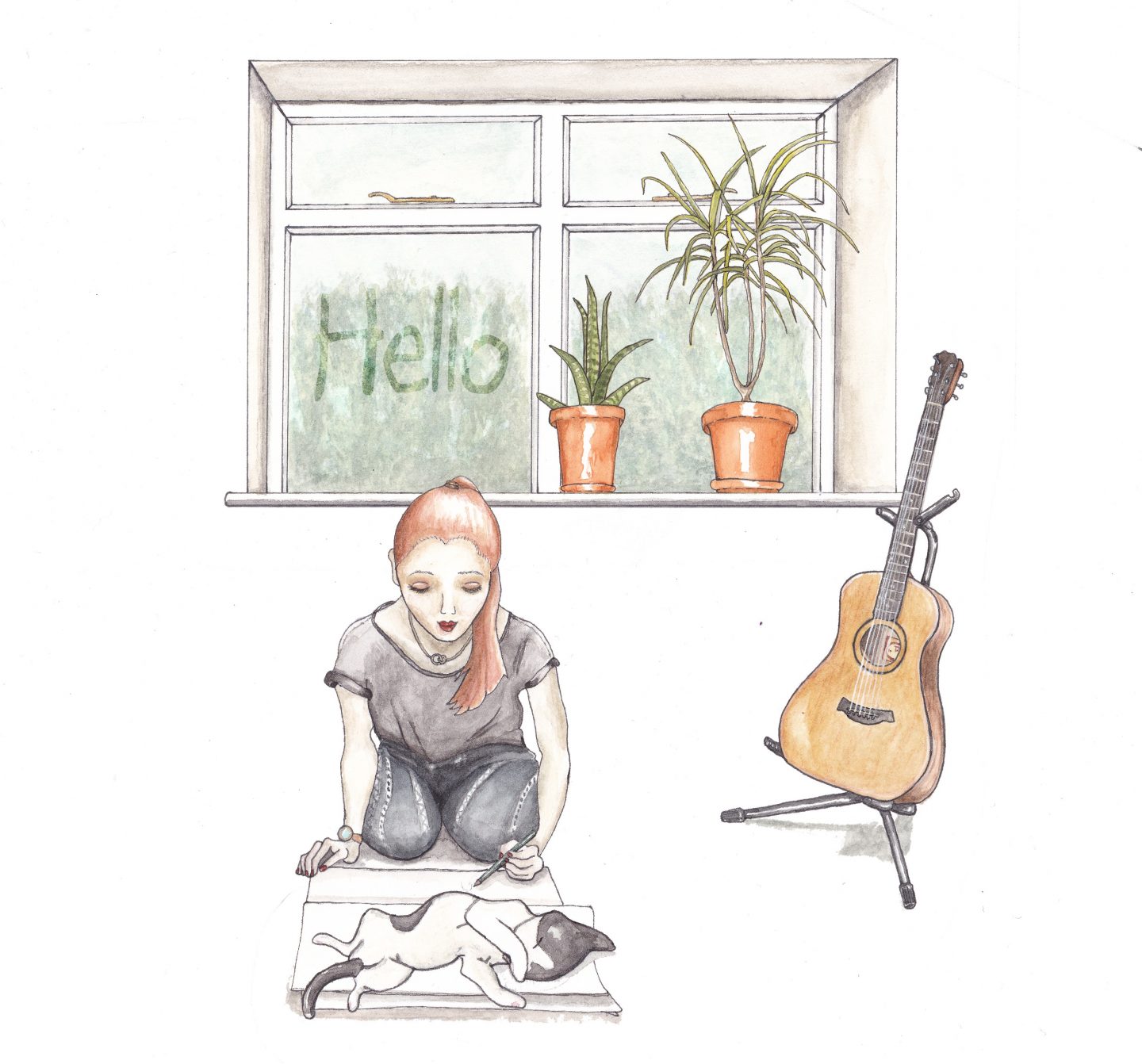
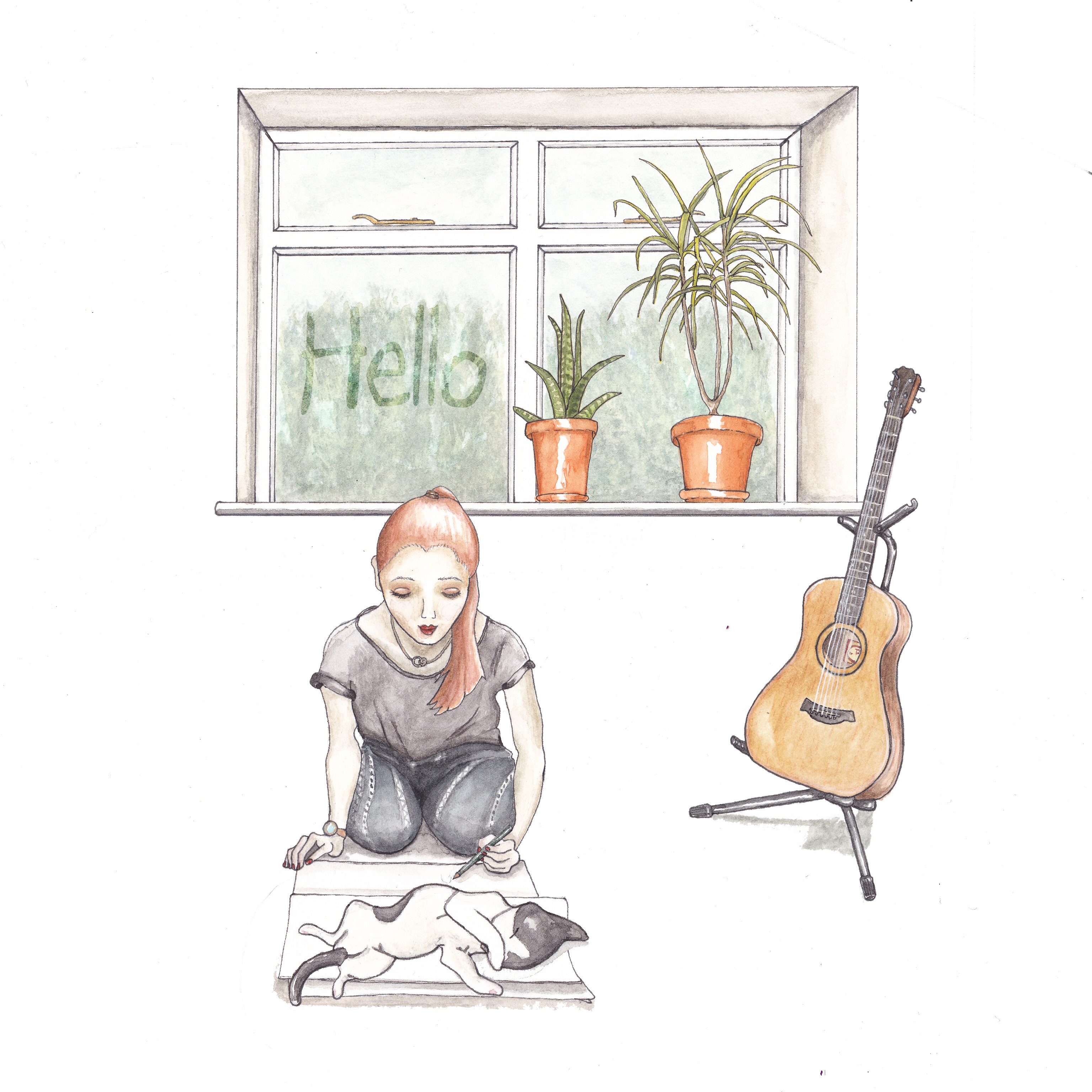
It took me along time to complete this assignment. One reason for that is I painted the scene as individual objects so that I was less likely to make mistakes and have to redo the whole thing. I did redo the guitar once and the girl a few times before I was happy with it. The second reason being that I am only just learning how to use photoshop, which is quite a challenge as I can never remember what tool does what. To fix this problem, today I started writing down what tools do what and what different short cut commands do. The laptop I’m using is very out of date so unfortunately it can’t run illustrator, which I’m told is the on I should be using.
Because of these technicality’s I ended up not adding as much as originally intended in my original sketches. I also wasn’t able to colour the background which I think would have looked better. However I am still happy with my effort. I am keen to move on now and start afresh as I was spending far too much time on this one, getting stuck too many times along the way.
I used watercolour for these drawings, I first drew each item and when I was happy with it traced it on to the A3 watercolour paper. I placed all of the items in the same sheet and then cut them out after. This way I could be sure the colour palette and paint style matched.
I then scanned them and used photoshop cc to resize and layer the images. The words in the window was born from a happy my mistakes and experiments in photoshop. I’d had an error where the background was not working correctly and was not layering in the correct order, therefore partially concealing the things in front. I thought I’d try duplicating the effect but layering in an order that meant that the words remained hazy and by changing the opacity and having the right font, looked like the words were written on the window like condensation. After I was finished editing I sent it to Moonpig the online card retailer and got my image printed out as a card which I will be posting to my tutor. I do like the colour palette in this one. I tried to keep to just a few colours and to keep it simple.
After I did this however I realised I forgot to talk about what mediums I like to use etc. My fault for rushing though the final part. But I was keen to move on, as I have spent far too long stuck in my first module.
































 Ashley's OCA Illustration BA Blog