Lisbon Group Study Event

I have just this second finished the study event with our Lisbon group and wanted to write up on my learning log whilst everything was still fresh. I have been looking forward to seeing everyone for a while now, and was excited to participate in this event. I was concerned as my internet connection has been playing up, but I was very lucky and it only cut out for a few mins today. Many thanks to Diana Ali and Michelle Whitting once again for a fantastic study event and to Alison Dollery for organising. Our Lisbon trip was the last big event that happened for me before lockdown and I have fond memories from the trip. It came at the right time as I was struggling, feeling isolated with my studies and the Lisbon trip changed that completely. I met some amazing people and am really glad we have all stayed in touch. It made me realise that I am not alone. You just have to reach out and you will find your classmates are all there, also in the same boat. Since then I have also joined the illustration group on discord, which is another great group of people that inspire and support each other. I in no way feel lonely when I’m studying anymore.

Today, after catching up. We were read to by Michelle Whiting, her paper that she has been working on. We were asked to think about how we feel in response to this and were encouraged to move around whilst we drew. I initially found this very difficult and felt a bit lost. So I started just by walking around the room and making marks on my page based on that experience. After that I sat down and concentrated more on the words Michelle was reading and listening more intently. And I started to make marks based on what she was describing and also from the feelings and thoughts I was having. I started to think about movement and dancing in particular, and drew a few lines based on this. I think this exercise is something I should practice more and develop as it would help my illustration work to try to feel more and as Michelle mentioned, feel the time and place of your illustration, ‘feel the sun on the back of your neck’ etc… Which I think is definitely key to creating a believable illustration and something that I need to take on board and explore more as I work. as this would really add dimension to an illustration.

Photo taken by me in Lisbon whilst on our way to Pada studios.

After lunch we each used a photo we had taken in Lisbon and chose five words to describe the feeling we got from it. The words I chose for my image were bright, contrast, surprise, fun and colourful. The word I chose to focus on was colourful as I wanted to have fun playing around with colour. I used oil pastels as I have not used these before and started to create shapes on black paper. I had no plan or idea as to what to do, so I just kept adding colours and as I did this, it started to evolve into more of an idea or form. Therefore, the left side of the drawing is less structured than the right side as I started on the left. From doing this, more ideas were triggered. From which, I made a series of drawings which developed as an idea from the drawing before.

My First drawing

On the right side. I started to see what looked like part of a face emerging so I decided to start on a fresh piece of paper and recreate that face.

Second drawing

I decided not to make this into a full face or character as I really liked the way the eyes and the feathered shapes coming down were looking interesting and I did not want to ruin the shapes by overcrowding the drawing as this was starting to happen at the top (hair). So I decided to stop here. However, if I wanted to develop this into a character I would work on a fresh sheet and develop ideas from this. Looking at him now. He kind of reminds me of a ‘Rayman’ type character, which is a cartoonish computer game that I played as a child.

My third drawing

For this drawing I chose to take the outside shape of the jellyfish in my original photo, which I thought was really beautiful and experiment with that technique and the shapes whilst keeping with my chosen word which was ‘colourful’. Here i used a combination of chalk pencils and Conte sticks.

My fourth drawing – unfinished

With my fourth drawing, I expanded on my previous drawing taking the same shapes but seeing what else I could do with them. This developed organically and initially I did not have a plan to make them 3D like this, but I was experimenting and wondered what would happen if I did x,y,z… and this is what I came up with.

I really enjoyed today and am really happy that I got the chance to experiment and have some ‘free play’ time. This past year with the OCA, from my time in Lisbon, as well as the other study events I have been participating in. I have been trying new things and getting lots of inspiration. However, outside of those events. I haven’t continued to experiment as much as I would like. Part of this is due to time constraints and also because I am working on my exercises for my course which are structured, I tend to forget about experimenting. Today was great because I got to experiment again and this is something that I really must make more time for. As through experimentation, it is possible that some of the techniques or ideas that I have, can be developed into a larger project or else stored to be used for a project at a later date. On reflection, this reminded me of my abstract exercise for part three and thinking back, the process I developed today would have been quite useful for that exercise. I now see how much further I could have pushed that illustration and how I could have worked what I had, into something more or something totally different.

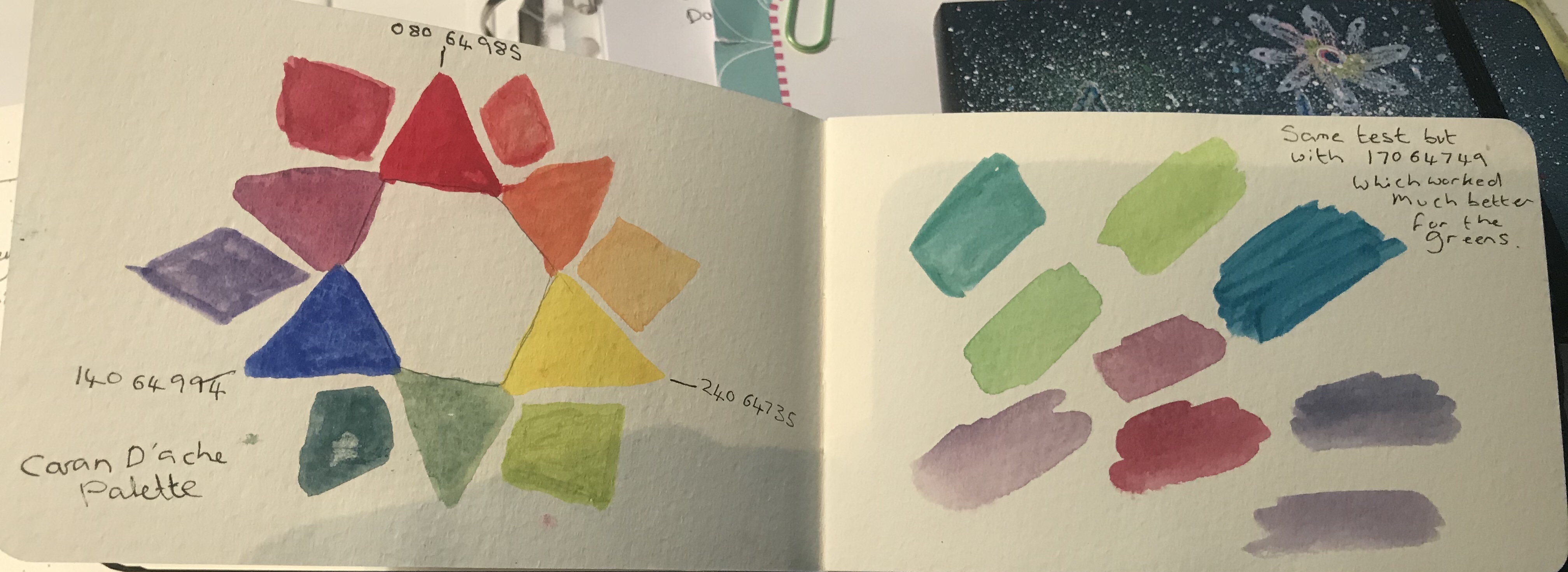
Mediums sketchbook experimentation

On my feedback from our my second assignment from my tutor. She suggested that I start a few smaller sketchbooks for each medium so that I can explore painting techniques. Painting is something I am new to and I am learning through doing as I go along. However, I have no technical knowledge of how to paint. This is something that I have been meaning to learn more formally and I thought that my tutor’s suggestion would be really great for me.

Gouache

I purchased three A6 sketchbooks, one for gouache, one for acrylics and one for watercolour. I started by using the paints that I have, to paint colour wheels. I found a reference colour wheel online and used that to compare the colours that I was mixing. I tried to match the colour of the reference colour wheel each time, with each different set of paints. The reason for this was so that I could test the difference in the paints and see what happens when I try to mix same colours. I found that although some of the colours mixed as expected, when I mixed the secondary colours, the Greens did not always seem to come out as I had hoped. As the image below shows on the second page, I used the different blues and yellows that I had, to see how they mixed and whether I could match my reference colour will with those paints. Quite often these did mixed better.

Gouache
Acrylic
Acrylic

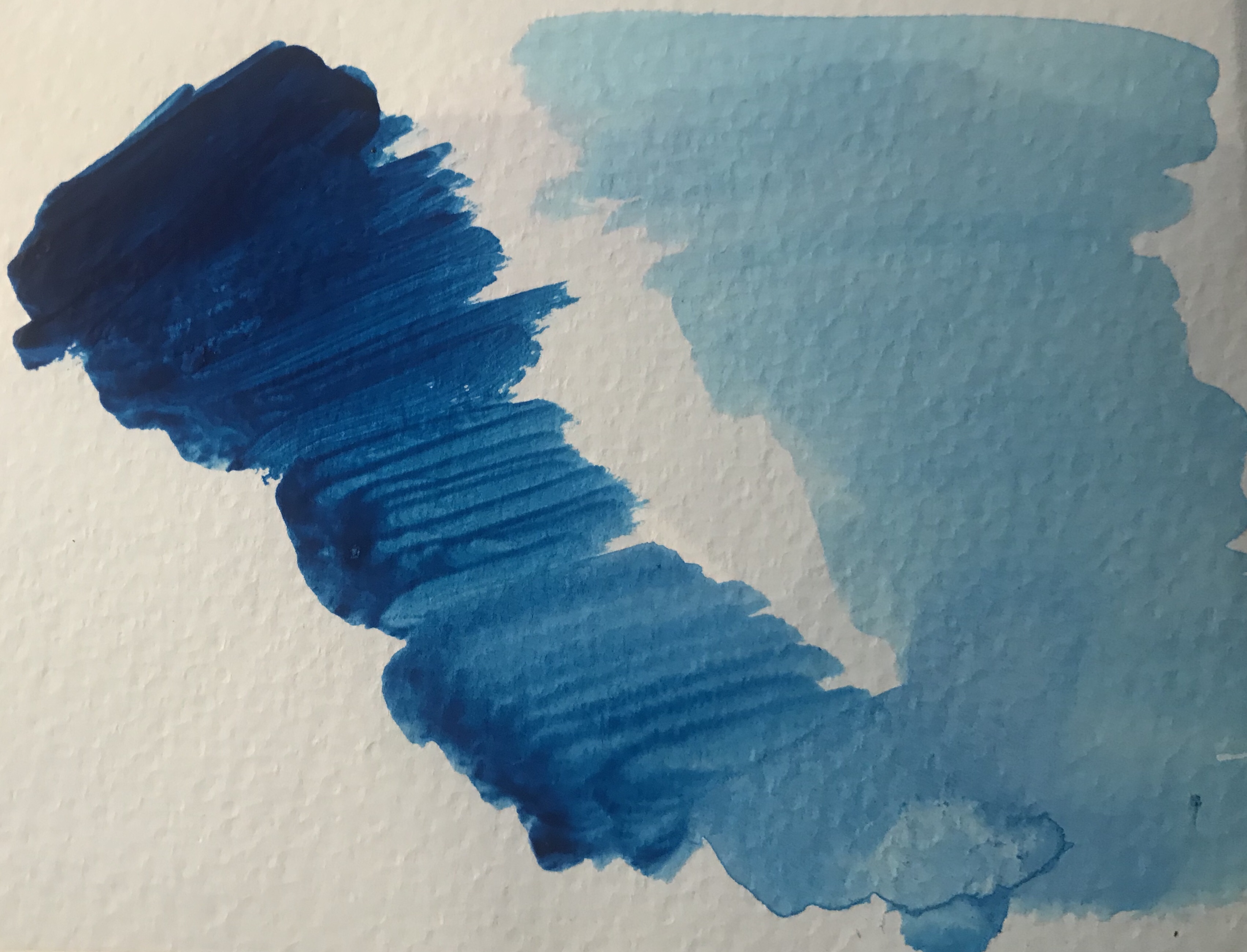
With the above image. I was testing the consistency of acrylic paint. I have successfully used acrylic inks. The however, I have not used acrylic paint before on paper. Acrylic paint is not something I’m used to and I was unsure as to what the consistency should be as I tend to see people painting rather heavily with this paint and not adding much or any water. Here I tested the acrylic paint neat and then gradually added a little more water until I got to a nice light wash. I really like the wash as the colour is very vibrant still and I like the way it looks on the textured paper.

With the image below. I was actually inspired by the paint marks on my kitchen-towel left from when I was doing my colour wheel. I liked the combination of colours together and also the overlapping lines. Therefore, I decided to use the leftover paint from my palate to experiment with, rather than wasting them. This was very therapeutic and pleasing to do. I like the way the colours overlap each other, but you can still see through them, almost as if this is glass or transparent plastic. This blue mark in the centre reminded me of a stained glass window.

Acrylic
Acrylic
Watercolour
Watercolour

After a recommendation from a friend. I got the book ‘If you’re bored with watercolour, read this book’ by Veronica Ballart Lilja. In this book. The author shares techniques on how to create textured paper. I had heard before that you can use salt on your watercolours and it soaks up some of the paint, leaving patterns underneath. It was also suggested in this book, so I thought I would give it a go. For this one I used table salt because at the time it was all I had. I thought that perhaps this would not work as well, as it would give me just small particles of salt. Therefore, I assumed a very even pattern would be left behind. However, as you can see, this is not the case. On some parts of the painting, it did just stick to the page and did not create much paint lift. On other parts of the page, it created striking patterns, as in the top right red. I really loved this section and feel like I can see an ostrich in that splodge. I was quite struck by how different every patch came out. There seemed to be no repeating pattern happening and I wonder what conditions each patch of paint was in at the time I added the salt, and whether I could replicate the effect easily. I imagine that this is affected by how wet the paint is at the time of adding the salt, how thick the paint is and perhaps even some colours may react differently to the salt. These are things that I intend to explore further, as well as trying this again using rock salt both whole and partially crushed to see what effect that has.

I have enjoyed my experimentation so far and endeavour to keep adding and experimenting in these sketchbooks.

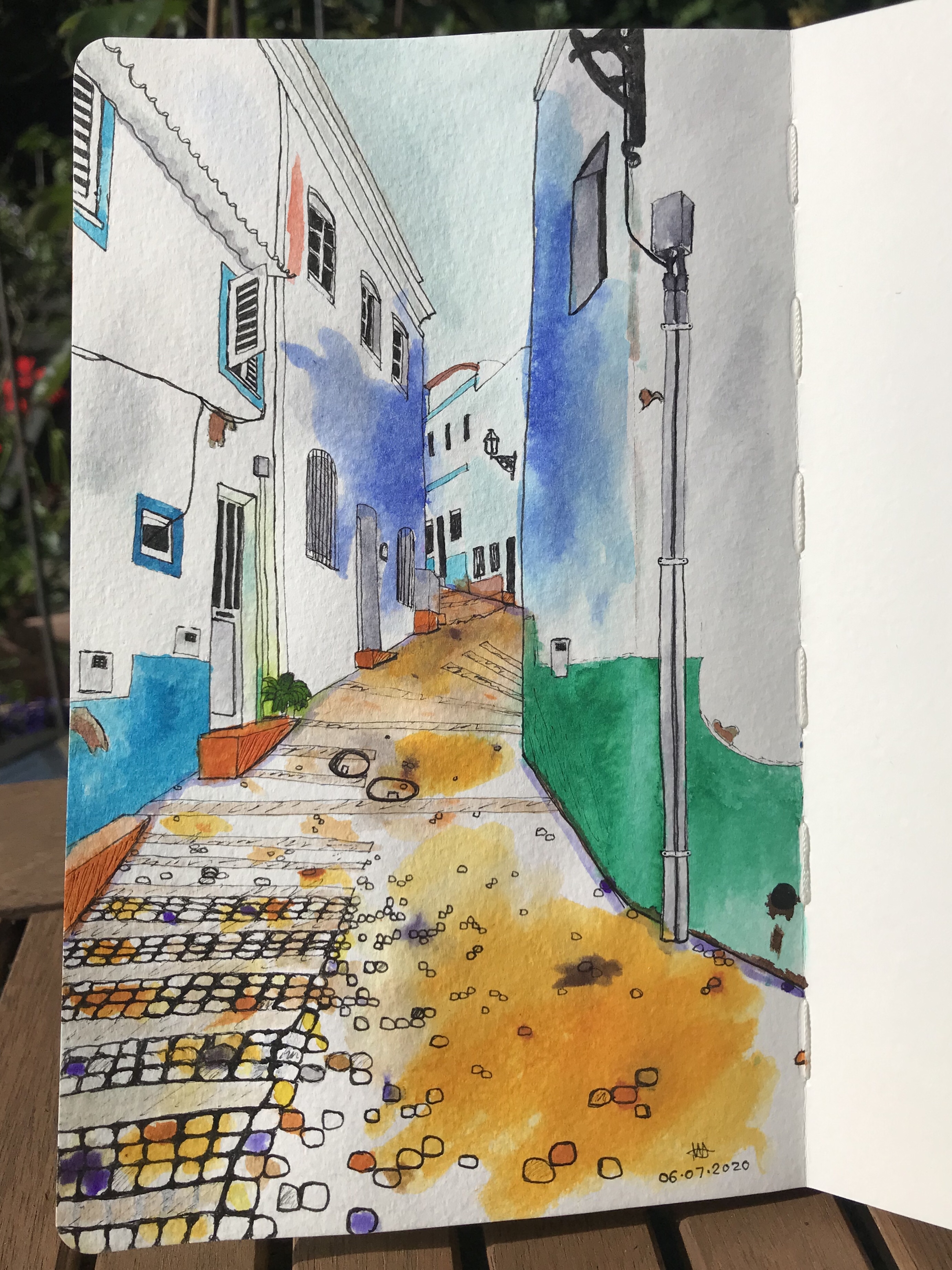
A painting I did in gouache – I really love this painting, but i didn’t plan how I was going to do the floor very well and I realised after starting, that I couldn’t draw every stone. The floor also seems to slope down towards the right, which was not intentional. The floor was meant to veer around to the right and continue up hill evenly on both sides.
Another gouache painting of a Lizard that I rescued from the cat in the garden. I took a few photos before releasing him. Detail drawn with ink. It was very tiring drawing all the scales, and I realise that next time I should do the scales slowly over a number of days or use a technique where I am not drawing every scale, as my scales do not graduate into each other well. I also discovered an easier way half way through, which made it much quicker, but then the scales did not match up with my first batch. I am going to finish painting this one regardless for practice and also because this is in my sketch journal.

Lisbon Study Trip

I recently attended the OCA Lisbon study visit. The trip was three days of Gallery visits lots of walking and sketching on location. Our tutors were Michelle Whiting and Diana Ali. This is the first study visit I have attended and the first time that I have met any OCA tutors and students. We arrived on the Monday and met with the other students at the hotel for dinner where we introduced ourselves before retiring to our rooms to prepare for the next day. We met in the morning and there we met our tutors and the rest of our fellow students. After our introduction we left for our first outing.

IMG_9307
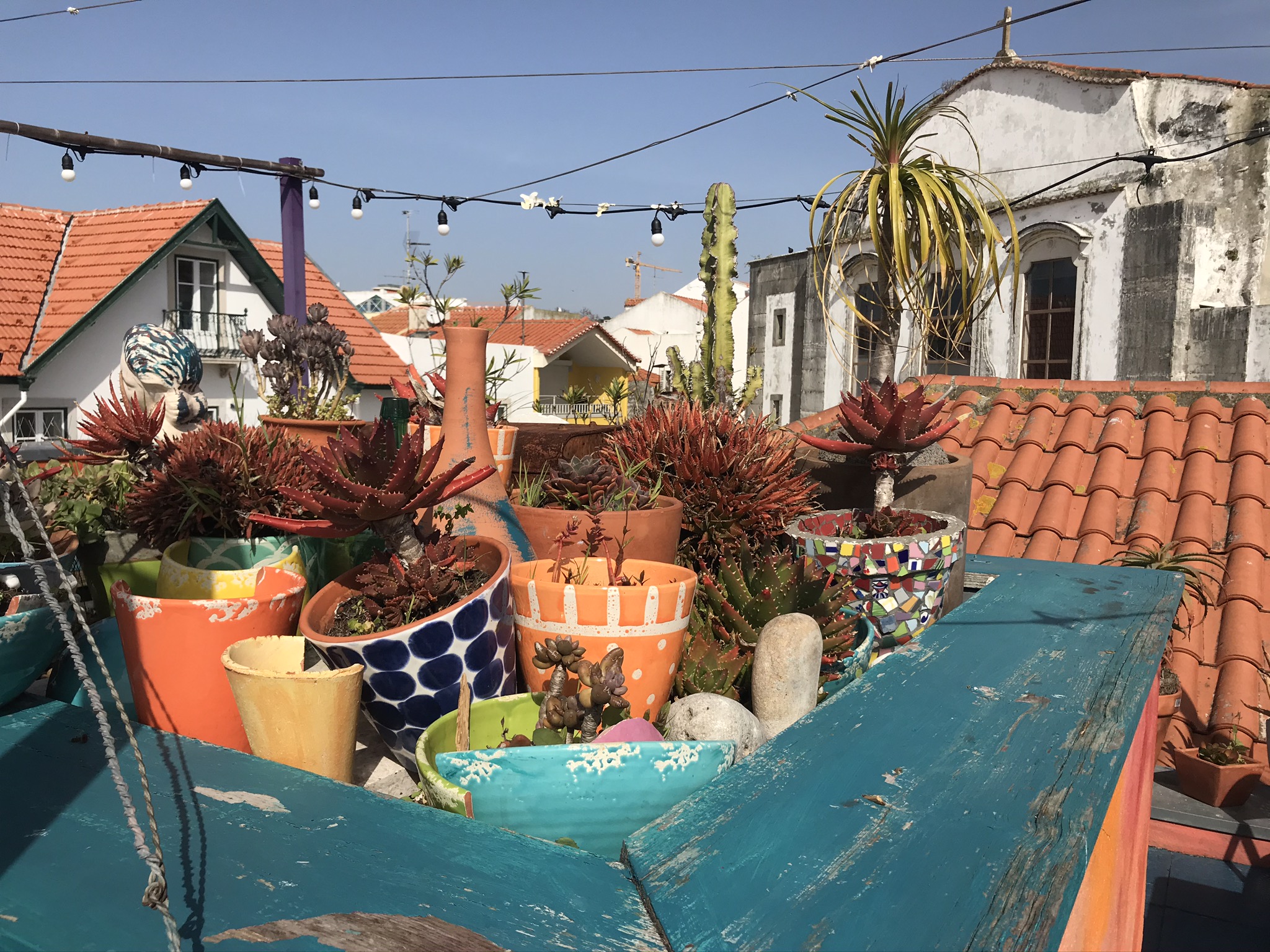
Roof top restaurant – The House of Wonders 

These three days were packed with visits to various places. We visited the Museo Berardo where we had an interesting guided tour of a contemporary gallery, my knowledge of contemporary art is very limited, so it was very helpful to have the guide explain the pieces in the gallery. I left with a very different view of these types of artwork than when I went in. We also visited the Paula Rego exhibition at the Casa das Historias which showed a vast collection of her sketchbook work as well as some of her final pieces. I found this exhibition to be extremely inspirational and relative to my studies. I like that she used her art to get a message across, mostly political and quite controversial. It was great seeing her sketches the line style she used the mediums and her experimentation.


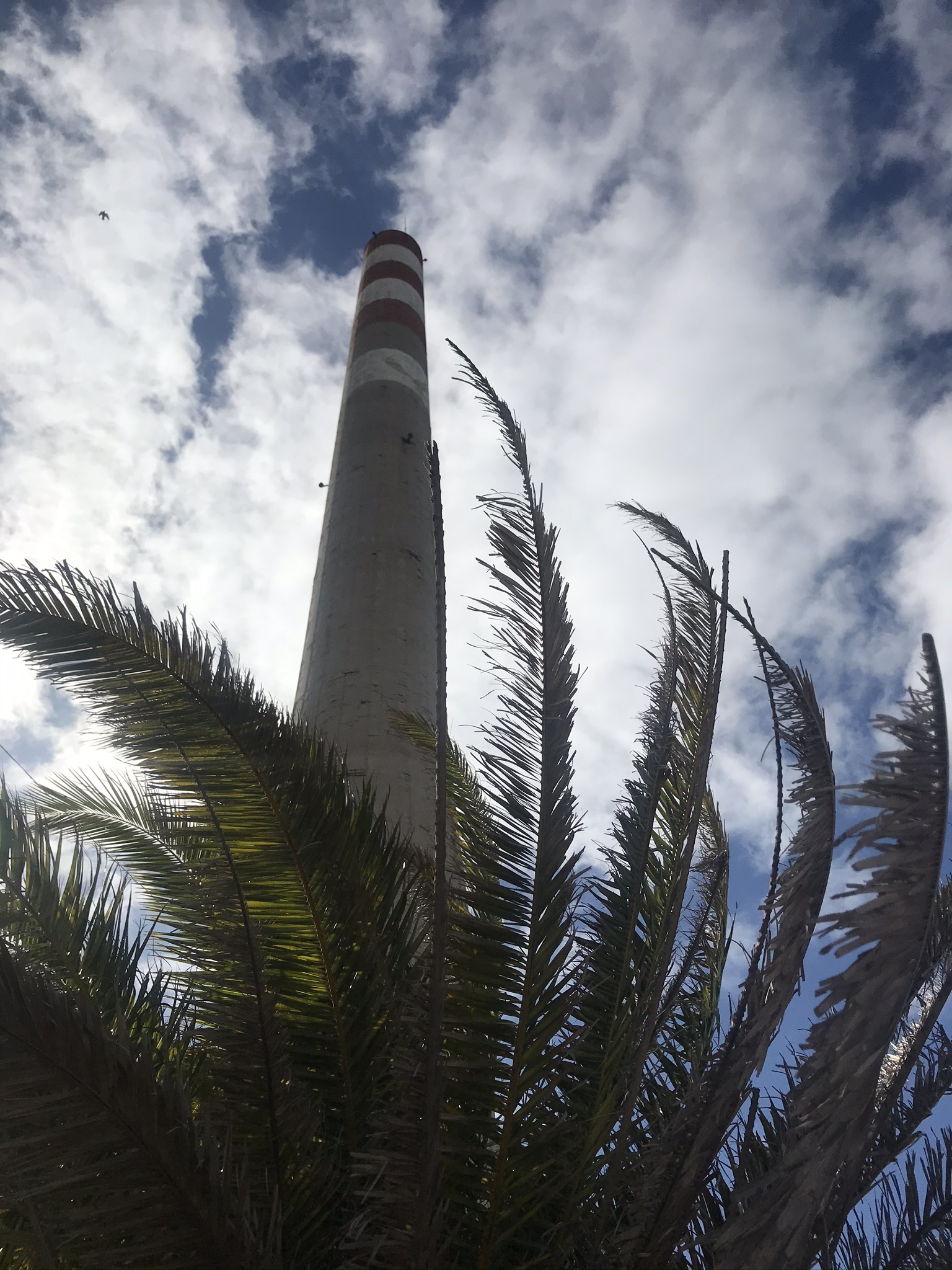
We got to see some beautiful sites including the botanical Gardens which hosted an array of cockerel’s and hens, Peacocks, ducks and terrapins, the castle on the sea which was like something out of a fairy-tale with its little beach cove, a harbour and PADA artist in residence in Barreiro, who gave us access to restricted industrial estate that had incredible views across the water of the whole city of Lisbon and a great many thing to draw.

My PADA sketch
My sketch at PADA

I really enjoyed meeting my fellow students and tutors. We ate amazing food, had a great time with plenty of laughs and I learned a lot from them all and from our visits as well as the guides from the museums. I got to push myself out of my comfort zone a little bit and try new things and it was very interesting seeing my fellow students work and the ways that they approached this. I came back very excited to get back in my studio and am looking forward to incorporating the things that I learnt on the study visit into my future work. I hope to stay in touch with the other students that I met and will hopefully see them again at other study visits. The tutors did an amazing job of organising the trip, giving us a great experience that I will treasure.  I had such a great time and am so glad that I went, I really hope that OCA runs more of these types of study trips.

IMG_8808
Photo at PADA – Property of Ashley Mclaughlin

Gallery visit – David Hockney Exhibition

I went to visit the David Hockney exhibition at the Light Box gallery in Woking, Surrey today. He’s not an artist who’s work I knew of, although I’m sure I’ve heard the name before.

I was impressed by how varied his work was. He had oil pairings, inkjet painting that he’s done when inkjet was first released. He had ink line drawing work and he had even experimented with pressed pulp drawings where he made his own papers, incorporating the image he wanted to make into the process, so that the pressed paper itself was the piece of art.

They exhibited a letter he had written to a friend, where he sounded extremely happy and excited about his work and what he had been learning during his experimentation. This was a nice glimpse into his thoughts about how he felt about his work. I really liked his experimental style. But the one thing I told away from the visit was that although some of his works were perfected to a high level, most were not. Most of them had brush marks, you could see the pencil under-drawings, some looked half finished and if an artist today released his inkjet art I don’t think it would go down so well. But he was incentive with the new materials he had at the time, he was exploring and experimenting and was not afraid to make a ‘bad mark’. I remember seeing the same things when I went to the Comic Museum in London. The work was amazing, but they too had left brush strokes or felt marks and made errors that they the cut out new paper, placed it over the top and repairing the section and used stark white highlights that look like they had been painted in tipex.

After the visit, when I was reflecting on my own work and working practices I realised how hard I am on myself and my work. I am always striving for perfection and spend a lot of time making sure there are no brush marks and lines that aren’t in the wrong place.

I guess what I’m learning is that perfection is overrated and that I really should let go a little and experiment more. Which ties in very nicely with my next exercise which is to create a sketchbook with different materials or types of paper and using different mediums experimenting the different effects I can make. I am quite excited about this exercise as this is something I never do. Although I have been using and learning more and more mediums i.e. watercolour, gouache, pastels, I will always use the appropriate corresponding paper and I have not pushed past that and tried more unconventional materials. I am looking forward to doing more gallery visits to get inspired and see the way others worked.

Artists I Love: Dorothea Tanning

Whilst researching for my 1950’s project I am starting to come across some artists that are new to me and that I like the style of their work, so I thought i’d start this page off. I am quite fussy with art, there’s really not a lot that I like. Perhaps that’s because I like a very specific type, I’m not quite sure. I do like realistic art and very much admire the amazing skin tones and texture I’ve seen at the Tate Modern before. Perhaps creating this section of the blog will help me pinpoint some kind of theme in the ones I do like.

Dorothea Tanning, ‘Eine Kleine Nachtmusik’ 1943

Dorothea Tanning, Eine Kleine Nachtmusik 1943. Tate. © DACS, 2019. Source: http://www.tate.org.uk

I really like this painting. I find it very interesting and I can spend a long time looking at it, wondering ‘what is going on’. The limited colour palette and effective use of light and shading helps make the image more dynamic and adds depth.


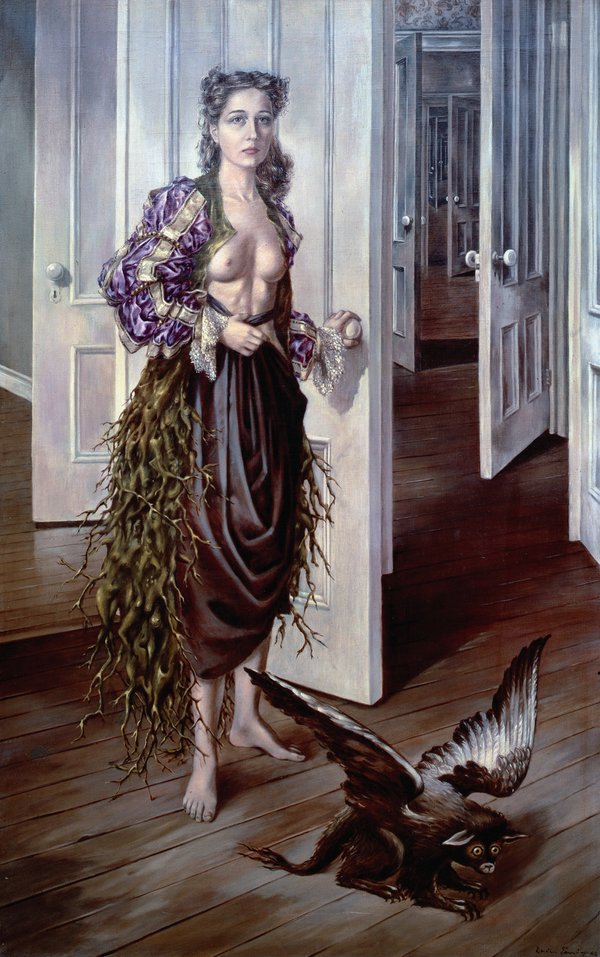
Dorothea Tanning Birthday 1942 Philadephia Museum of Art. 125th Anniversary Acquisition

Dorothea Tanning Birthday 1 942 Philadephia Museum of Art. 1 25th Anniversary Acquisition.
Purchased with funds contributed by C. K. Williams, Il, 1 999 DACS, London. Source: http://www.tate.org.uk

I also love this one, her work is very dynamic and interesting and imaginative.


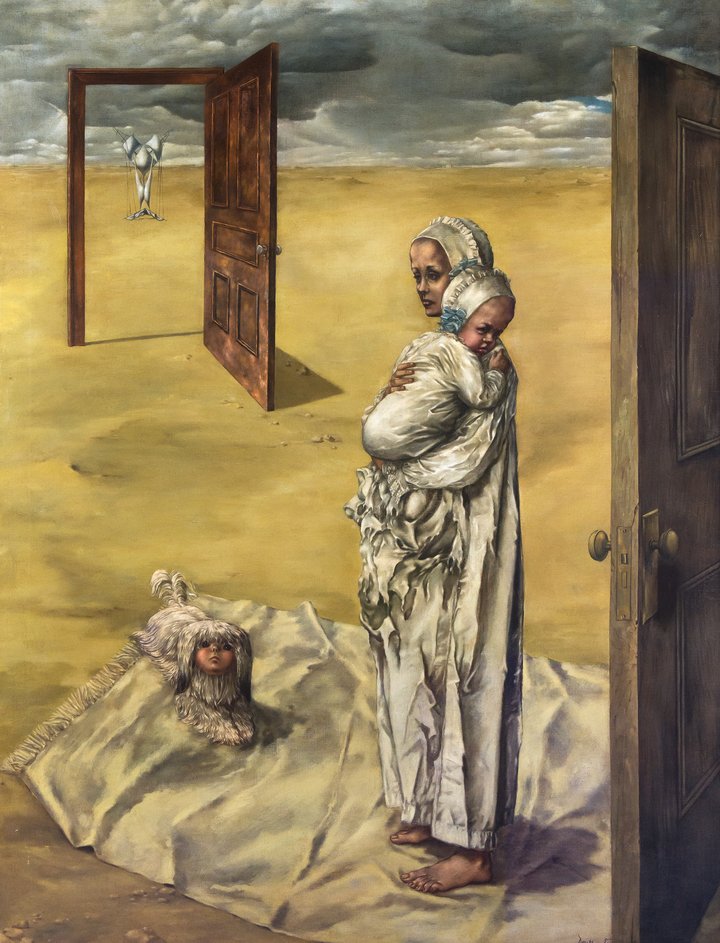
Dorothea Tanning Maternity 1946-1947 Private Collection

Dorothea Tanning Maternity 1946-1947 Private Collection ©DACS, London. Source: http://www.tate.org.uk

This one reminds me of how I envisaged the doors when I read the Stephen King Books, ‘The Dark Tower’.

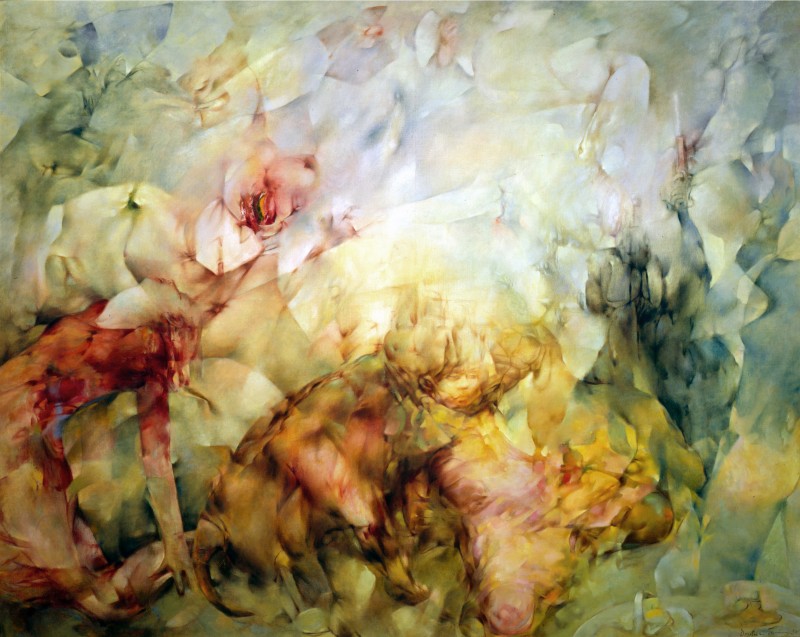
<i>Midi et demi (Half Past Noon)</i>

Midi et demi (Half Past Noon), 1957 Source: http://www.dorotheatanning.org

This one is so different from the previous three. I just love the colours and that the

re seems to be something going on there, I can see bodies and faces, it’s very difficult to work out, but that makes it all the more interesting.