Re-work of Assignment 5

After receiving my tutor feedback for this assignment I wanted to implement some of the changes she had mentioned and push my illustrations a little further. I really enjoyed working on this assignment am quite keen to keep developing these characters and see how they evolve over time, as I learn more and more during the duration of my course.

Reflecting on my research

My tutor had asked me to take time to consider my research on comic strips and discuss what I had learned about this area. When I used to get the train in London, I would read the comic strips in the Metro Paper, my original layout idea was inspired by this. I was thinking of displaying my images in one continuous strip so that they could be intended for a space at the bottom of a page in a newspaper. However, when I tried this I realised I had too many images to work this way, as the images would end up too small in order to fit across the page. Therefore, I decided to place them in two rows instead, after looking at reference of comic layout.

My research lead me to look at and consider different types of layouts and think about how I could explore this further in my next modules. The comics I looked at, such as newspaper strips, Garfield and Beano tended to have evenly spaced lined boxes or could have no spacing at all. Some of the characters were drawn extending outside of the boxes. Boxes tend to be uniform or various sizes. However, they were always clearly defined and neat. This makes them easy to read. As this is the first comic strip I have done, I decided to keep mine to a simple, clean layout. This was a challenge in itself to get everything evenly spaced and lined up.

The comic strips I looked at, tended to have a simplicity in the visual information contained. They tend to be line drawings, some black and white and some with colour. Most contained backgrounds. My original images did not contain a background so I added this to see how it would look. My tutor had also mentioned this is something I should consider. I much prefer the versions with the background. It gives the strip more substance and context and adds more life and colour into the images. It also shows the cats being inside a house which helps give context, for example, if my comic strip was called, ‘Toby gets a new friend’ etc., which is the idea behind my narrative, it should be clear what is happening in the comic. I could have shown this within the illustrations by perhaps adding a bow to the neck on the first image to give the impression of the female cat being a present. When I showed my DSA study tutor, she had said that because they didn’t have a background, she pictured a background for herself and imagined the cats were in her home. I found this quite intriguing and that got me thinking about the audience and how much of their own imagination they contribute to illustrations they see. Before I re-worked these I did a lot of sketches to learn comic styles using two new books I bought. These are; Sha, B. (2015) Doodle Dogs and Sketchy Cats: fun and easy doodling for everyone. (First Edition) Ash, Ohio: North Light Books. and Hart, C. (2009) Humongous book of cartooning. New York : Lewes: Watson-Guptill Publications ; GMC Distribution [distributor]. From these I learned different head shapes, how to draw different expressions and emotions and I learned to be more confident and bold with my shapes and move away from realism. I did tests to see how different line styles would look, but decided to stick with the line style I had originally used as I liked the soft effect better for this particular set of images.

Another thing my tutor had mentioned was that all my images were from one view point. I looked at the examples she provided as well and revisiting my composition and viewpoint exercise and re-worked some of the drawings so that they included a more varied range of viewpoints. I think this made it harder to create clear context, however, I think as a whole the story can still be read as intended. I am glad I tried this as it has made me think differently and include another dimension to my illustrations.

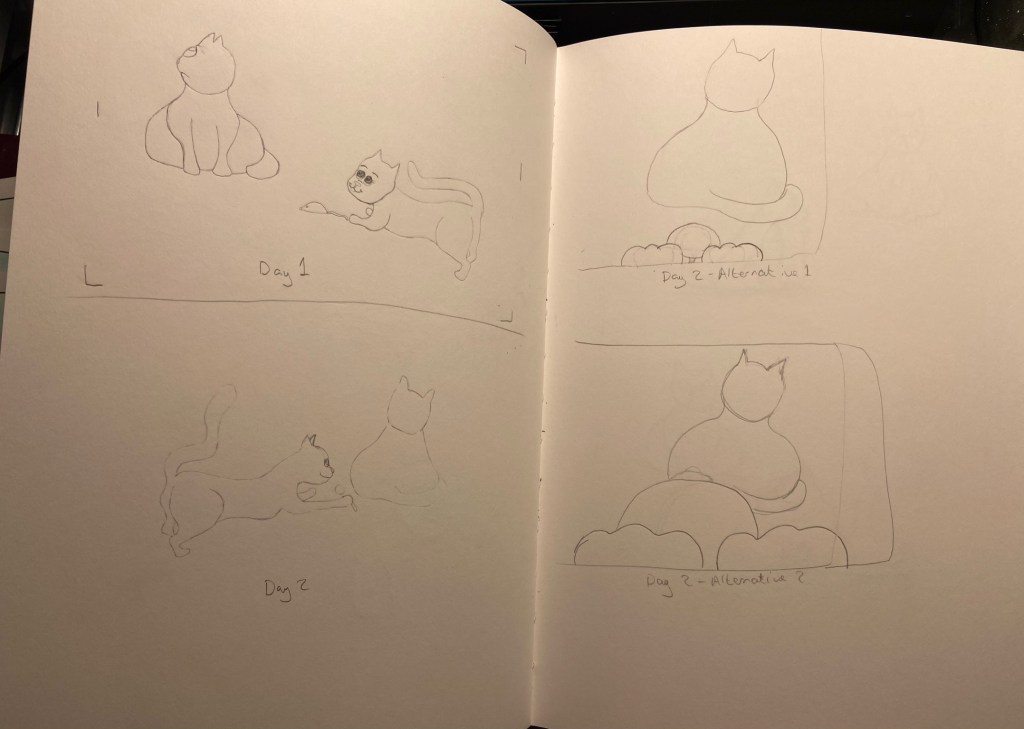
The stories in comic strips are told effectively without words by exaggerating expressions and keeping the images simple and not too busy to distract from the intended point of each frame. A comic strip is a continuation of an evolving story, that each image builds upon. I did show my images to other students and family to check that the message of my comic was well received and the feedback was positive.

I worked in watercolour and then finished the images in PhotoShop.

My Final Images – Photographed version – Layout variation
Final Version – Closer Spacing

I photographed my images to get them into photoshop, I do not have my camera and lighting set up with me at the moment and therefore had difficulty getting my photos clear enough with just my phone. The paper texture is very clear and the images have a grey hue that is not in the originals. Despite altering the colours in photoshop I could not find an effective way to correct the grey hue nor the texture, without losing the image quality. I therefore also did a second version where I scanned the images, however the scanner bleached the images. Even though this corrected the paper grain issue, like I had expected, it left the images with limited colour. I lowered the brightness, but still preferred the original painted version as I was unable to get the pink colour back in the images.

Final Images – Scanned version original
Final Images – Scanned version Colour adjusted
Final Image with Title

Conclusion

I learned a lot by reworking this project. However, I can still see much room for improvement and space to push this further. Part of doing so would require me to learn and improve, as some of the things I would want to do, I do not know how yet or else cannot quite get my hand to do. I am overall pleased with the outcome and much prefer this version of my comic strip. I am grateful for my tutors advice and direction on how I could improve my work and am excited to take this knowledge onto my next module.

Mediums sketchbook experimentation

On my feedback from our my second assignment from my tutor. She suggested that I start a few smaller sketchbooks for each medium so that I can explore painting techniques. Painting is something I am new to and I am learning through doing as I go along. However, I have no technical knowledge of how to paint. This is something that I have been meaning to learn more formally and I thought that my tutor’s suggestion would be really great for me.

Gouache

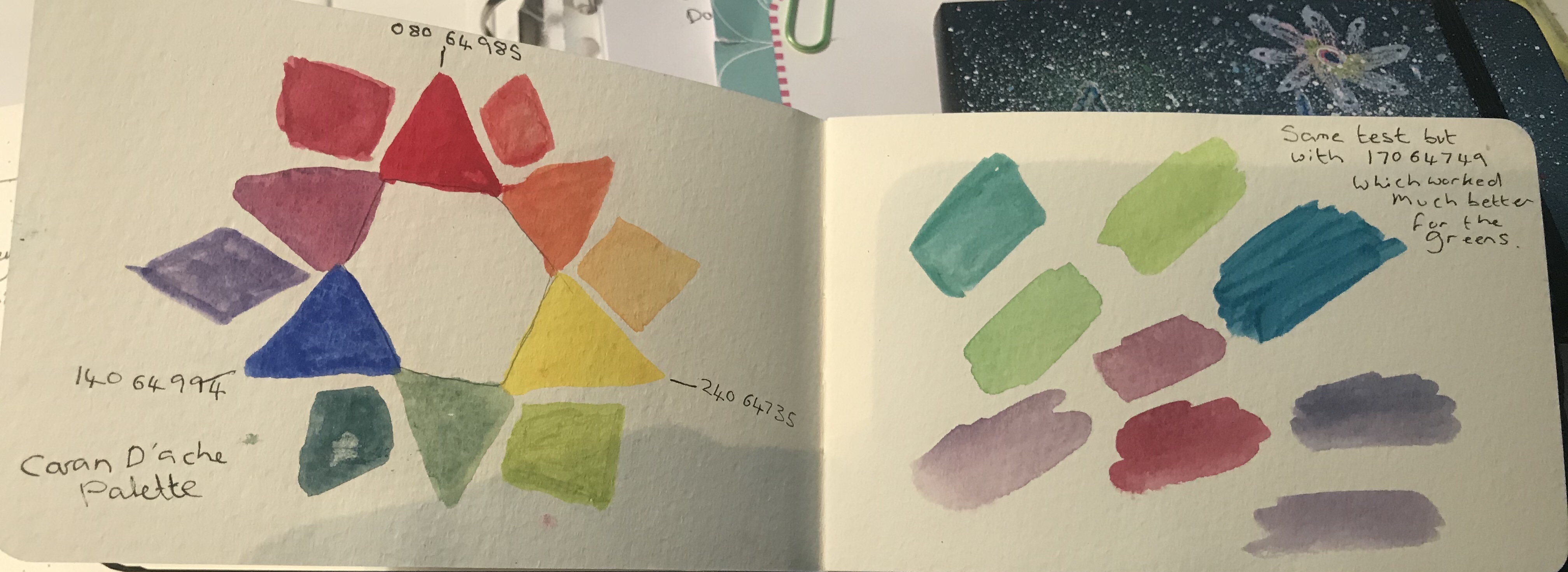
I purchased three A6 sketchbooks, one for gouache, one for acrylics and one for watercolour. I started by using the paints that I have, to paint colour wheels. I found a reference colour wheel online and used that to compare the colours that I was mixing. I tried to match the colour of the reference colour wheel each time, with each different set of paints. The reason for this was so that I could test the difference in the paints and see what happens when I try to mix same colours. I found that although some of the colours mixed as expected, when I mixed the secondary colours, the Greens did not always seem to come out as I had hoped. As the image below shows on the second page, I used the different blues and yellows that I had, to see how they mixed and whether I could match my reference colour will with those paints. Quite often these did mixed better.

Gouache
Acrylic
Acrylic

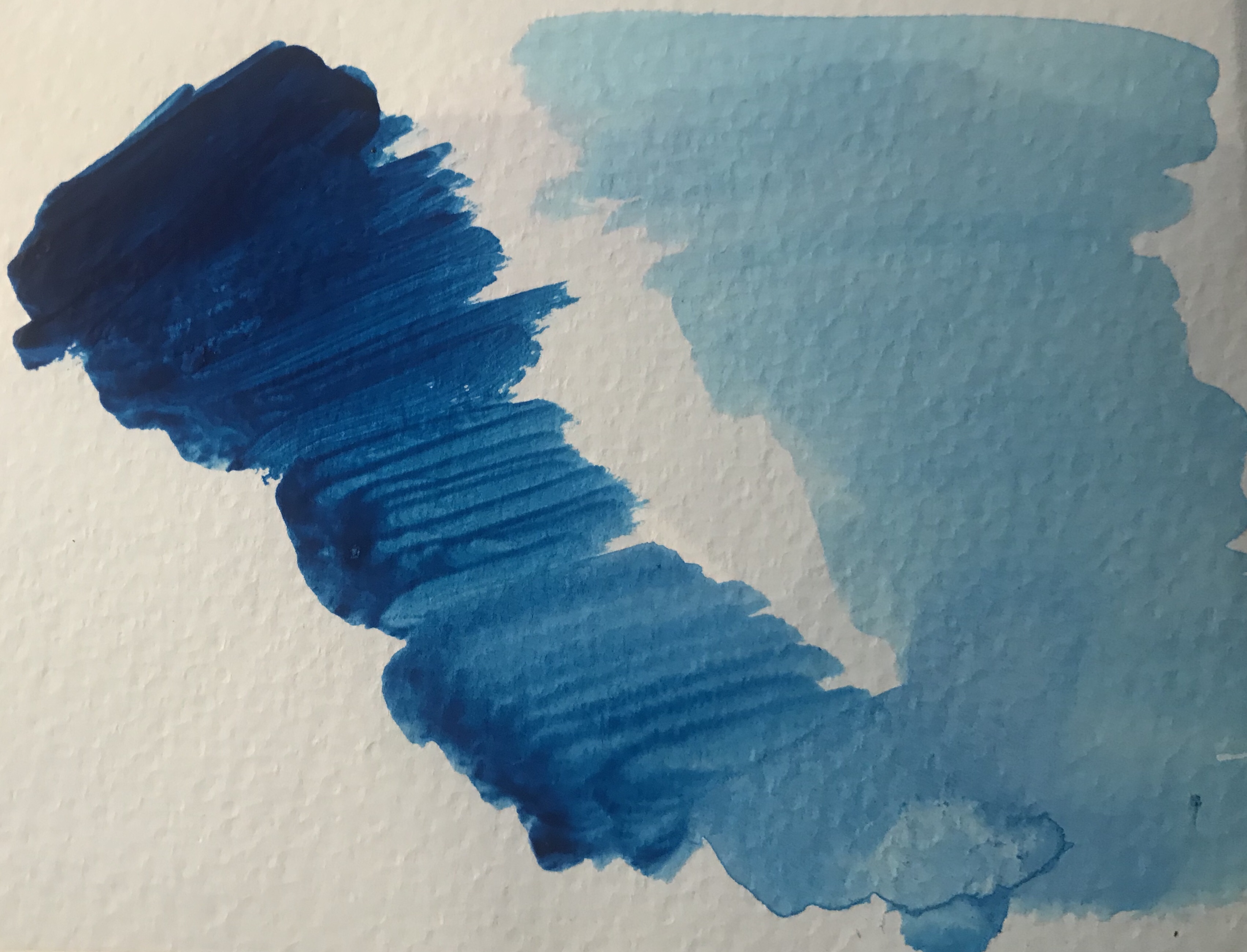
With the above image. I was testing the consistency of acrylic paint. I have successfully used acrylic inks. The however, I have not used acrylic paint before on paper. Acrylic paint is not something I’m used to and I was unsure as to what the consistency should be as I tend to see people painting rather heavily with this paint and not adding much or any water. Here I tested the acrylic paint neat and then gradually added a little more water until I got to a nice light wash. I really like the wash as the colour is very vibrant still and I like the way it looks on the textured paper.

With the image below. I was actually inspired by the paint marks on my kitchen-towel left from when I was doing my colour wheel. I liked the combination of colours together and also the overlapping lines. Therefore, I decided to use the leftover paint from my palate to experiment with, rather than wasting them. This was very therapeutic and pleasing to do. I like the way the colours overlap each other, but you can still see through them, almost as if this is glass or transparent plastic. This blue mark in the centre reminded me of a stained glass window.

Acrylic
Acrylic
Watercolour
Watercolour

After a recommendation from a friend. I got the book ‘If you’re bored with watercolour, read this book’ by Veronica Ballart Lilja. In this book. The author shares techniques on how to create textured paper. I had heard before that you can use salt on your watercolours and it soaks up some of the paint, leaving patterns underneath. It was also suggested in this book, so I thought I would give it a go. For this one I used table salt because at the time it was all I had. I thought that perhaps this would not work as well, as it would give me just small particles of salt. Therefore, I assumed a very even pattern would be left behind. However, as you can see, this is not the case. On some parts of the painting, it did just stick to the page and did not create much paint lift. On other parts of the page, it created striking patterns, as in the top right red. I really loved this section and feel like I can see an ostrich in that splodge. I was quite struck by how different every patch came out. There seemed to be no repeating pattern happening and I wonder what conditions each patch of paint was in at the time I added the salt, and whether I could replicate the effect easily. I imagine that this is affected by how wet the paint is at the time of adding the salt, how thick the paint is and perhaps even some colours may react differently to the salt. These are things that I intend to explore further, as well as trying this again using rock salt both whole and partially crushed to see what effect that has.

I have enjoyed my experimentation so far and endeavour to keep adding and experimenting in these sketchbooks.

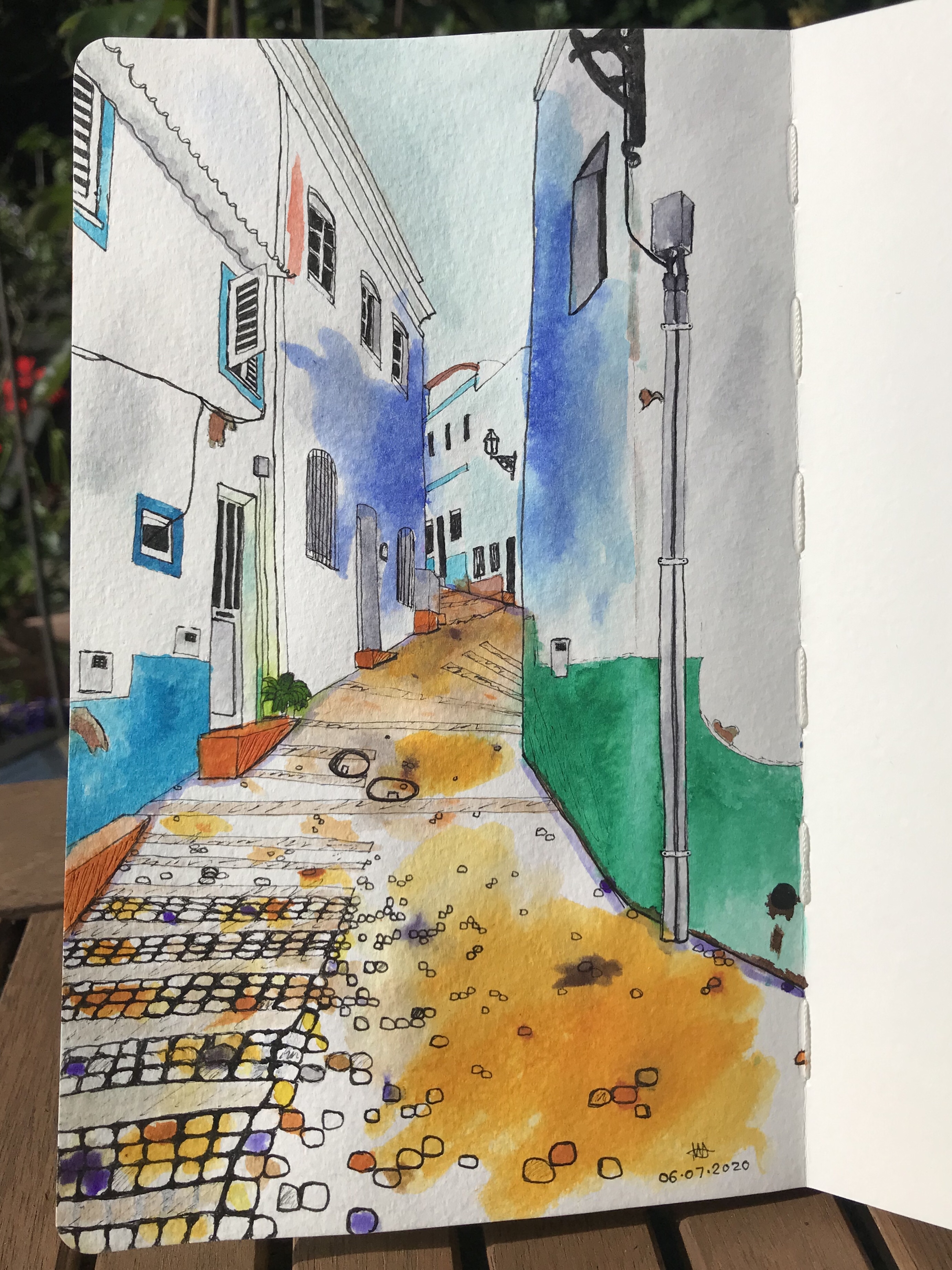
A painting I did in gouache – I really love this painting, but i didn’t plan how I was going to do the floor very well and I realised after starting, that I couldn’t draw every stone. The floor also seems to slope down towards the right, which was not intentional. The floor was meant to veer around to the right and continue up hill evenly on both sides.
Another gouache painting of a Lizard that I rescued from the cat in the garden. I took a few photos before releasing him. Detail drawn with ink. It was very tiring drawing all the scales, and I realise that next time I should do the scales slowly over a number of days or use a technique where I am not drawing every scale, as my scales do not graduate into each other well. I also discovered an easier way half way through, which made it much quicker, but then the scales did not match up with my first batch. I am going to finish painting this one regardless for practice and also because this is in my sketch journal.

Lisbon group collaboration project

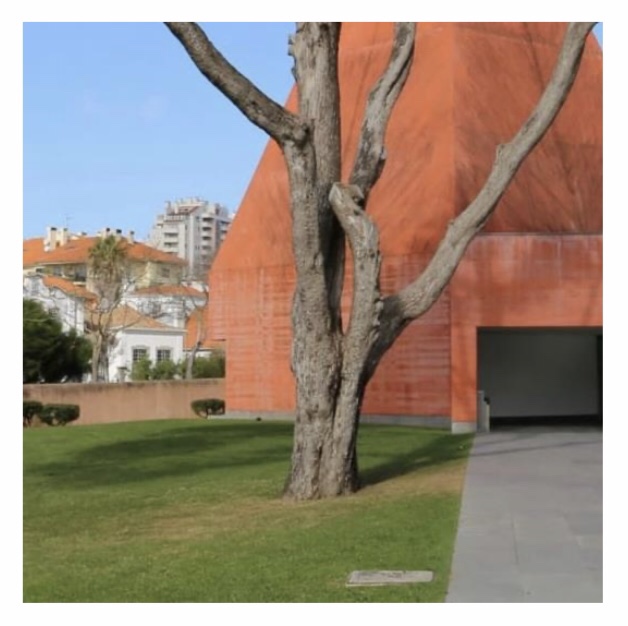
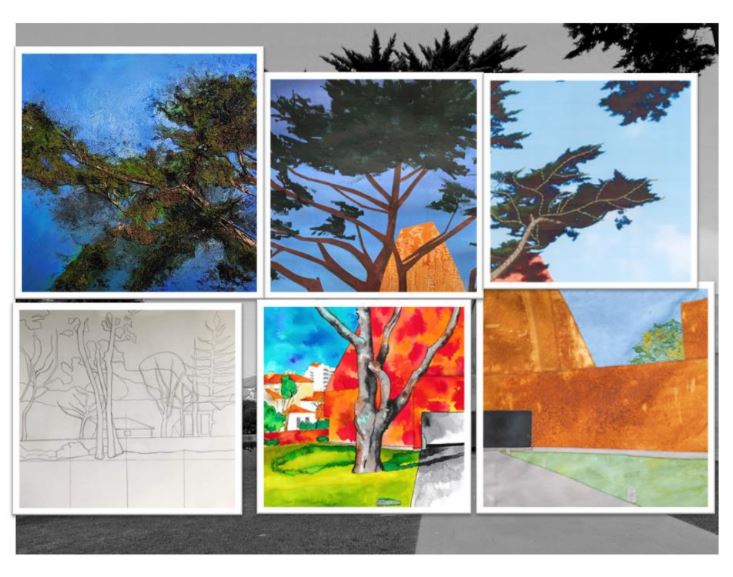
I recently participated in a group collaboration project with 6 of my fellow students from the Lisbon trip. This was led by one of the students, Martine Elliott by one of the students. For this group project. We took a photo that was taken during a Lisbon trip of the Paula Rego Museum and divided this into six sections. We each picked a section with the idea that we each used whichever mediums we wanted to recreate the tile that we were given. Once we had all completed our sections. These were then handed back to the student leading the project, who then pieced them together to create one piece of work.

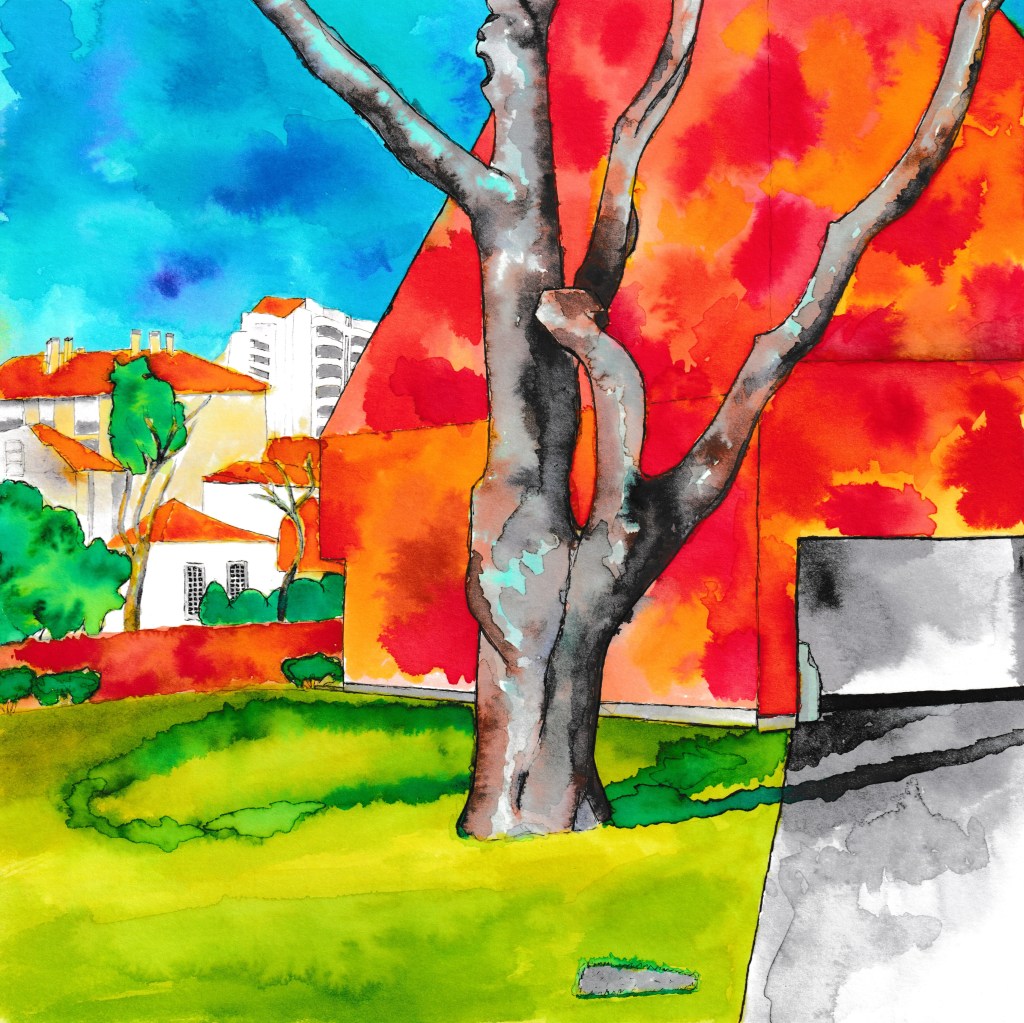
My Final Piece

I really enjoyed doing this collaborative project, partly due to not feeling any pressure for it to be good, as it was not going to be marked and was purely for fun. I therefore decided to take what I had learnt in Lisbon from my tutors and fellow students and apply that to this painting. One of the things I mentioned in Lisbon, is that I have not been very explorative in my artwork. I wanted to set myself the task of pushing my boundaries and pushing myself out of my comfort zone. Whilst in Lisbon, we experimented as a group with India ink and made a big old mess! This was really fun and made me realise that sometimes I need to experiment and to do artwork that I do not need to take so seriously.

My arrival back from Lisbon was timed perfectly with my mark making project for key steps, part two. Inspired by Lisbon, I completed my mark making project and then did this group collaboration. For this painting. I used ‘Viviva Colorsheets’ to paint with which are described as super vivid, transparent watercolours. They come in a paper pad rather than paint in pots which is very handy for carrying around when on location. I found these colours to be extremely bold and bright and was inspired by these to create the colour palette that I did.

Once I had finished my painting. I was not so sure about the building and wondered if I should have painted it all one shade, so that the sky and the tree stood out more. However, now that I look back at this painting. I do not feel so overwhelmed by the brightness of the building and I do see the other elements in the painting as competing. This was very enjoyable to make and these are definitely techniques, I would also like to try again, perhaps on other assignments. I particularly liked the technique for the sky and I really liked the tree which was my main focus, with my plan being to incorporate blues into the highlights, as opposed to using more realistic colours. This did not take me much time to complete, I think this is partly due to me not being so precious with it.

I choose this part of the grid as it was the most interesting to me, due to it having varied subjects i.e. buildings, tree, hedges.

My grid selection
The original photo of the Paula Rego Museum
The Finished Grid

Due to the success of the grid collaboration. We are now embarking on a second collaboration project led by one of the other students in the group. I am looking forward to participating in this next collaboration project.

Exercise: A subjective drawing

For this exercise I had to take an object and write a down a series of words to describe it. These words would need to describe its particular qualities. The object I chose was a glass of gin and tonic with fruit in it. The words I chose to describe it are; refreshing, fruity, bubbly, cold, wet, delicious.

We were then asked to choose one word from our list as the basis of our idea and explore the idea visually by making a mood board. Due to the Covid 19 lockdown. I have limited materials with which to make a mood board. However, I do have some travel magazines and National Geographic magazines left over from my last mood board. Therefore from these and also from searching the Internet, I managed to find the images I wanted for my board.

My chosen object

The word I chose to use for my moodboard was ‘refreshing’. I looked through magazines to find images that represented this word. Once I had finished with the magazines, I did a web search to find other images that I wanted for my board, such as the cucumber and mint leaves.

Working on my moodboard
My finished moodboard

Once I had finished my moodboard I started adding the colours, textures and materials identified during my exploration to my line drawing.

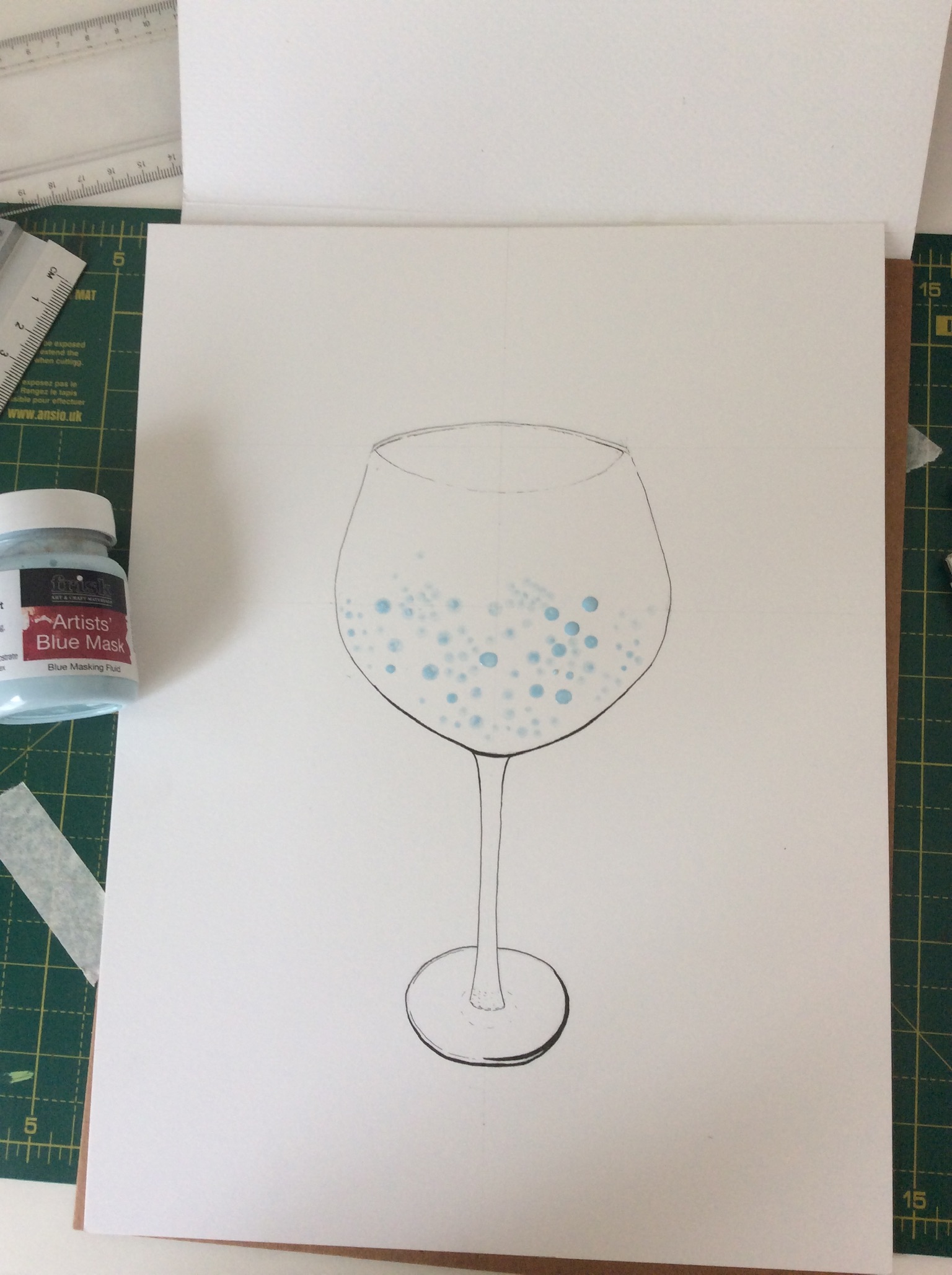
My line drawing

I used artists, masking fluid to keep the area where the bubbles were going to be clear and started to paint. I used Viviva Colorsheets to paint with as I love how vivid the watercolours are.

My Final Drawing

I am pleased with my final piece. There were many elements to this drawing that were new and experimental for me, such as drawing bubbles and painting in less realistic style’s. This was the also the first time I have used masking fluid. I liked the freedom that this exercise gave me to experiment, as the drawing was subjective rather than objective. Therefore, this was a fun exercise. The only thing I would have liked to incorporate which I did not, is to have the effect of condensation on the glass. I feel like this would have reinforced the idea of a cold, refreshing beverage. I think this would have been quite difficult to draw on a technical level, but is something that I would quite like to experiment with, to see if I can find a way of effectively communicating that.