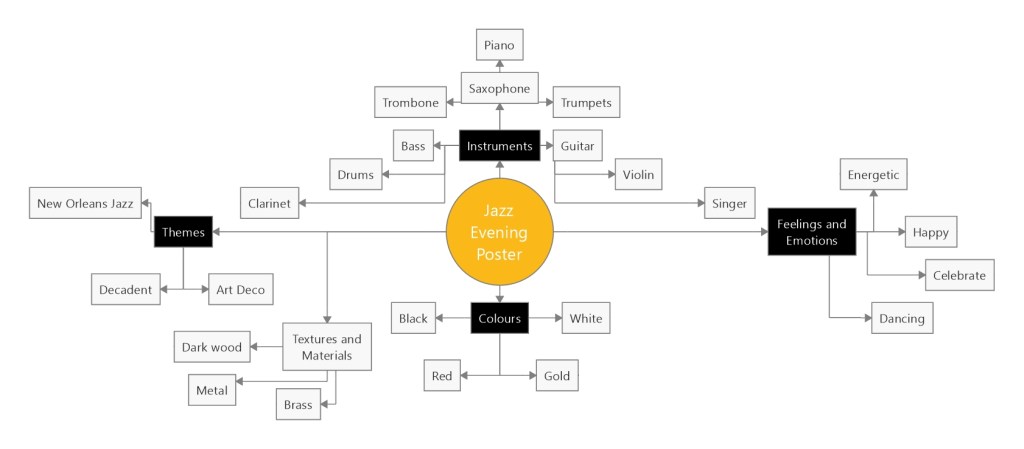
For my third assignment I chose the title ‘Jazz Evening’ for my poster. I started by doing a mind map of the things that I associate with jazz, which helped to give me a basis to start to trigger ideas. I really love the idea of going to new New Orleans and experiencing the culture there; of which music is a big part of. I decided to use New Orleans jazz as my concept and started to collect reference images. One of the first images I came across was a black-and-white image (as below), which had ink drip marks coming from the characters. I was inspired to try my own version of this and see where I could take it.
My moodboard
I collected images for my moodboard and realised that I really liked a simple colour palette. I wanted to have my poster combine old jazz vibes, but have the poster modern and crisp looking. For this reason I decided I would use modern text to make sure that my poster did not look dated. I collected images to use to for the poses of my characters from Adobe stock images. Quite a few of the ones I had found on my Google search were also on there.
Thumbnails
I started working on some thumbnails to develop my ideas. I was drawn to the thumbnails that included a group of individuals the most and selected my two favourites to try out as visuals.
Visual 1
Visual 2
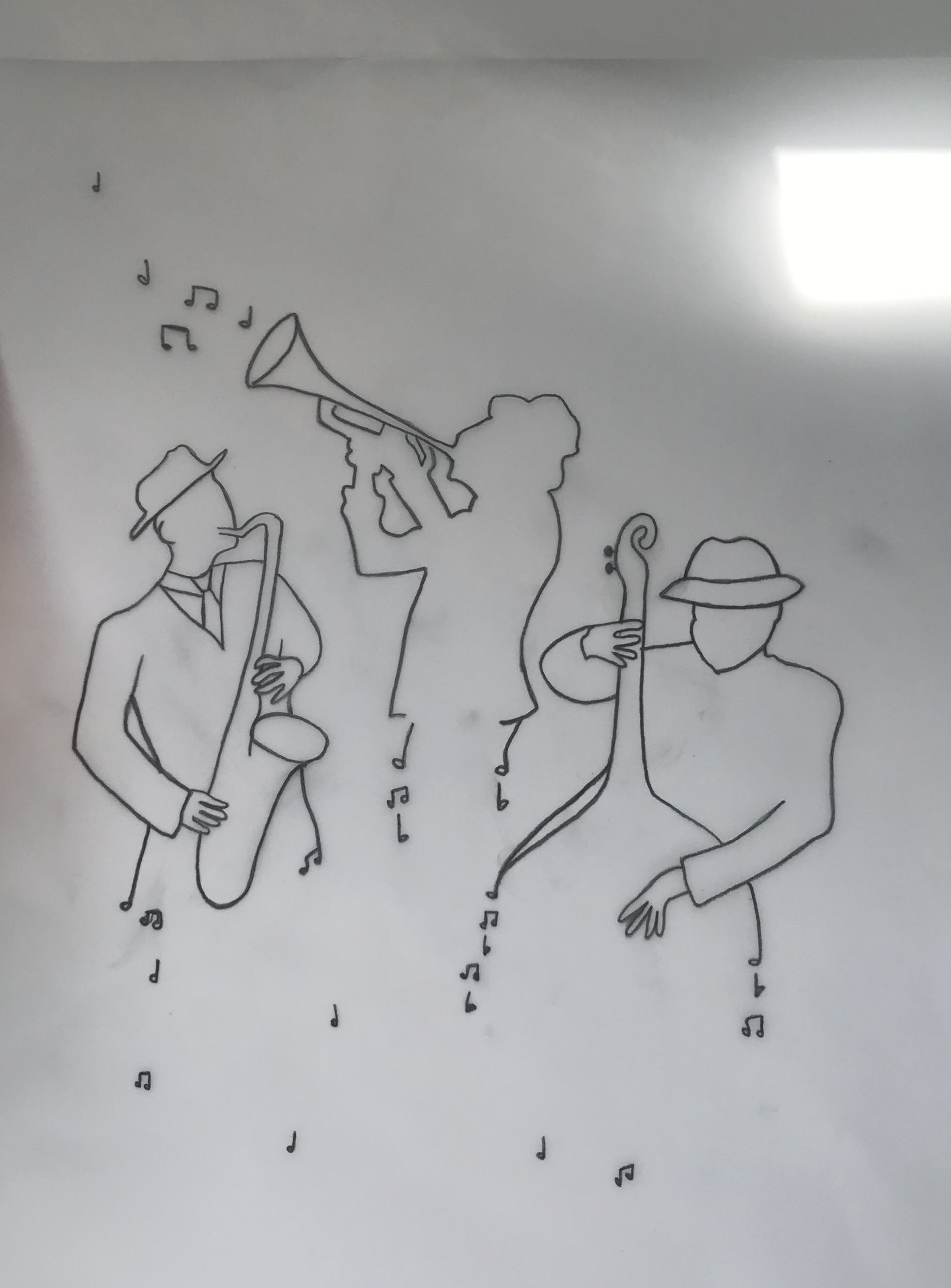
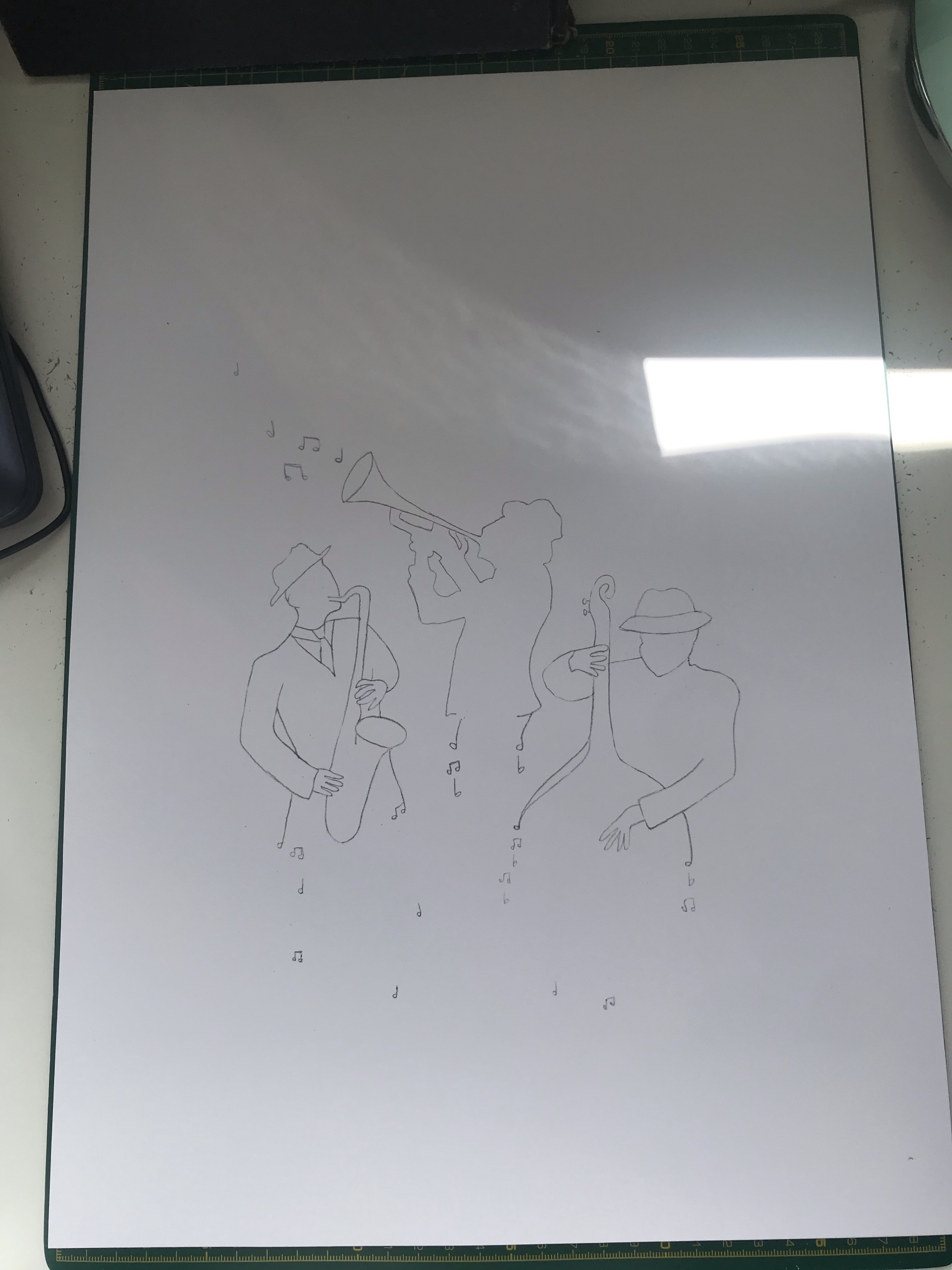
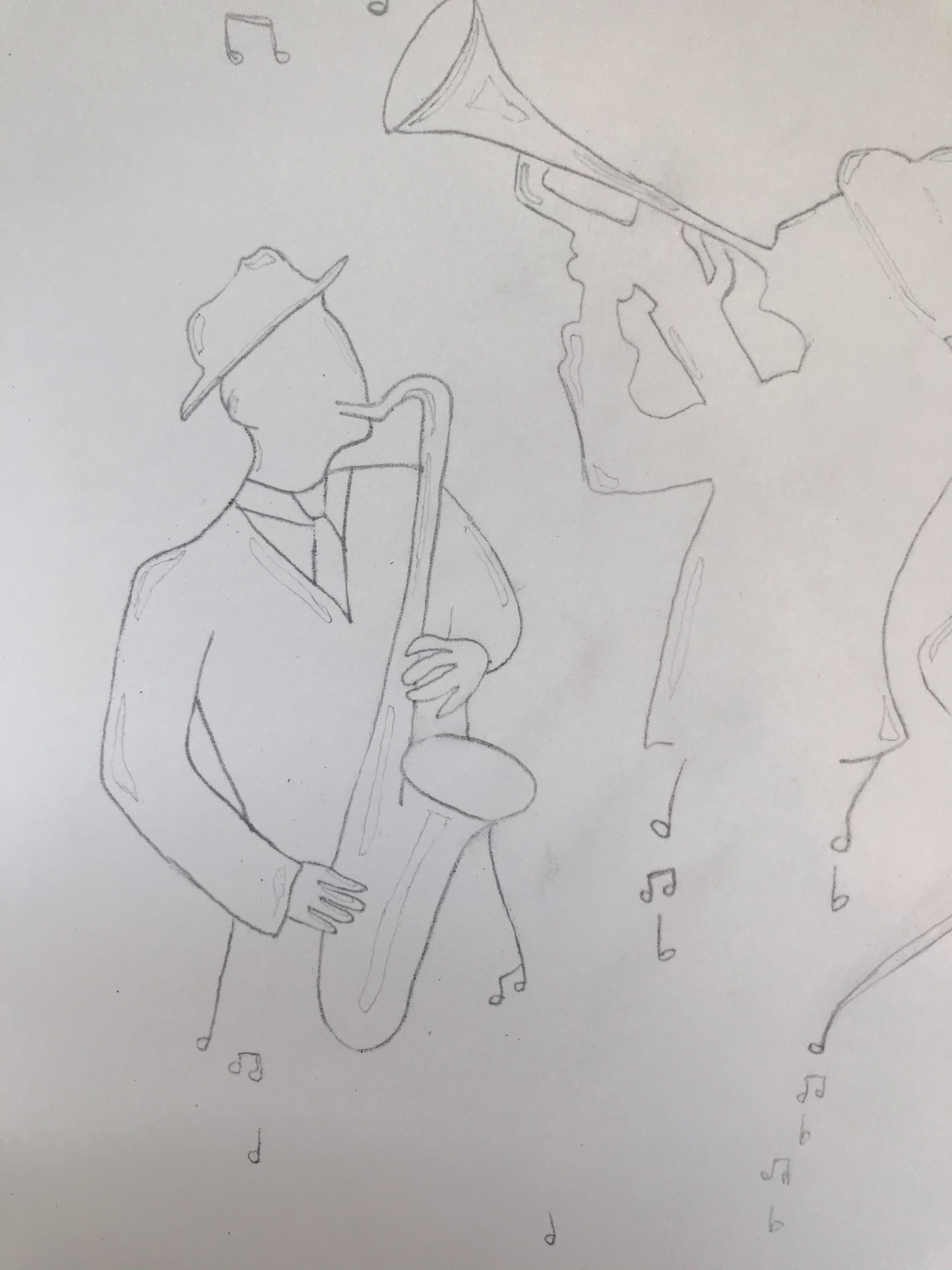
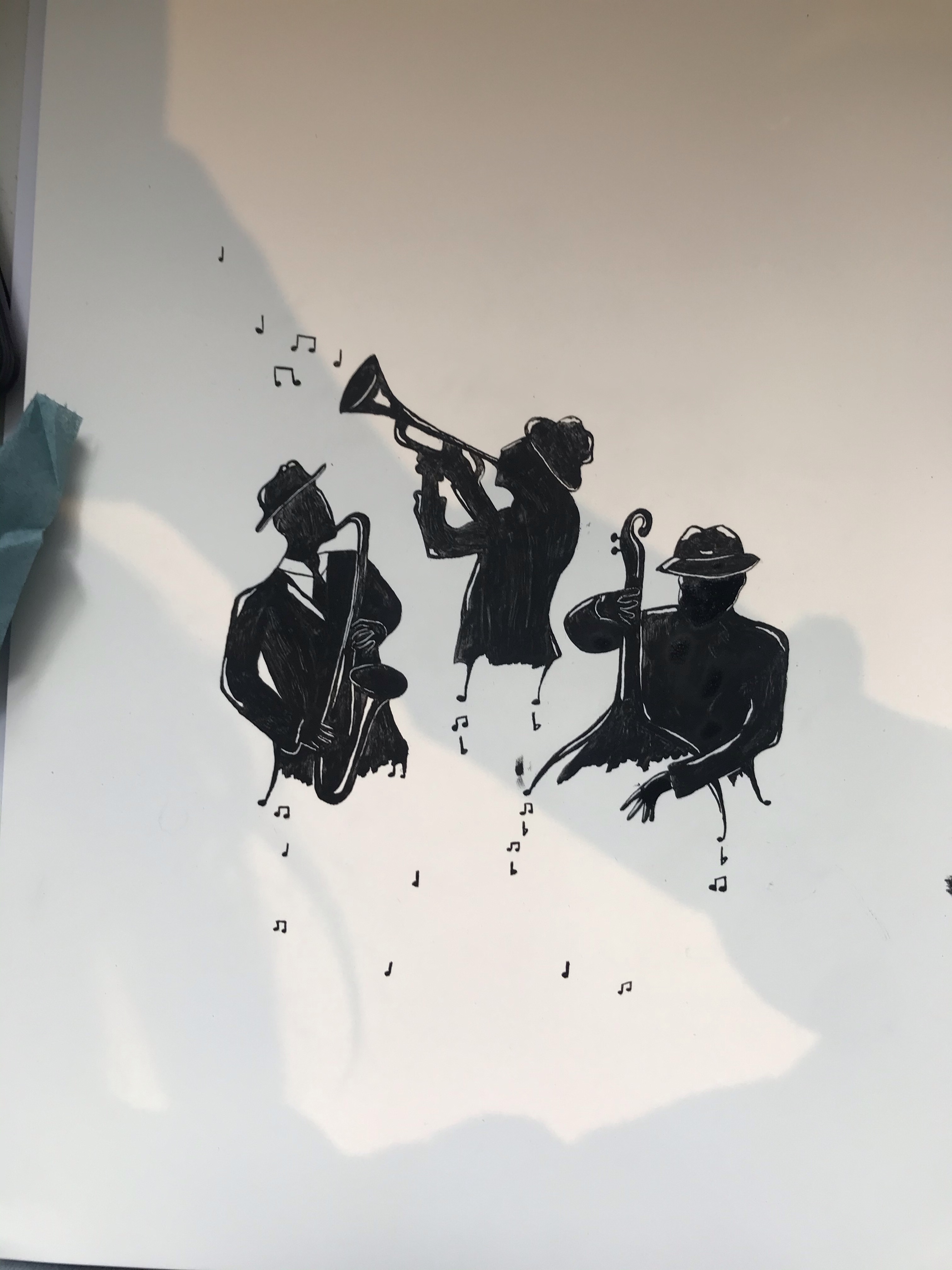
Though I liked the idea of having a pianist in my drawing for visual no.1, I did not feel that this would work for a poster and that the drawing had too much detail and too much going on. However, I really liked visual no.2. The design is more simplistic and stylised. I had done my visuals on A3 paper so was able to do a tracing of my chosen visual and used this to place my image onto fresh paper. I ended up doing three attempts of my final artwork. Originally I was trying to do this in India ink with dip pens on Bristol board, but the paper surface was disturbed when inking. Therefore, it was not working and I did not like the texture. On my second I switched to cotton watercolour paper to see if that worked any better. However, I was still not happy with the results. I ended up using acrylic ink on watercolour paper, using dip pens for smaller details and a paintbrush for the rest. I did ink the outline first in a technical ink pen. Before I got to my third attempt I kept making mistakes and this led me to think about my technique and process and rethink how I was working. I ended up going back and sketching in all of the areas that I needed to leave white so that I was not making decisions as I went and I had a clear guide of where to colour, and when not to. This lead me to think about the black and white exercise I had done previously and how much that also needed planning. I also worked from the left side of the page down and then across to the right so that I did not smudge my work. These were such simple things that I could have done from the beginning, but I guess not having done any illustrations like this before. I was not aware of these rookie mistakes. I have definitely learnt some good lessons from this assignment that have led to a more structured approach and forward planning.
Work in progress
My Final Illustration
I am really happy with my final illustration. Although there are a few things that I would possibly tweak now looking back and did try to tweak once I had put them in photoshop. However, I did not want to spend any more time on the ink drawing as it was a very tricky process and I was going to be putting it into Adobe Illustrator anyway where I could edit it further if need be.
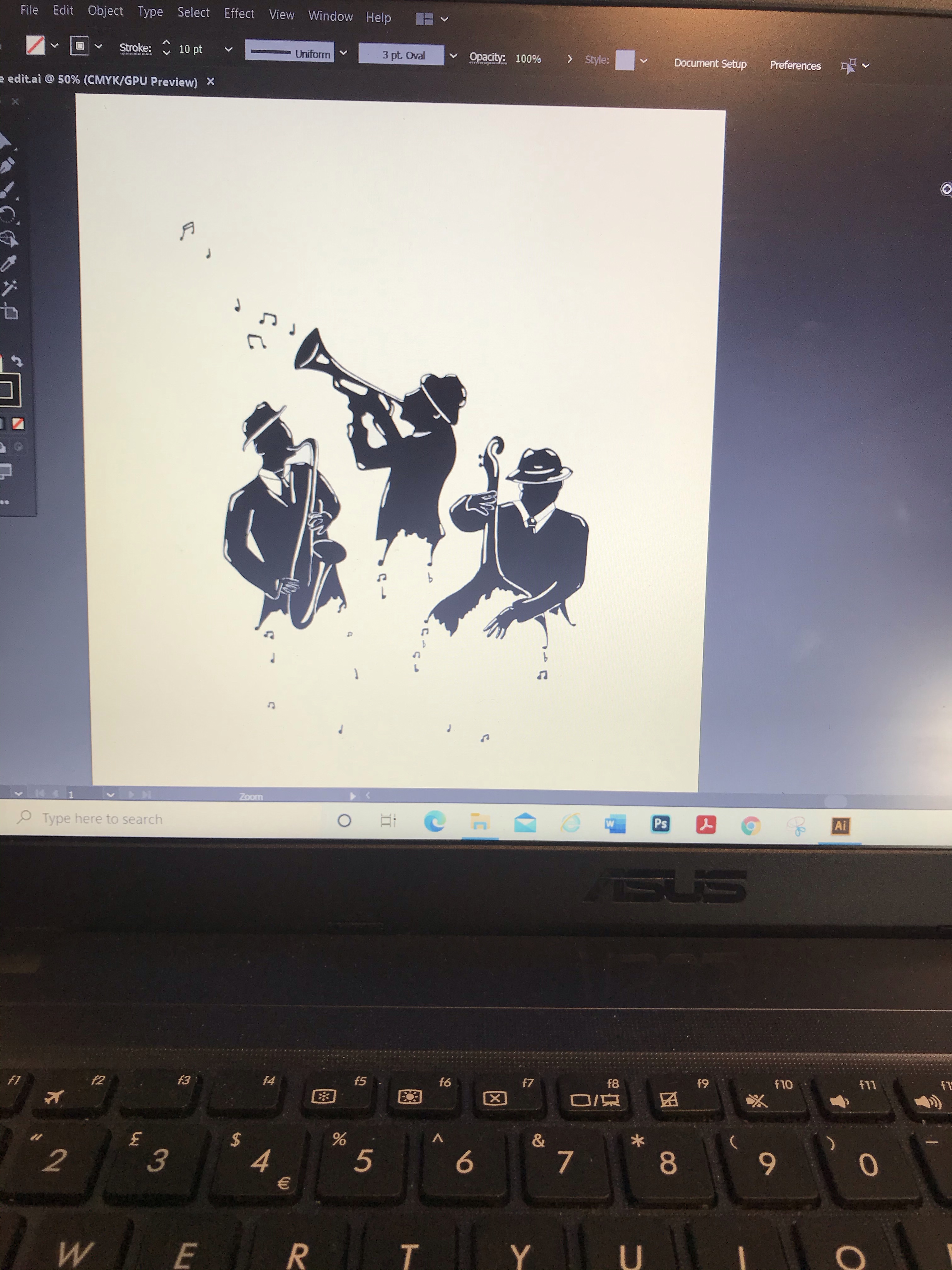
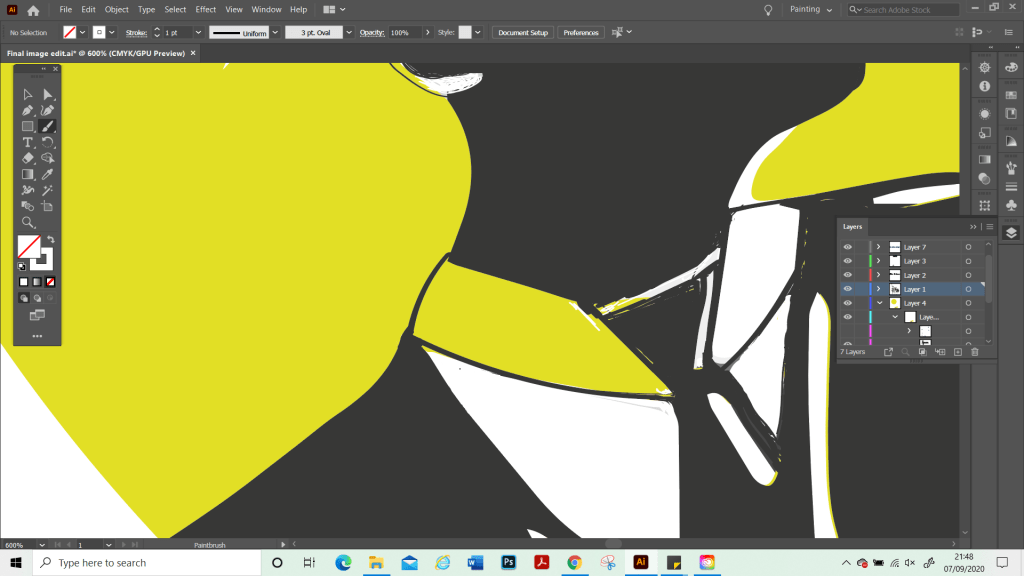
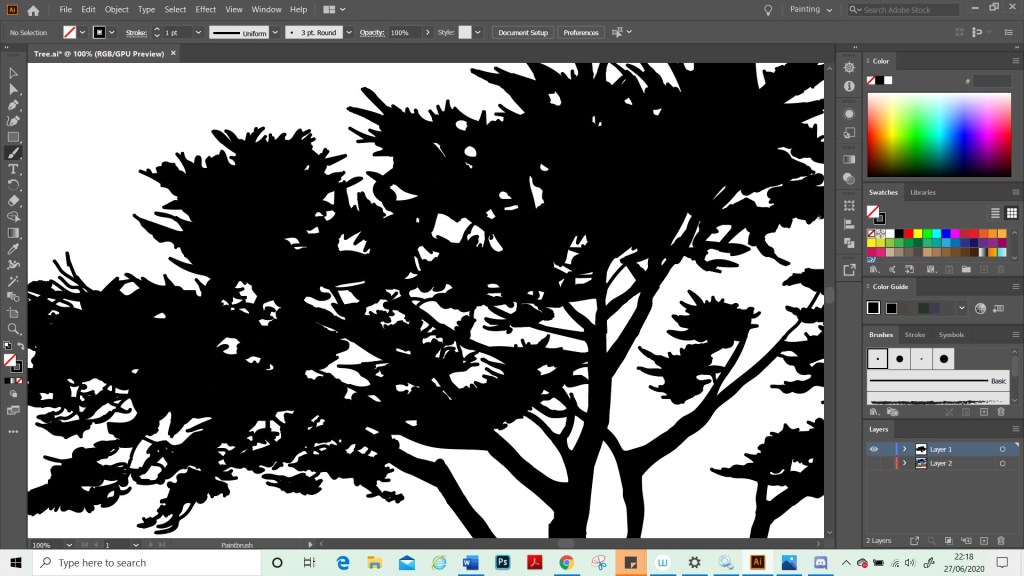
Screenshot from working in Illustrator.
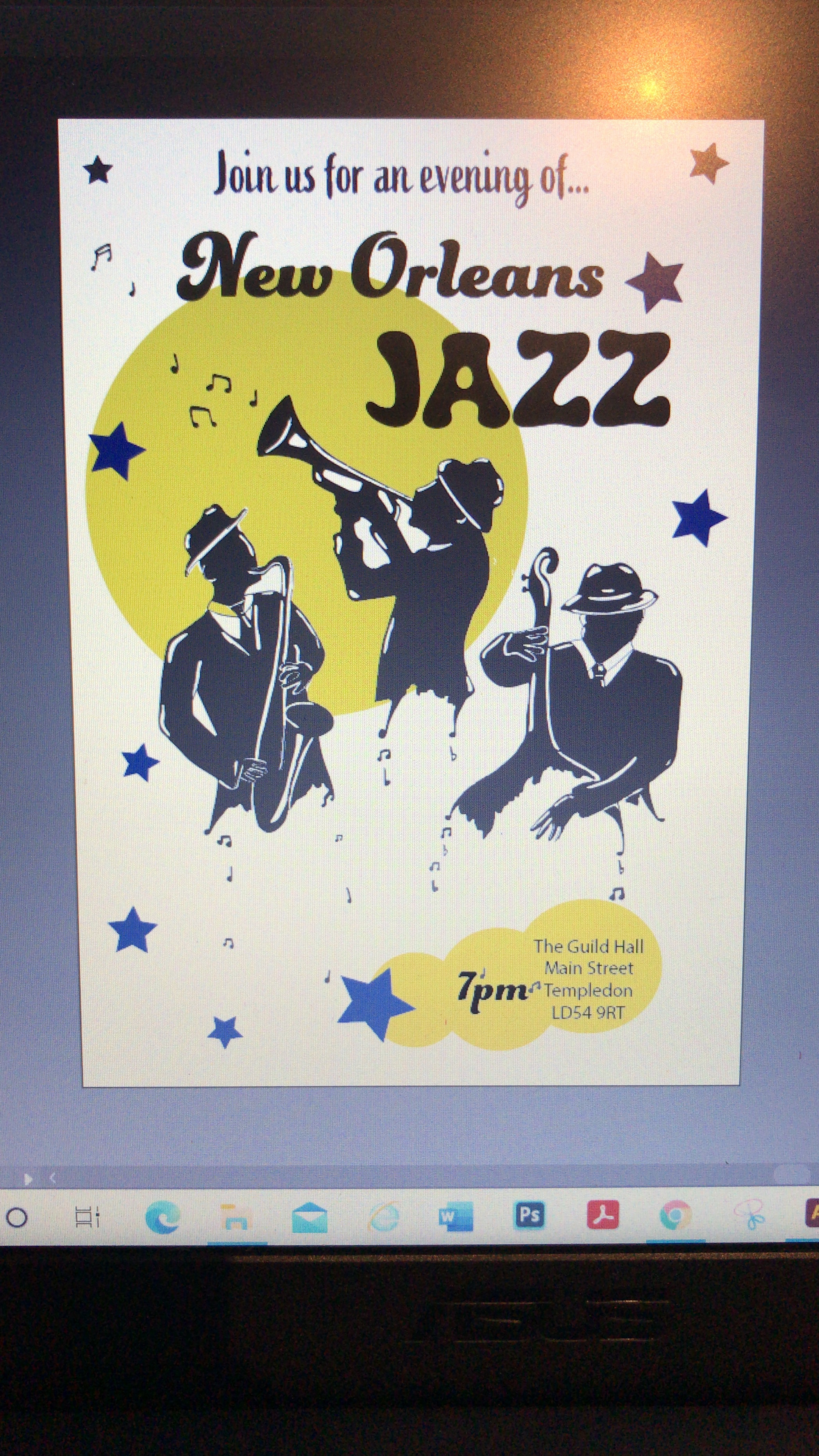
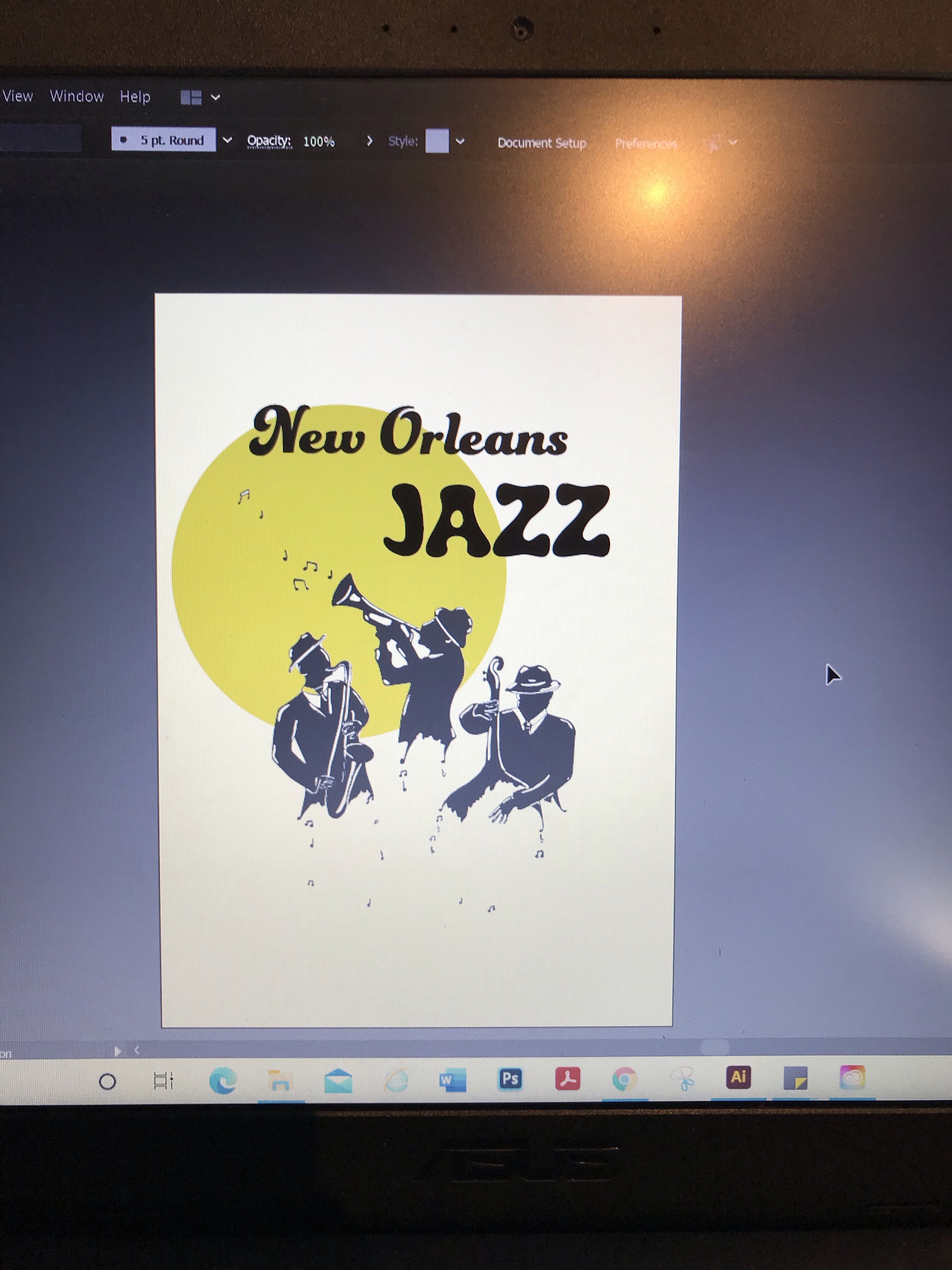
Once on Illustrator. I cleaned up the image as it did not scan very well and I pretty much had to redraw over the top of the whole thing to put some of the details and edges back in and recolour it as I went. At this point, I realise that although I had a strong plan and idea for my main illustration I did not actually have a plan as to how the poster would look as a final piece nor had I included these in my thumbnails. Partly this was due to my limited software knowledge and I wanted to just have a play with Illustrator to see what the possibilities were for me and to go from there. However, as I become more skilled with software programs, I know that this is something I will be able to plan more thoroughly at the beginning. I played around with different shapes such as stars. However, I felt that this made the image too busy and detracted from my illustration which I wanted to be the focus, and to make sure that the notes that are part of the image were clear and visible. Therefore, I decided to keep the poster more simple. Once I had found my final composition, I zoomed in again and did my final edit. Such as cleaning up the black-and-white sections and correcting where the background had come through on my illustration.
My Final Poster
In Summary
I am really proud of what I achieved with this assignment. A poster is not something I have done before. I also managed to master the basics of Adobe Illustrator, which I’ve been trying to learn. I did this by using short tutorials to learn different techniques and just played around with the different elements and fonts from the online library. I was unsure at first if my poster was too plain, or if a white background was the right way to go, but I had tried using different colour backgrounds also, and it did not look good.
Through doing this assignment, I feel it has given me more confidence. Although illustration part three has given me very valuable skills to carry on with, it did not lead me to produce any work that I was particularly proud of. It was also quite challenging for me as a lot of the exercises were more commercial types of artwork which I did not quite have all the skills to pull off successful illustrations in the style needed. I’m still working on developing a style and recognise that this is still early days. Sometimes this makes me feel a bit lost when it comes to some exercises as I have not developed my ways of ‘working’ yet. I am looking forward to moving on now to part four and continuing to develop my skills. Part three has made me feel more prepared for what is to come and that I am starting to develop processes and a way of working. Therefore, I am excited to see what is next.
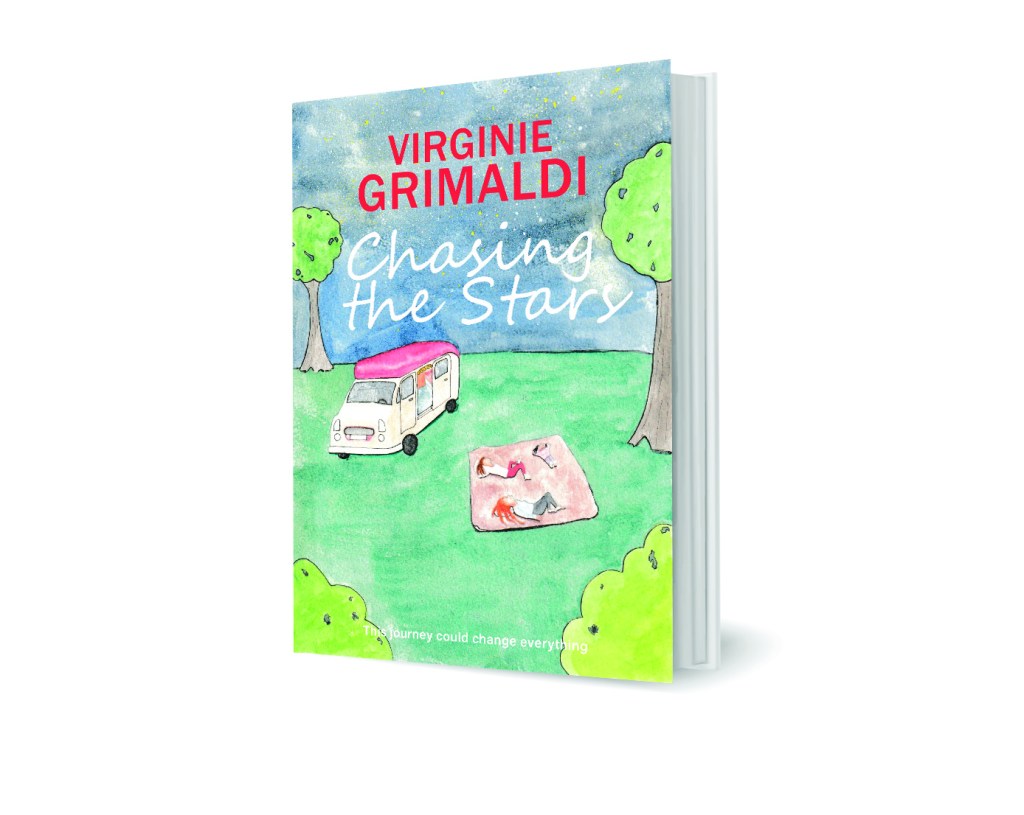
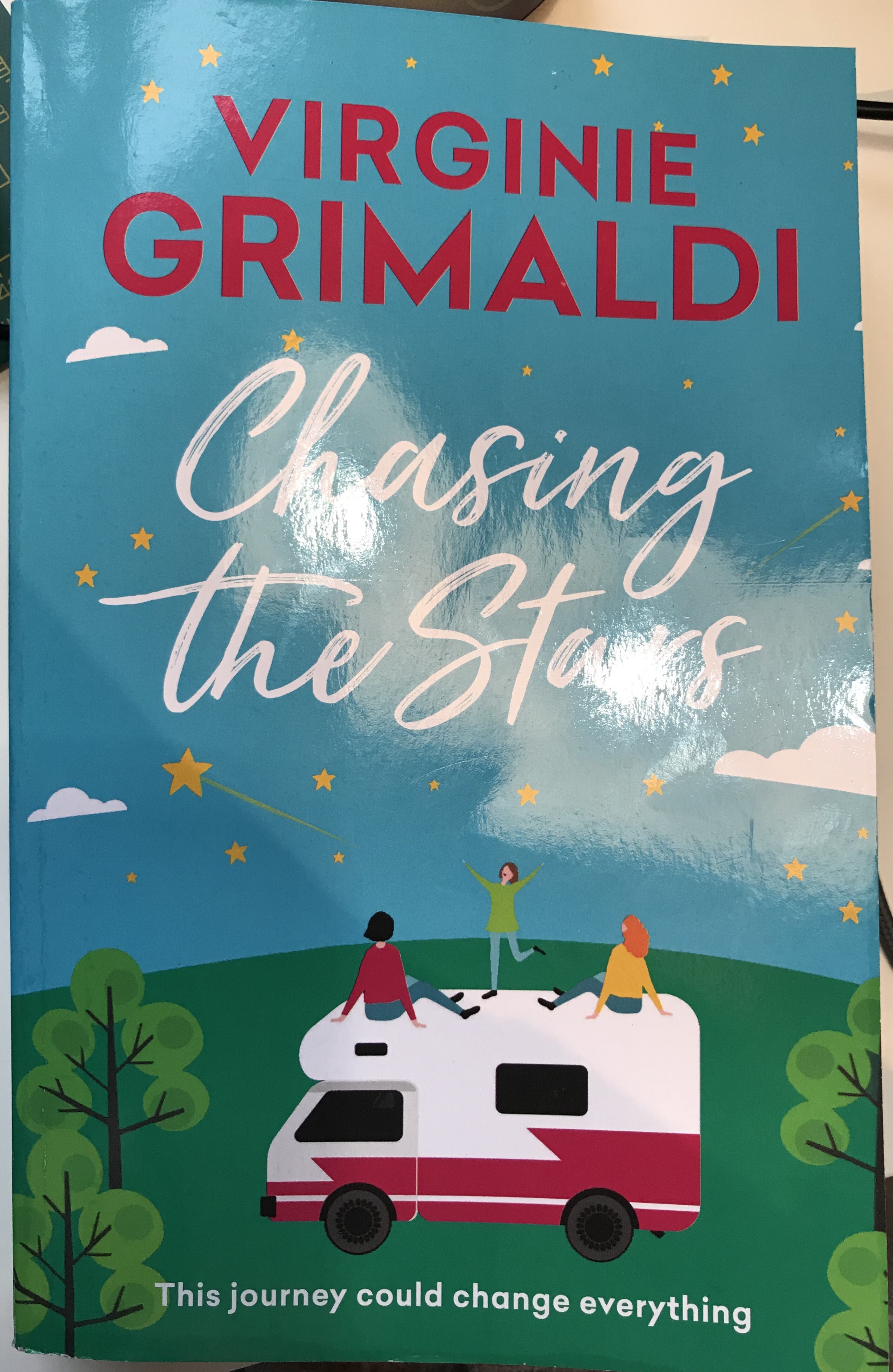
For this exercise I chose a book that I have just finished reading. From reading the book and the back cover. The title of the book does not necessarily reflect the book’s content in a literal way, as what the characters are actually chasing is the Northern lights, as opposed to stars. This is a story of a mum and her two daughters who take a campervan and go travelling in Europe. Because of the title. I felt like stars needed to be incorporated into the cover of the book. However, from the storyline I would have chosen to draw one of the scenes and places travelled in the story, or else the Northern lights had this had not been the case. I imagine that the stars, the characters and the campervan were the brief for the book cover. As well as the age and hair colour of the characters.
Ideas
My final design
I decided to draw my version of the cover based on the characters in the book and the way that I had imagined them as I had read it. Although I was not happy on a technical level with my drawing, once I had placed the text and created the mock-up. I did feel that it made a convincing book cover. I decided to create my mock-up in Adobe Photoshop and used a mockup template from Adobe Stock images. I am not sure how to add the cover so that it works correctly as a mock-up, but did the best I could and positioned it so that it did the job well enough. I decided not to print it as a mock up as my printer would not be capable of making it look realistic enough.
I used darker colours on the cover to show that it was night-time. I had originally planned to paint a soft light from the van over the characters. However, due to redrawing the van, due to a technical issue with the prospective, it did not end up being in the right position for this. However, now that the image is completed. I do wish that I had re-drawn the van in the original position I wanted, as the way the characters were positioned was more interesting and generally worked better overall. I feel like in my final image, the scene is a bit fragmented and there is too much distance and not enough interaction with the characters and the environment.
My finished book cover
I am quite happy with the outcome of this exercise, as part of the obstacle was to just have this completed and to have made something out of my illustration. Quite often I will critique my work as a simple image, however, now that I have had the experience of using my image for a purpose, I feel slightly less critical. When I critique other artists work. I am not as harsh as I am with myself and although I do not feel that my work is not where I want it to be yet technically, I can see that it is also not as bad as I think or at the very least, it can work.
For this exercise I looked at a range of books that I had most of which were adult book covers. Then I found a Roald Dahl book that I bought that has three of his stories and it. From this I chose my favourite Roald Dahl tale, which is the twits. This is a childhood favourite of mine and made this a very fun exercise to do.
I did a line drawing on A3 paper at 2.5 times the size of the original. Quentin Blake’s style is very simple. Therefore, it made this task easy. After I traced the image I’d made and redrew it on a new sheet of paper, adding back in only the most important lines in an attempt to simplify it even more so.
I love Quentin Blake’s style and from doing this line drawing, I see that his line-style combined with his beautiful watercolour work is what gives his work, its individual style and makes it stand out from his competitors work.
I then moved on to an illustration of the front cover of ‘Life of Pi’ by Yann Martel. This image was a little more complicated than the last. Due to the many number of characters in illustration. I did this in A3 in pencil at 2.5 times the original size and then inked over the top.
Pencil sketch
Final Image
This image ended up being a very simplified version of the cover. However, I wonder on reflection, if I should have added more details as it would have helped the image be clearer. Such as by adding the trails from the water to show that the fish were in fact swimming in the sea. My image is very one-dimensional and I think with this particular image. The colour is important to make this work, so that the sea animals are muted and the boat with the main characters are the focus of the image.
When reflecting the first image of Quentine Blake’s, I think that apart from the line work needing to be more interesting. The image works as a visual and shows what needs to be shown.
I have read most of the Dark Tower series. The story line could have presented with many different options for cover of this book. However ‘the dark tower’ is a focus point for the story, being a destination that the main characters are trying to reach. Each cover is the same image, but a different Hue. I think that the brief would have been to capture an otherworldly feel and the moody skies that are described in the book. I think this image effectively creates a sense of mystery about the tower, which is a good reflection of the storyline.
I found it difficult to find adult books with illustrations and found that most are photographs instead. I believe this illustration is trying to show a woman that is free, confident, happy and at her best. The book is a woman’s story interlaced with facts and figures and discusses biases and stigmas attached to women that are not in a relationship. I think that the illustration fits the purpose and gives the viewer a sense of freedom and calm from the image. Unless you are scared of diving like me, then it could also represent something risky and scary and be reflecting that side of being single.
I have not read this book, but was really attracted to its cover. The almost collage feel to the line drawings or perhaps Lino cut illustration is very striking and the limited colour palette is very clever. There is so much going on that you can spend quite some time looking at the image. I wondered what this image has to do with the title and now feel compelled to read it to find out what the salt path is. From reading the blurb I wonder if the cover is perhaps trying to represent freedom and a beautiful sight, but at the same time reflecting turmoil with the busy line work and almost overwhelmingly busy illustration. I assume that this scene is one of a place that is visited during the character’s journey.
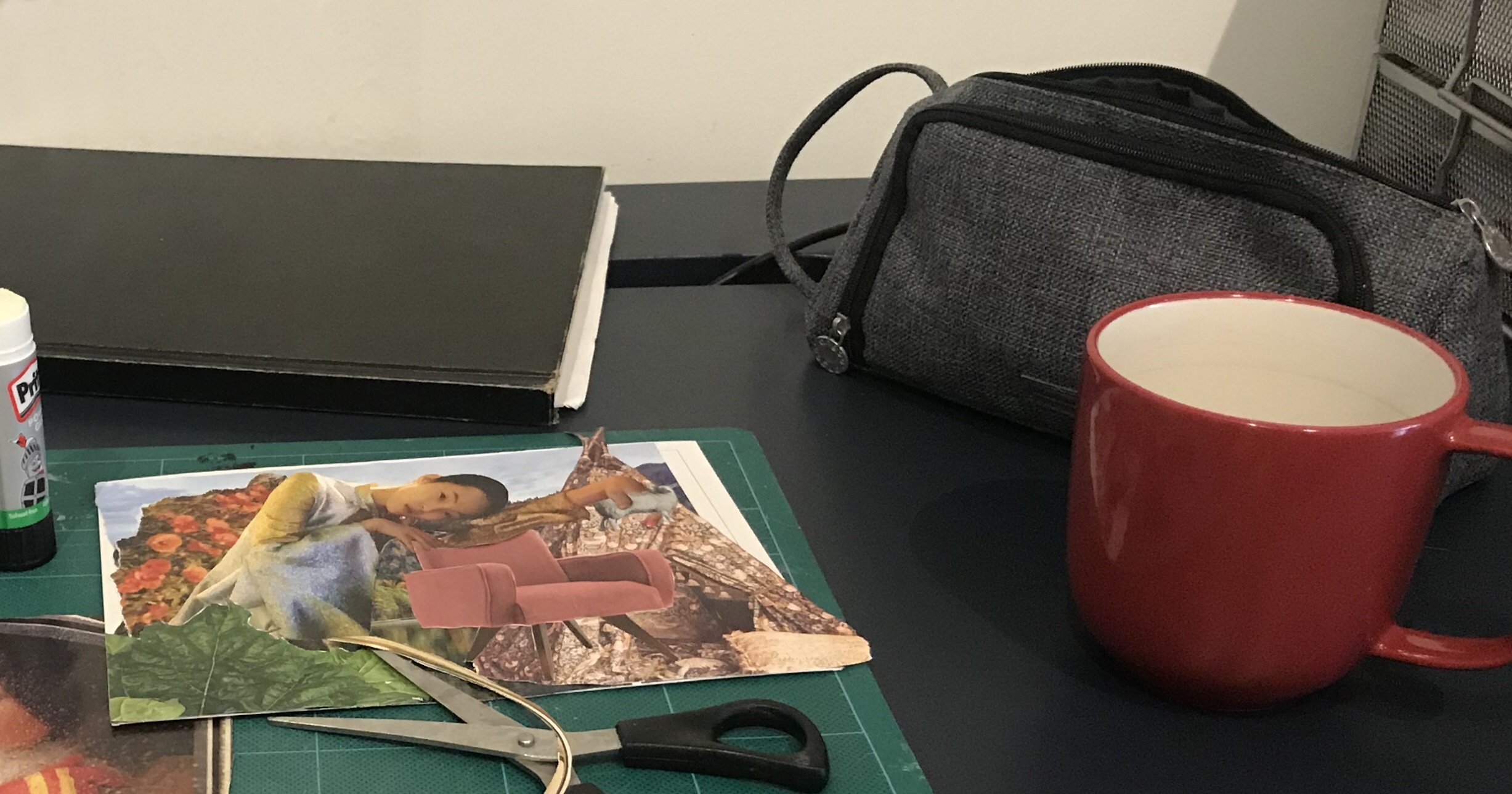
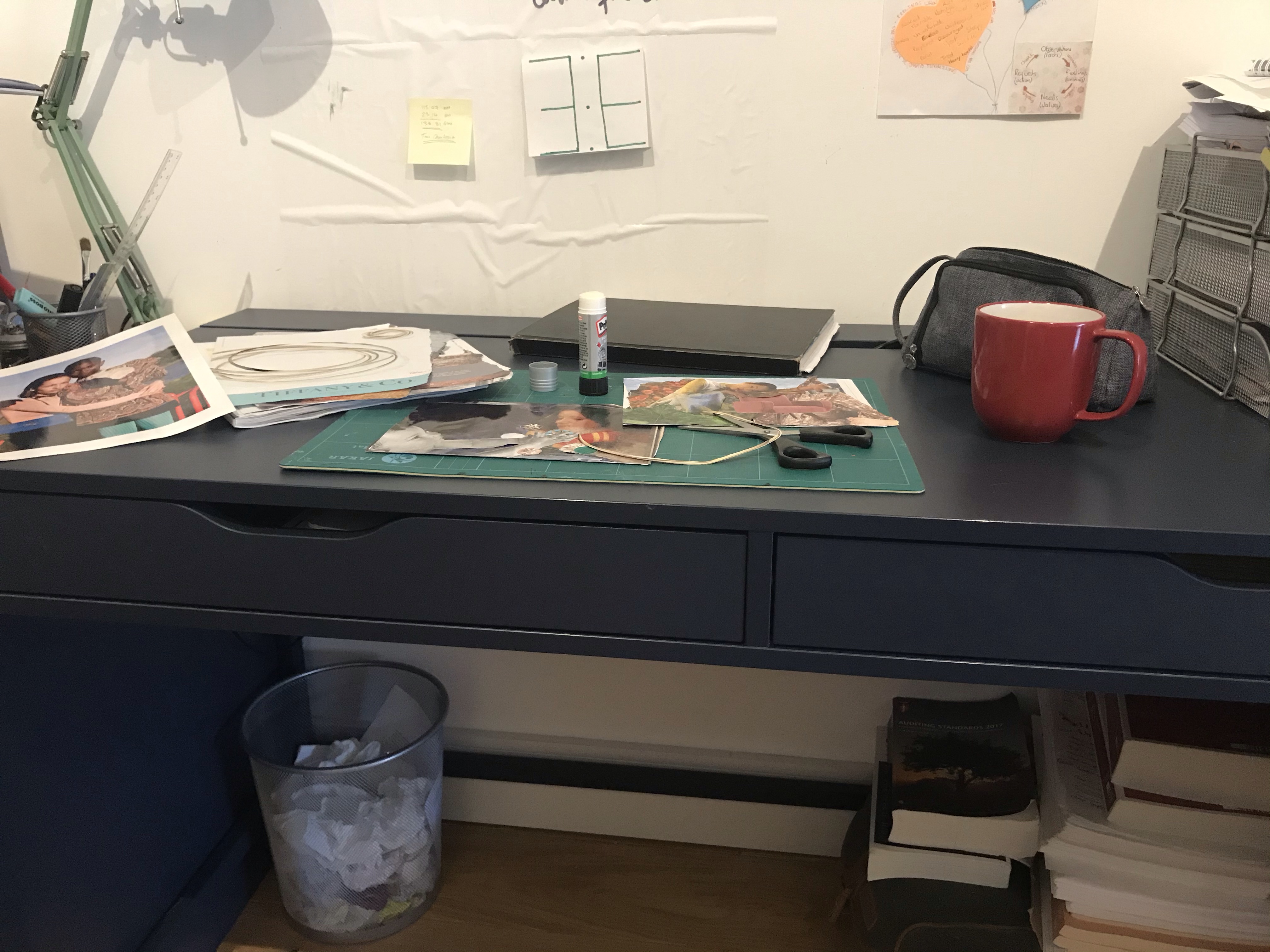
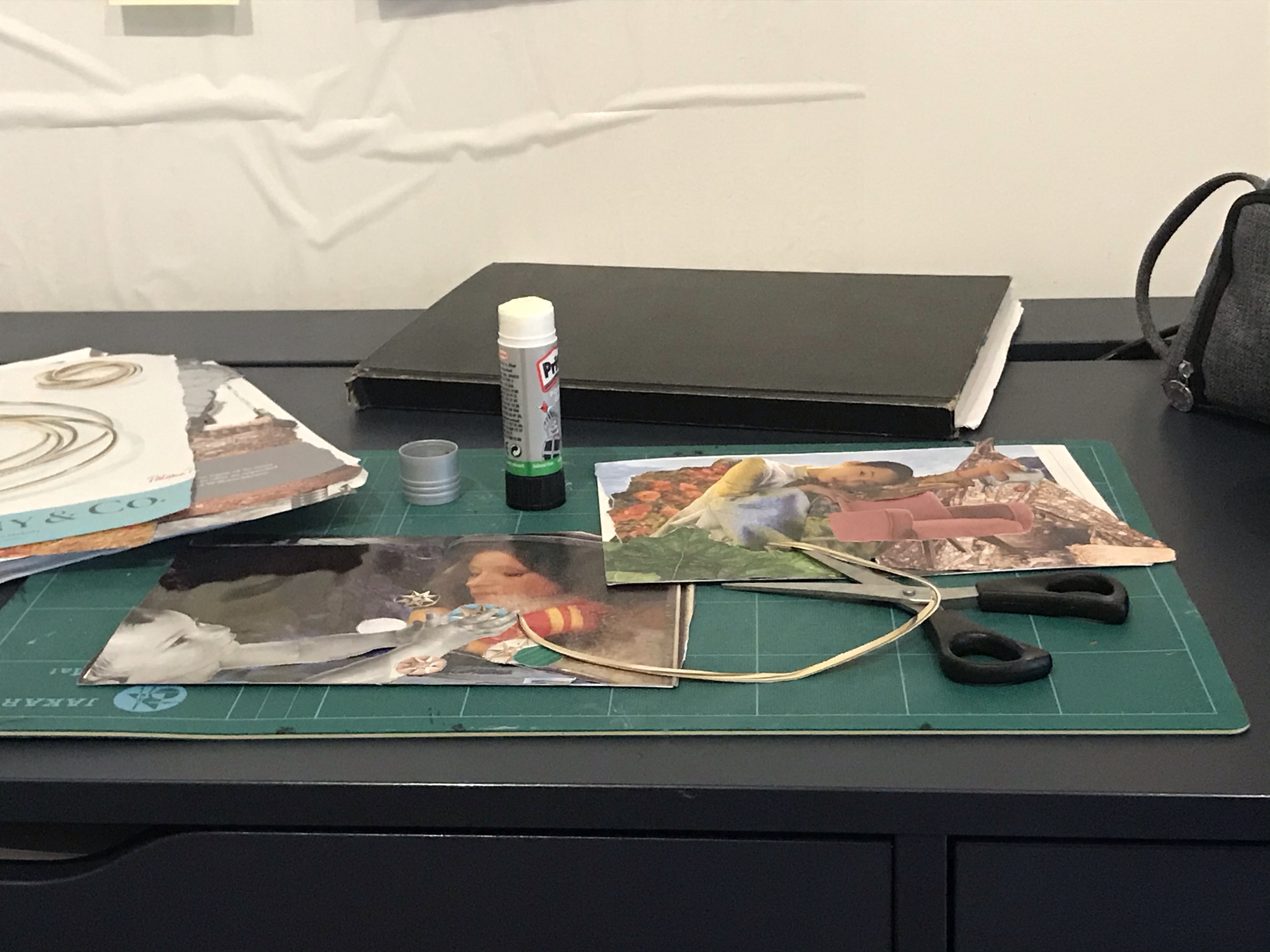
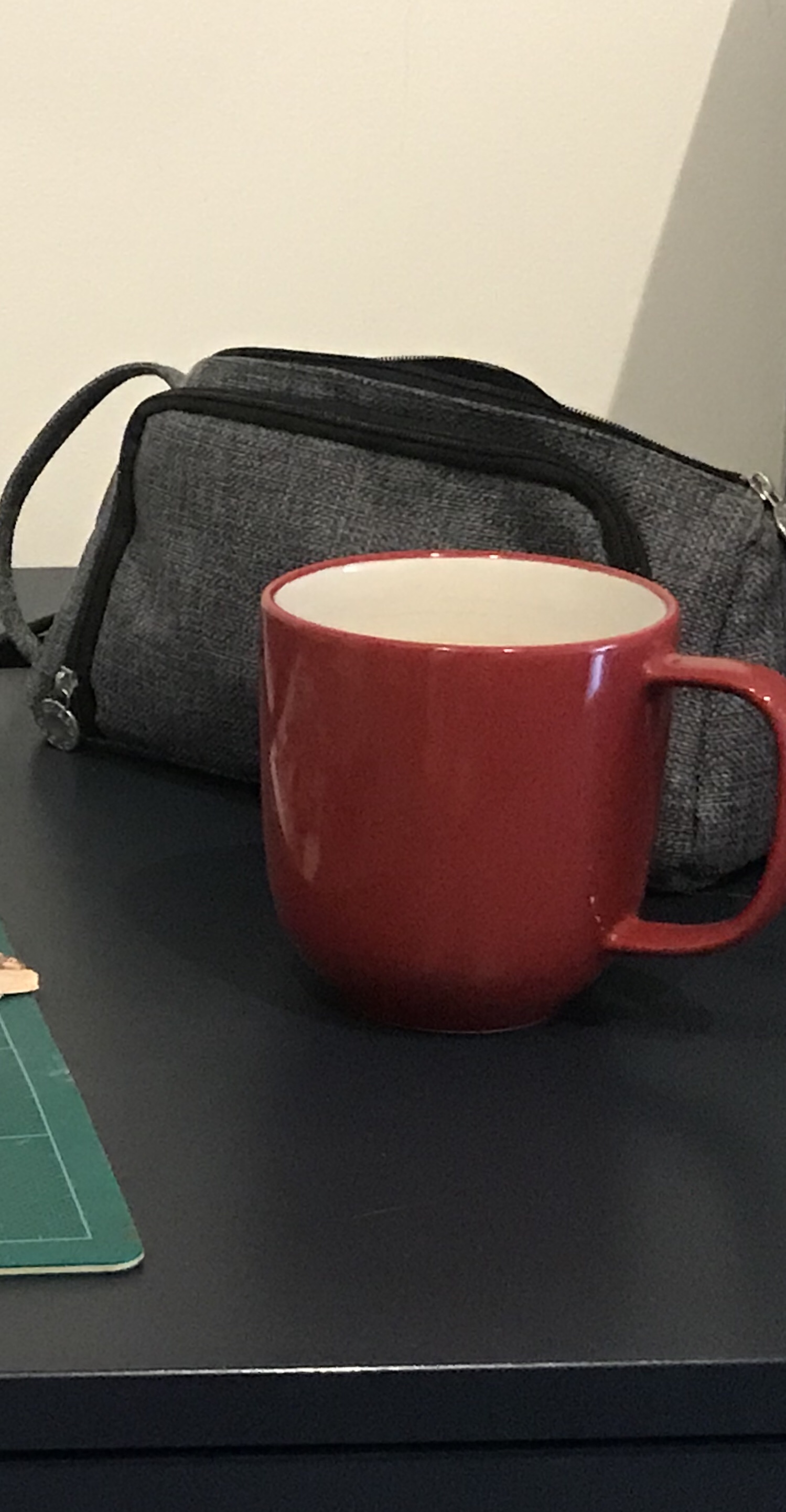
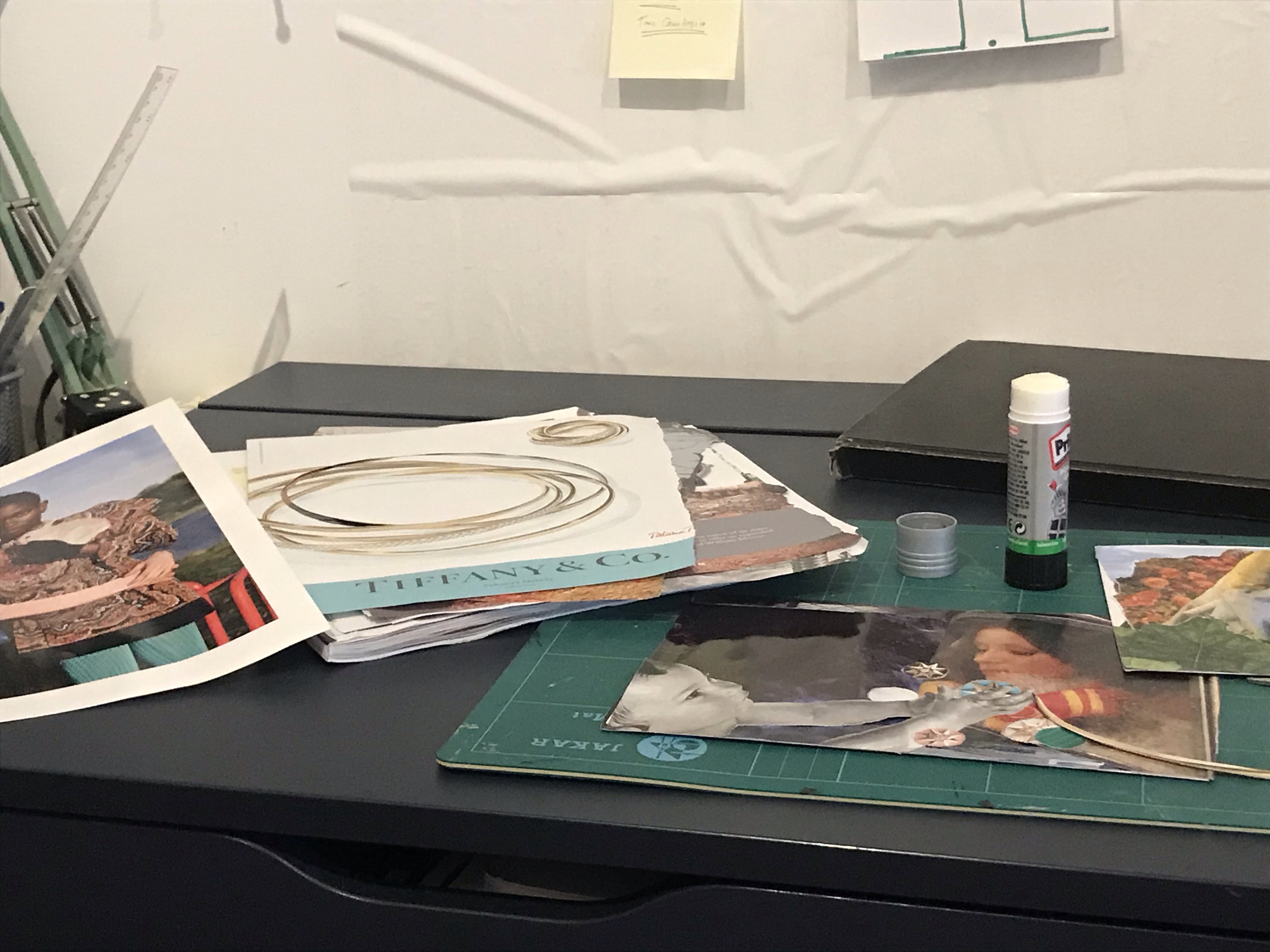
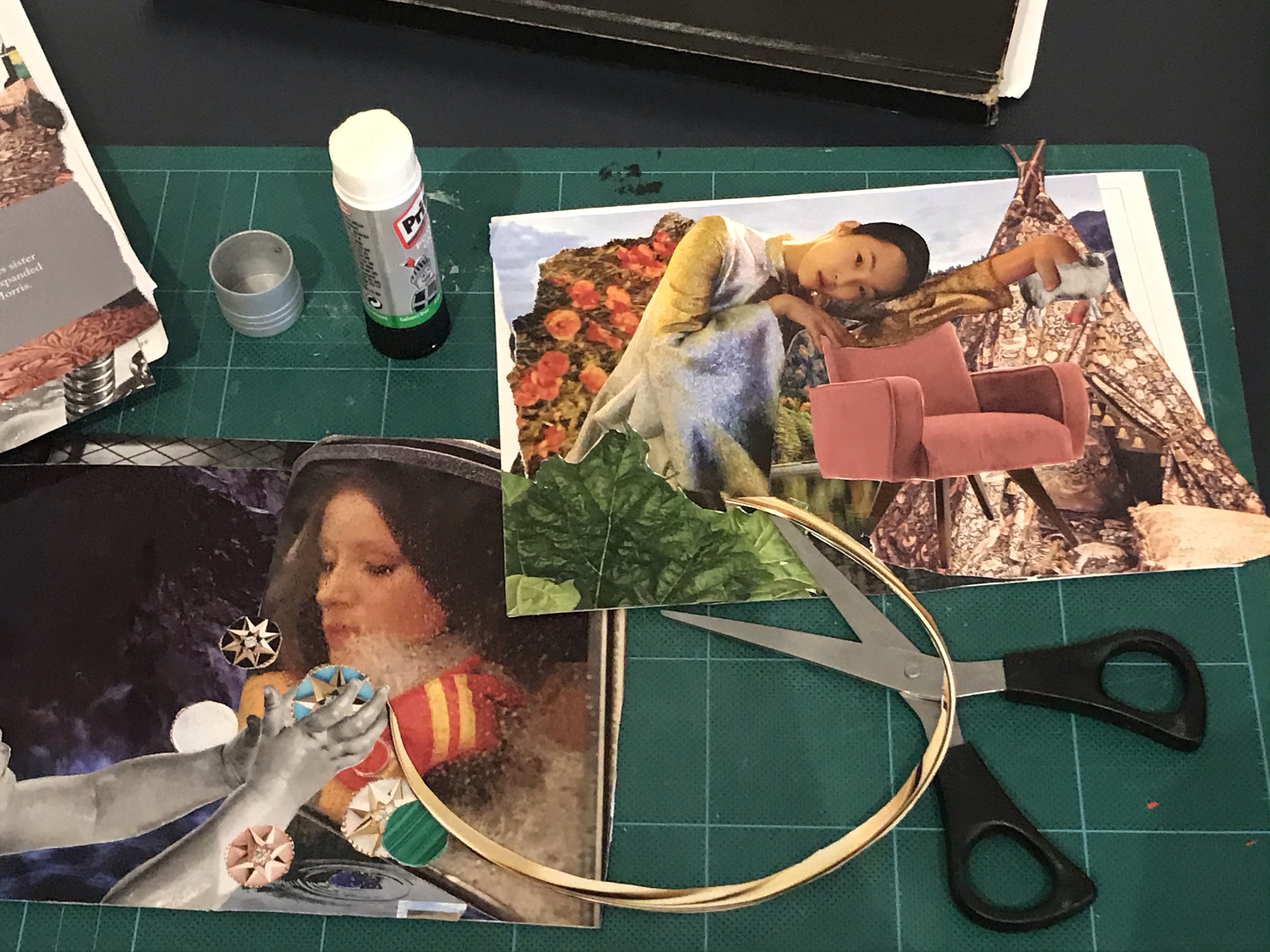
For this exercise I chose ‘workshop’. It was, not the most exciting theme from the selection. However, as I was staying at a friend’s house at the time I had very limited resources to create a collection of objects. I did have a desk that I was working at with my art equipment, which is why I chose this theme.
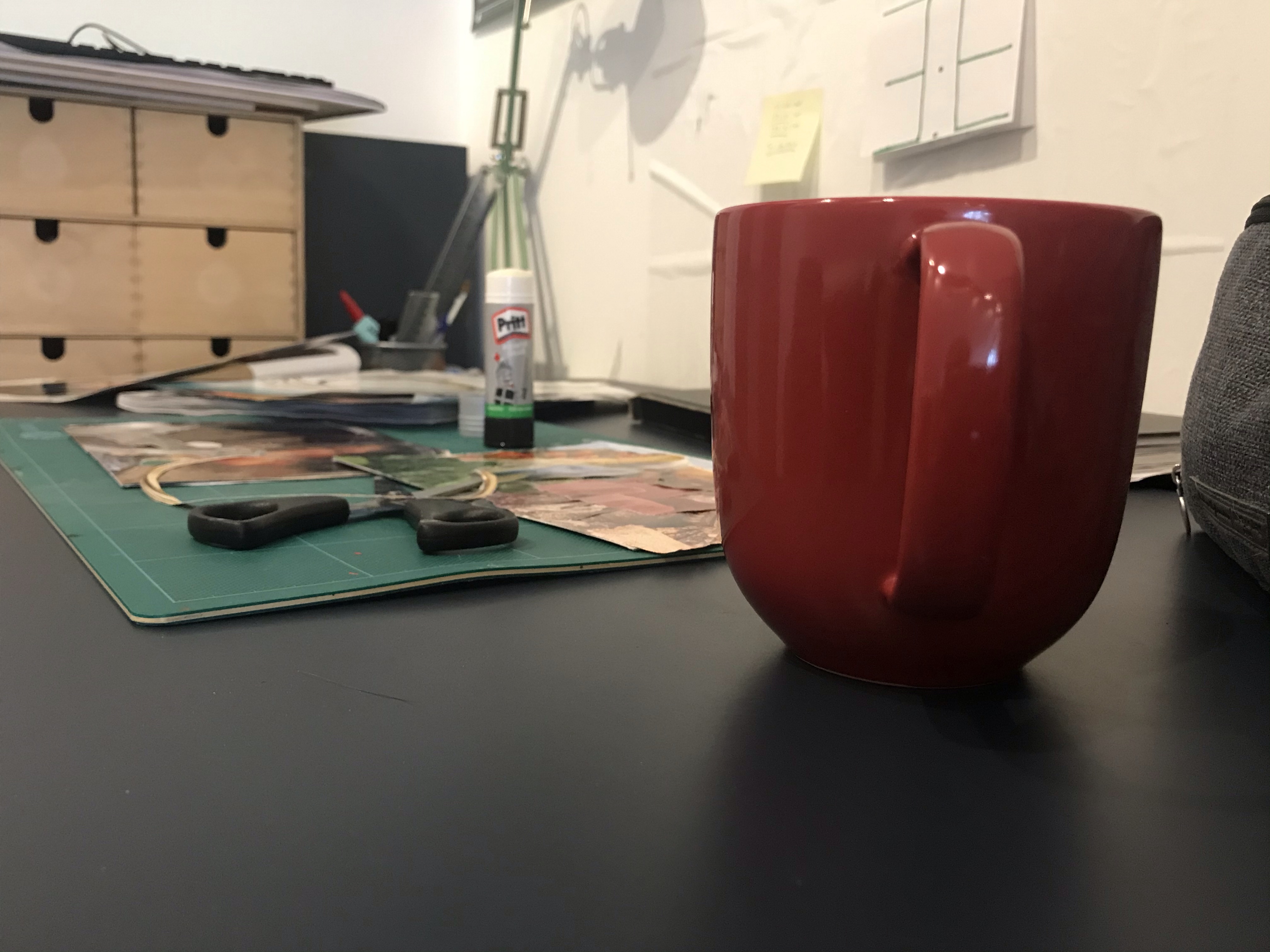
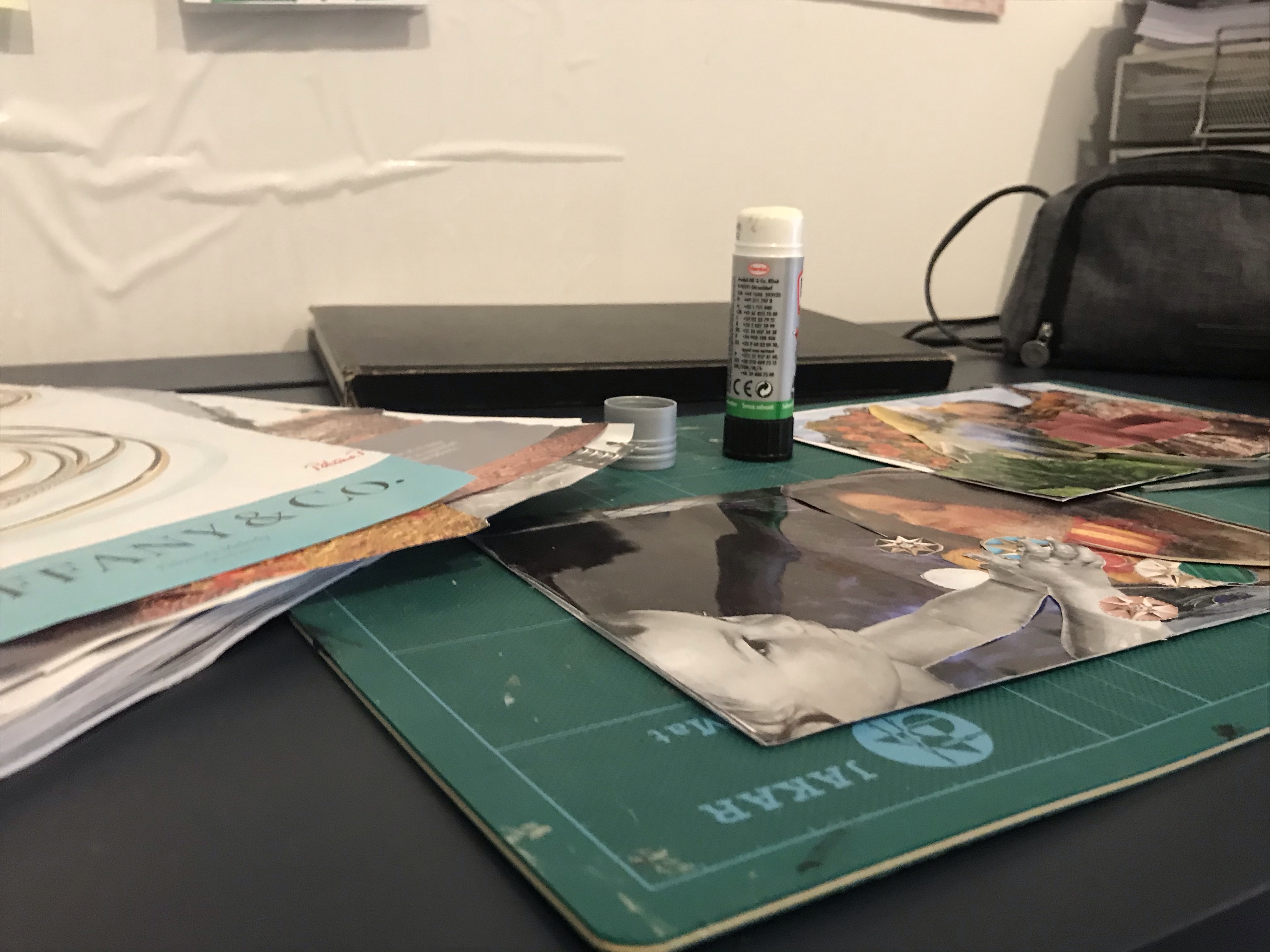
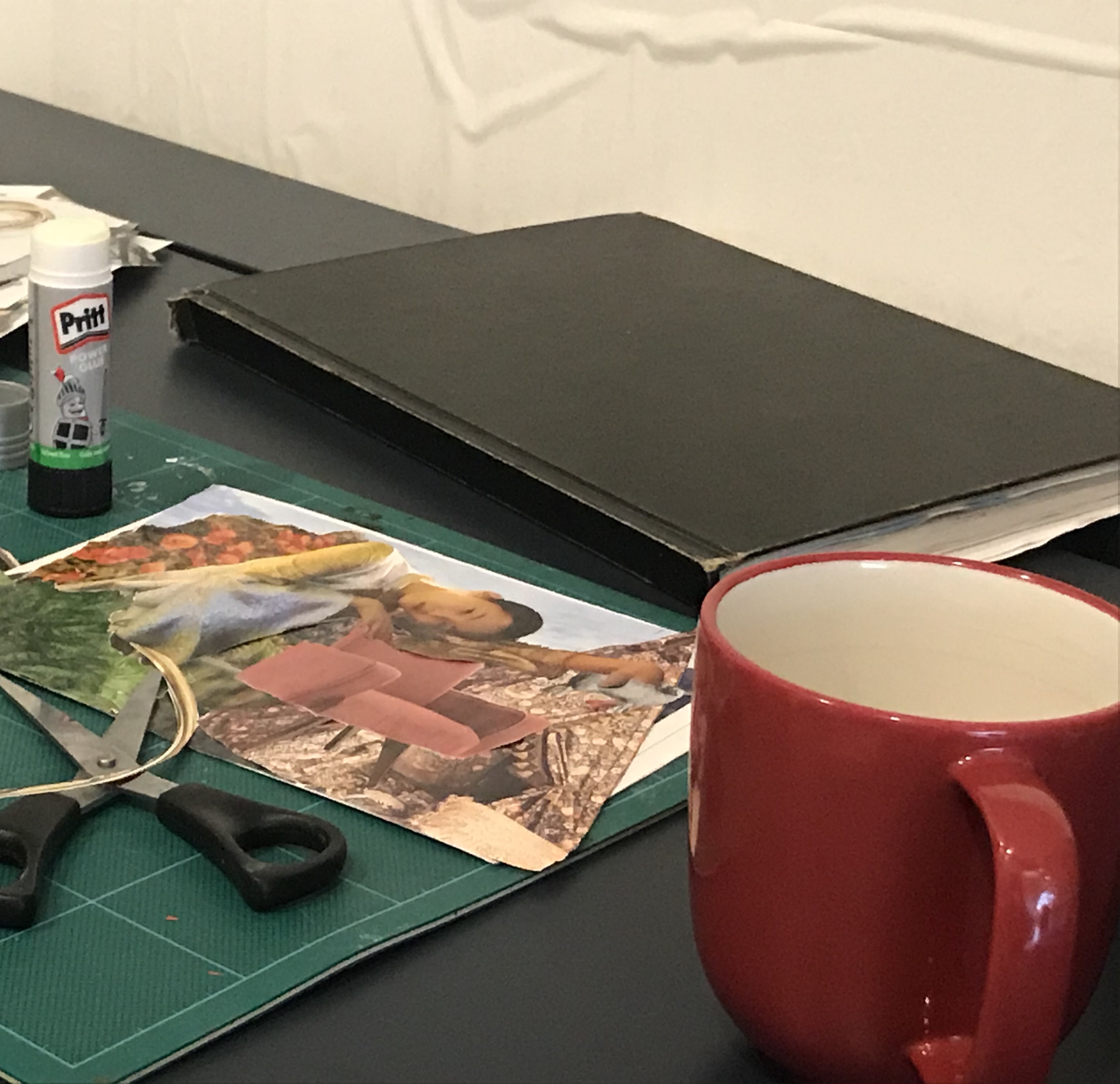
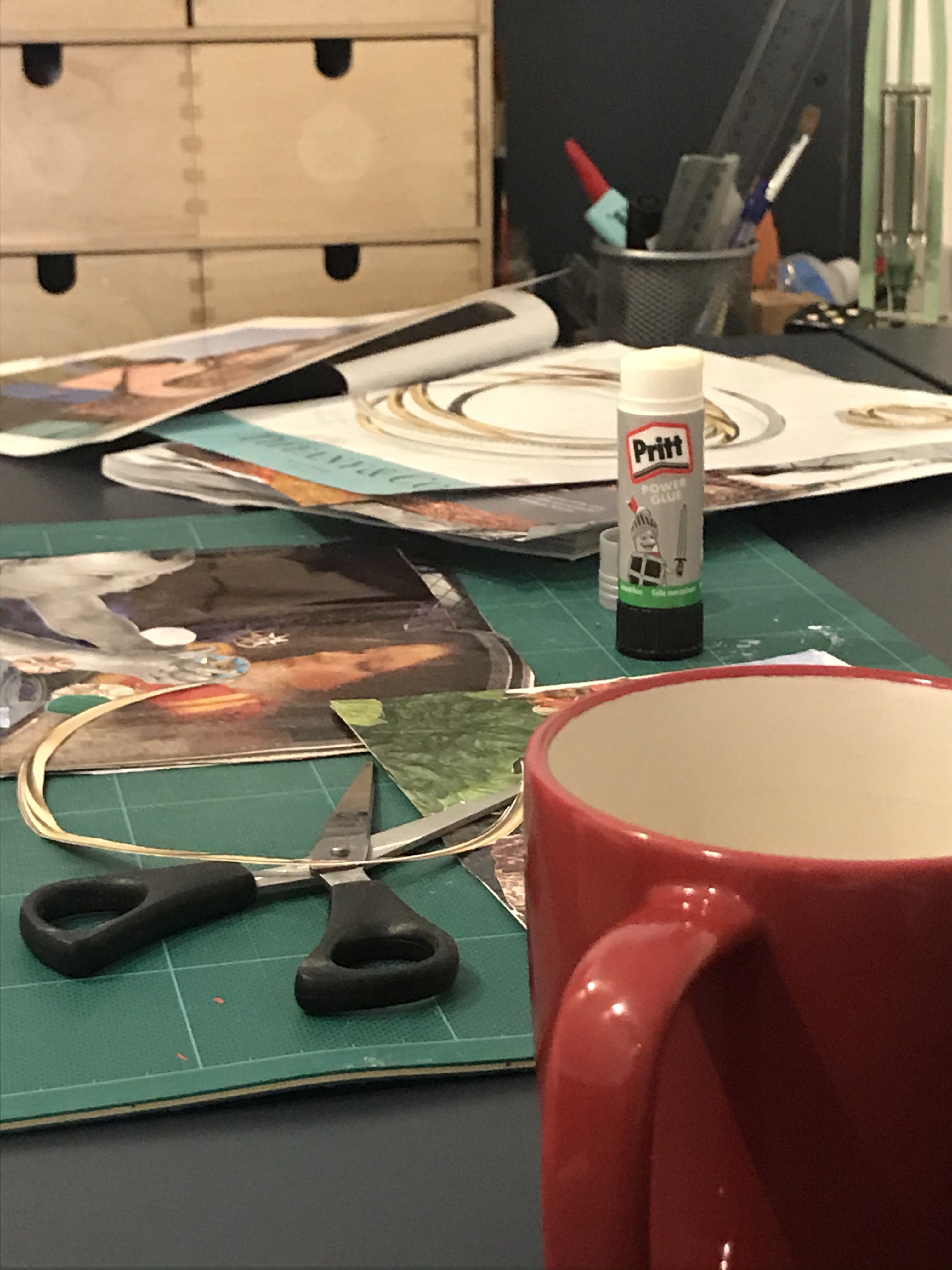
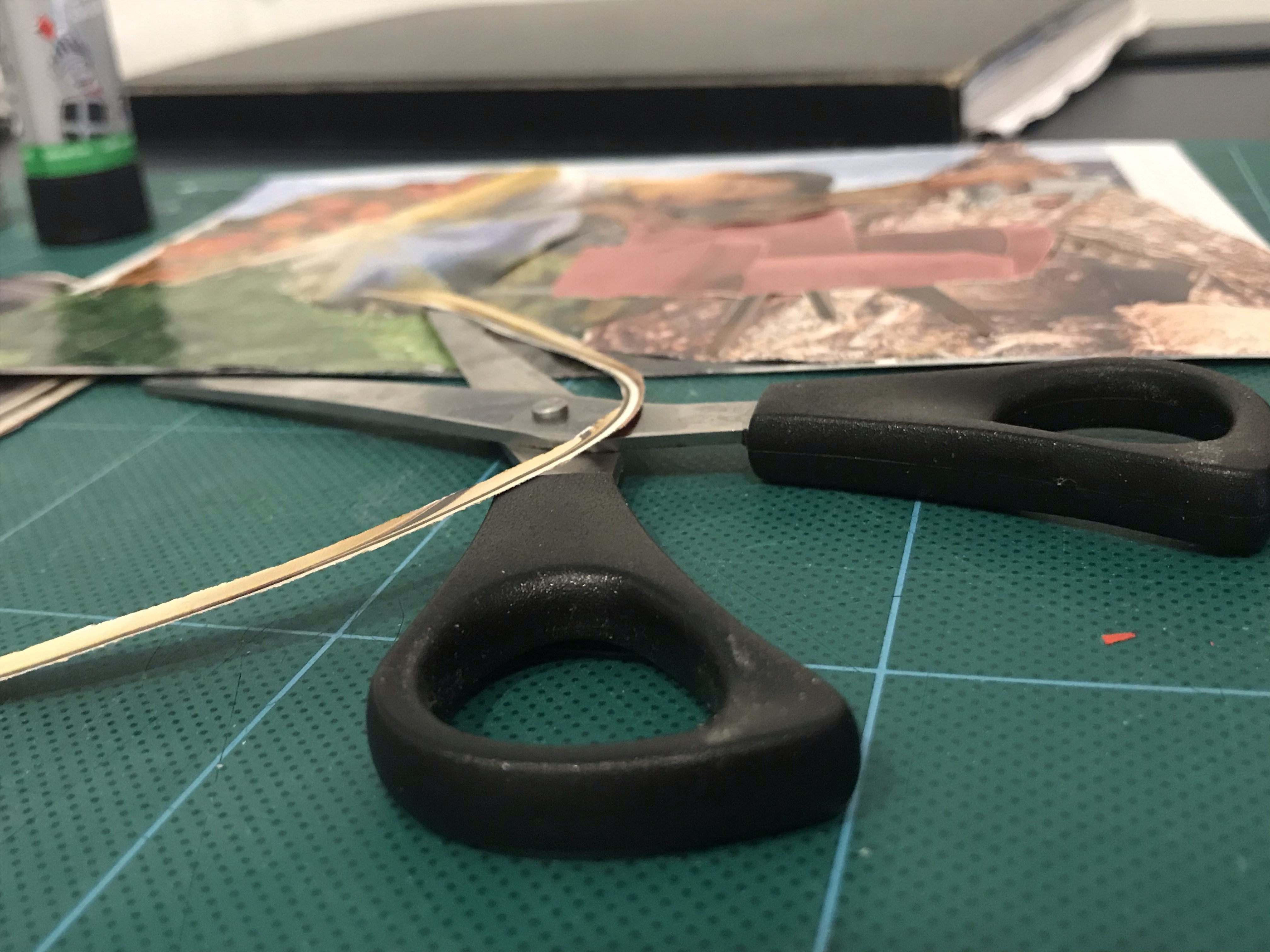
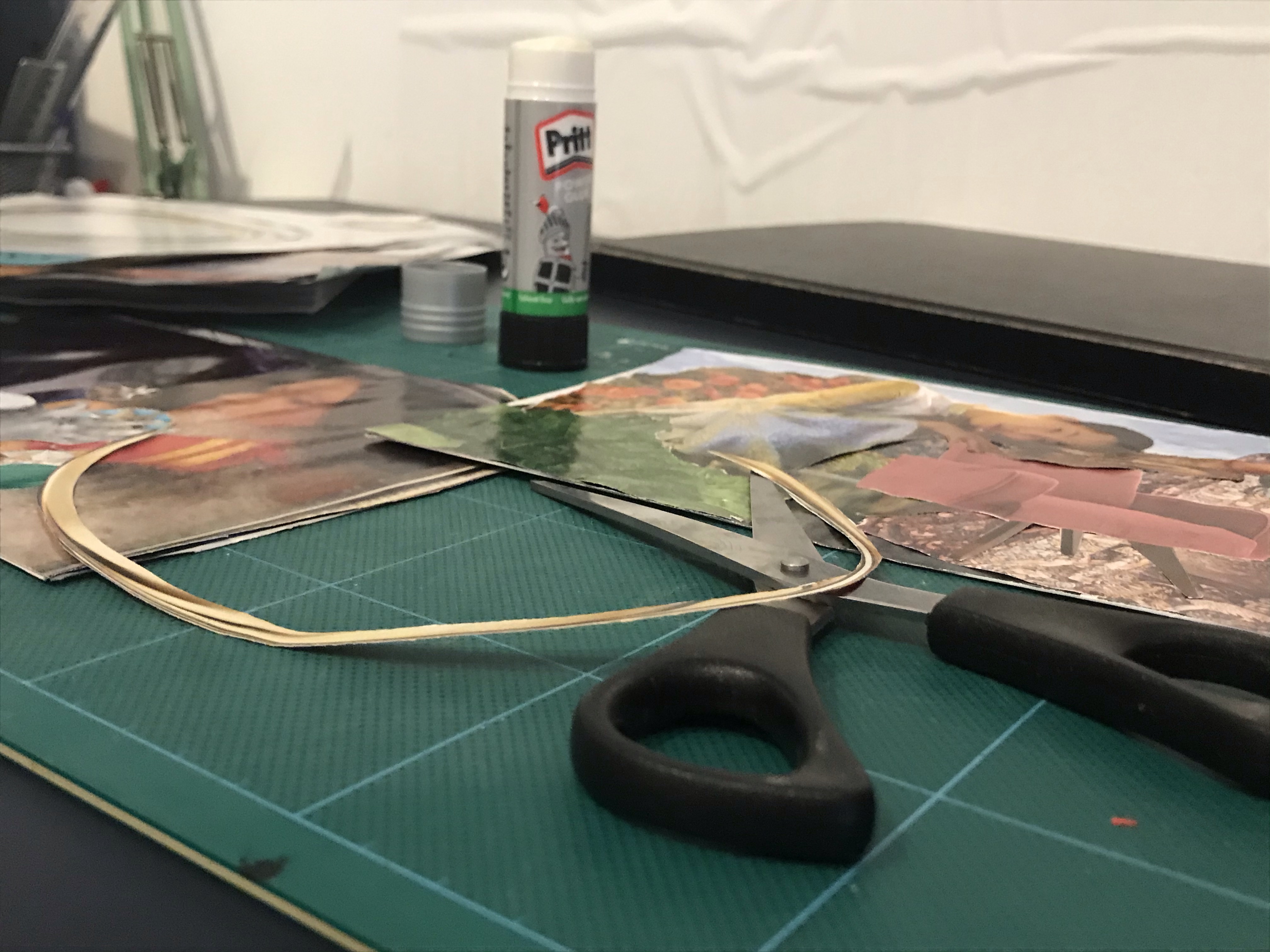
A selection of my shots with a digital camera
I tried to be unusual with the positioning of the camera in order to make the scene more interesting. I found that I quite liked the shots where the camera was lower and gave more of an interesting perspective of the objects. I did some sketches from my photos by cropping them into different frames.
My thumbnails
My final image
I chose the above as my final composition and frame and drew it in my A4 sketchbook. I tried to keep the lines clean and added a little shading to emphasise shapes. I felt that this frame was the most successful as it showed a range of objects where as some of the others, although more interesting, it was harder to see what the scene was meant to be. I felt that this one clearly showed that it was a ‘workshop’ or working desk.
I found this exercise valuable to teach me to find and experiment with new perspectives rather than settling for the first one I think of and to use this technique to find another more suitable one. I will bear this in mind as I go forward with my course to try to think more about the best perspective and layout for my illustrations.
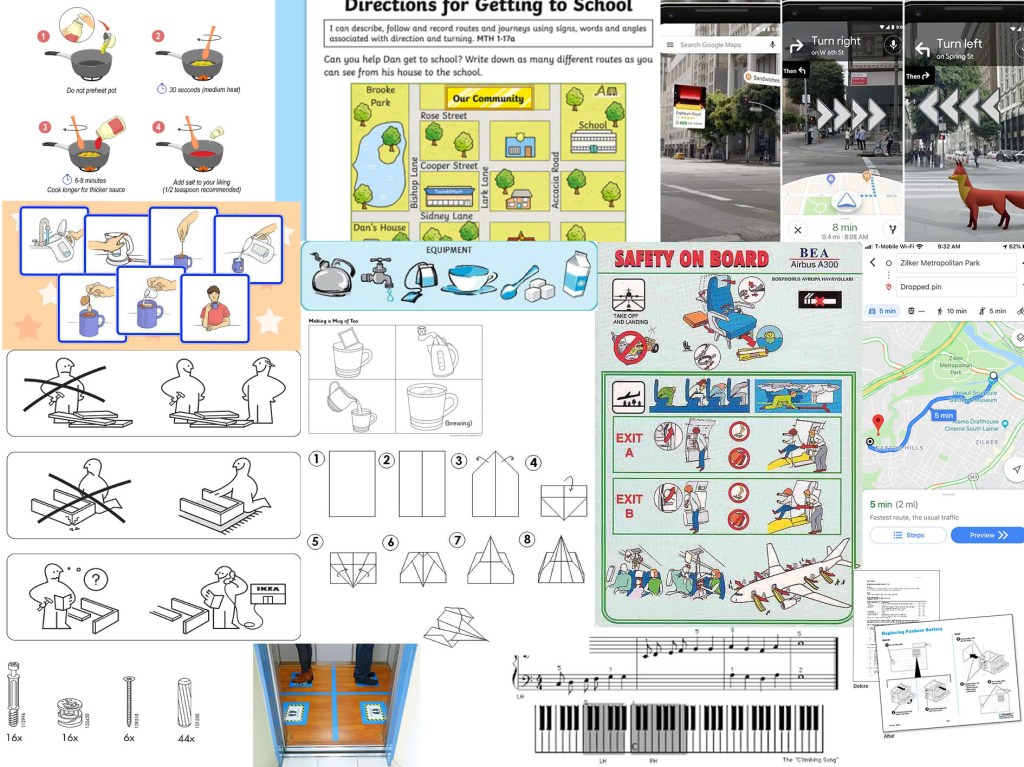
For this exercise I started by collecting reference material of a range examples of instructions. The thing I noticed most about these are that they tend to be in block colours or line drawings and tend to be clear and have images on a plain or solid colour background.
Collection of examples and reference materials
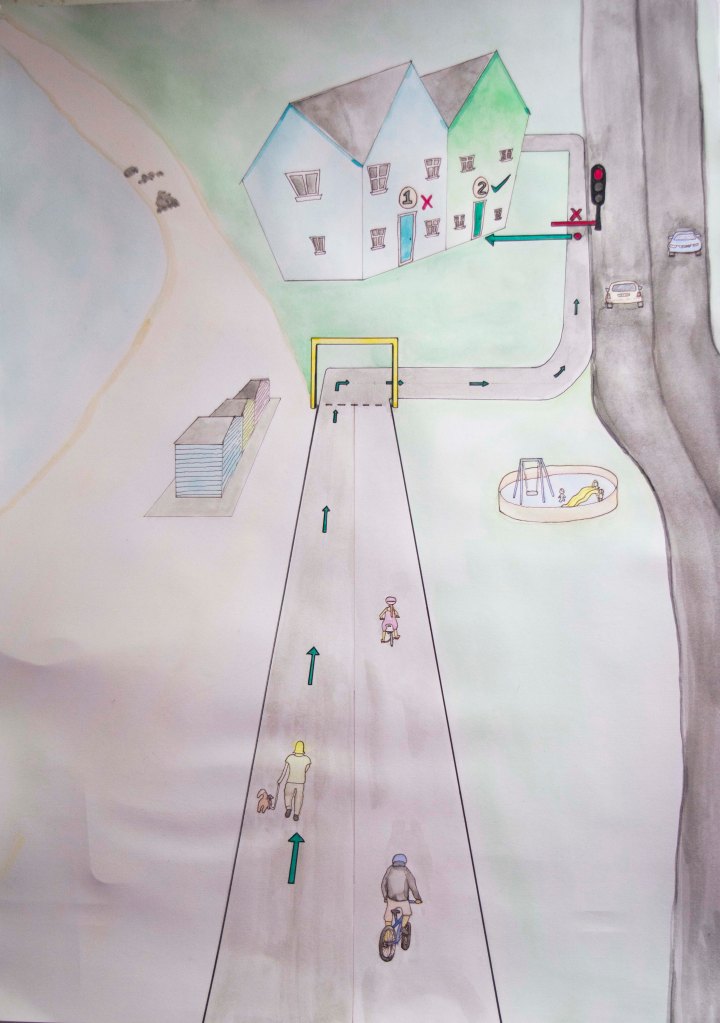
I chose ‘getting to my house’ as I liked the idea of doing something more personable to me. I started by doing loose sketches and seeing what bits I could cut out and identifying which were the important features or landmarks to be left in.
The design, I decided to go with was the more simplified version leaving in key landmarks that would be easily identifiable and therefore help direct the user.
I worked on an A3 format, which gave me just enough room to be able to draw the characters with enough detail. Once I had completed my initial painting, I decided that I wanted the colours to be bolder and more solid. I was trying to do a pastel colour palette. However, it did not work as intended, most likely due to the use of watercolour. I did want to achieve a hand drawn/hand-painted look. Once I started to re-colour in Photoshop, although I really like the colours I realised that I was not going to be able to achieve what I wanted that way either and decided not to proceed. I therefore have stuck with my initial hand-painted illustration. I think I could have improved this if I knew how to use a software such as illustrator, as then I could have kept the hand drawn feel, but change the colours. I also would have needed to have just a black and white outline drawing in order to digitally colour, this effectively as then the trace tool would have worked on Illustrator. However, as I hadn’t planned it this way from the beginning it was not going to work.
Final Painting
A as well as using a pastoral colour palette, I decided to use a traffic light system as a means of directing the map user. Green for the correct path and read for the incorrect path or stop points. I tried to make these brighter so that they stood out and made sure that everything else was more subtle. I showed this to a few of my close family members and asked them if they knew what it was. Each of them said that it was a map to our house, but recognised that I had removed many elements, which I had done to simplify the image so that it was not too busy and distracting.
I found this to be a useful exercise and with that I have recognised some limitations that I have. I also am starting to realise that I do not like to do commercial illustrations such as these, and that they do not fit my style or current skill set. However, I do hope to expand my skills so that I can find a task like this much more simple in future. In order to do this I need to set aside dedicated study time just for learning new programs and features that are not in conjunction with the assignment or exercise. At the moment I am struggling to schedule this in with working full-time and also trying to complete this module in such a short time frame. Once I have caught up. I intend on doing classes to improve my knowledge of digital art techniques.
The image here by Mark Oliver, is of a dragon in a cave surrounded by treasure, armour and weapons, in the room with him are two characters. I am unclear about the gender of the lead character.I believe it may possibly be female due to the long hair, but the scene makes me initially assume that it is a male character. This could be simply due to the quality and size of the print as it is difficult to see. However, I do not feel that the gender of this character would explain nor take away anything from this narrative.
The scene seems to be about two characters that have either found or have intentionally been looking for a Dragon, in a cave that is guarding a pile of treasure. There are weapons and suits of armour in the cave in piles, which could suggest that they are there from the failed attempts of men that have come to take the treasure from the Dragon. In the scene, the Dragon is asleep and there is one character in the lead with a torch, that is pointing towards the Dragon and a second character that looks like he is hiding behind the first character and is pointing back in the other direction away from the Dragon, suggesting that they should go back and not wake the Dragon.
This image uses both a hot and cold pallete, the hot areas are used for the main subjects, i.e. the dragon and the fire which is lighting up the cave in hot tones. It is also used on the faces and hair of the characters which makes them stand out. Although the second character is cooler than the first, leading him to recede slightly. The core colours are used mainly for the actual cave e.g. the walls and the floor. A lot of texture is used in this image, particularly on the floor, which helps identify the scene as a cave and also on the cave walls. This is more subtle in the cool areas of the cave and quite dominant in the area of the cave that is lit by the torchlight. This makes this area stand out as a focal point. There is a lot of detail used on the Dragon himself and the most detail is in the foreground of the image with the background being slightly out of focus. There is a definite contrast and a stronger contrast with the hot elements that helps bring them into focus and pushes the cool colours that use less contrast into the background.
I believe there is significance in the colours used for the story. The hot colours bringing certain parts of the story into focus as a main element. In contrast the cool colours are used to push those areas back with less focus on them. The Dragon being a hot colour could imply the significance of Dragon’s breathing fire and the characters having a fire torch with them ties those two elements and ideas together. The torchlight is creating a warmer, brighter glow on the Dragon, whereas in the shaded parts of the Dragon, his colours are cooler.
The most significant part of this image that the artist seems to want you to focus on are all in warm colours, including the faces and hands of the two characters. The other elements in the image are cooler, which takes the focus off of them. There are a couple of the other elements standing out that are warm to medium tones in the throne that the Dragon is guarding and also the green of the character’s outfit. Perhaps this implies that that throne belongs to this character as the two are matching in colour and both highlighted in this bright green.
I believe that the Dragon is a significant part of this image. However, I think that perhaps the character in the bright green and the throne on the right that is in a matching green is the leading element to this story, as they are paired and different in colour to all of the other elements in the image. The Dragon and the fire, I believe, are secondary elements, with the armour and the second character being the third elements. This is because as although these do stand out amongst the background, they are both slightly duller and therefore do not appear to be leading element. I think that the coolest colours being the surrounding caves, sets the scene, but is the least dominant element.
I like the way the bright colours have been used to focus the viewer on certain elements within the image. I think that this image is successful in creating a story and leading the viewer through a journey, very well in just this one image. It gives a lot of information and I found I could easily create a big section of narrative around just this one image. The textured areas in this image seem to not necessarily be the most important areas and therefore the areas are not as in focus and the smooth, clean cut textures, used on the Dragon specifically help him to stand out as the main focus point. My eye on this image tends to lead from right to left, focusing first on the large Dragon and his treasure, that is bright and taking up the main portion of the image. My eye, then works its way across to the left up to the ceiling with the fire and down to the lead character. This then leads me to notice the armour either side and finally the second character. When I first looked at the image I did notice the green throne, but I did not instantly put any value on this. It made me wonder what significance it had, but it took me a while to see what the possible connection between the character and the throne could be. This created interest as the story unfolded gradually.
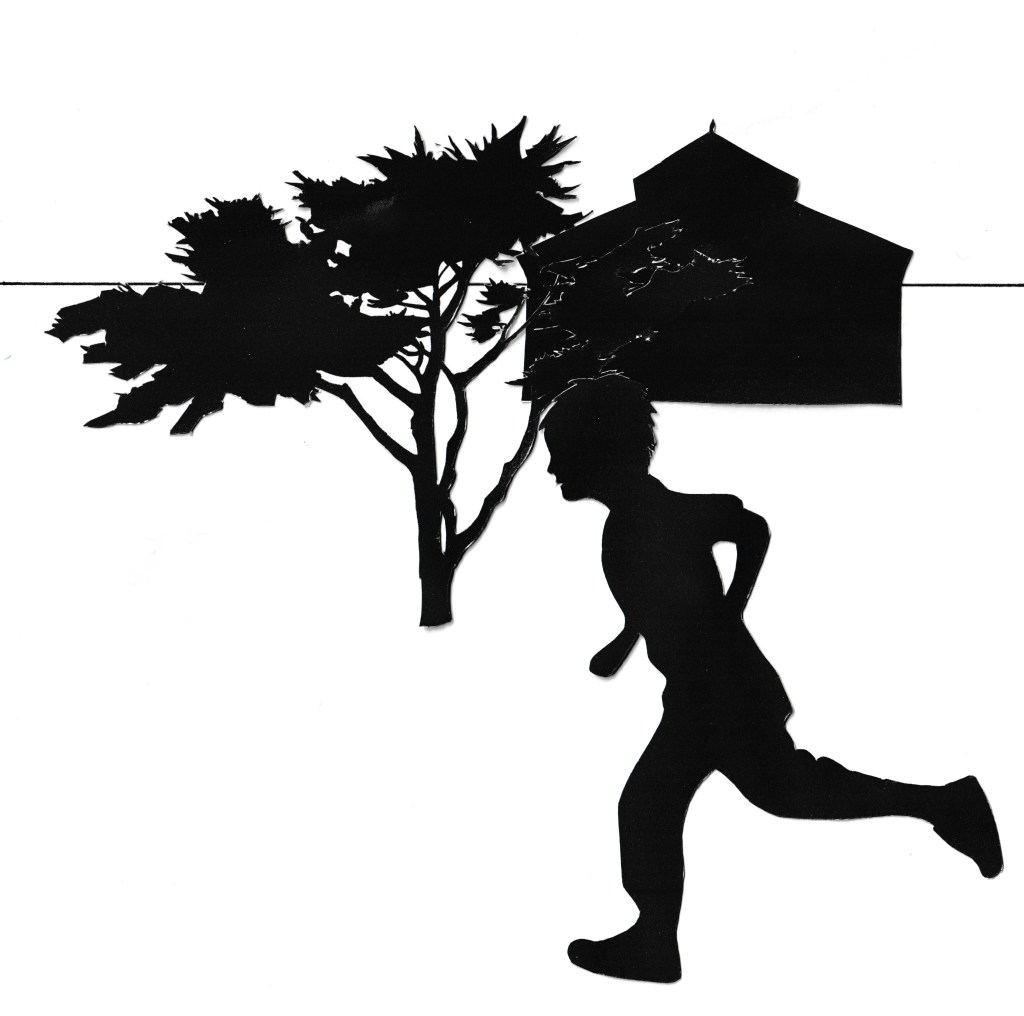
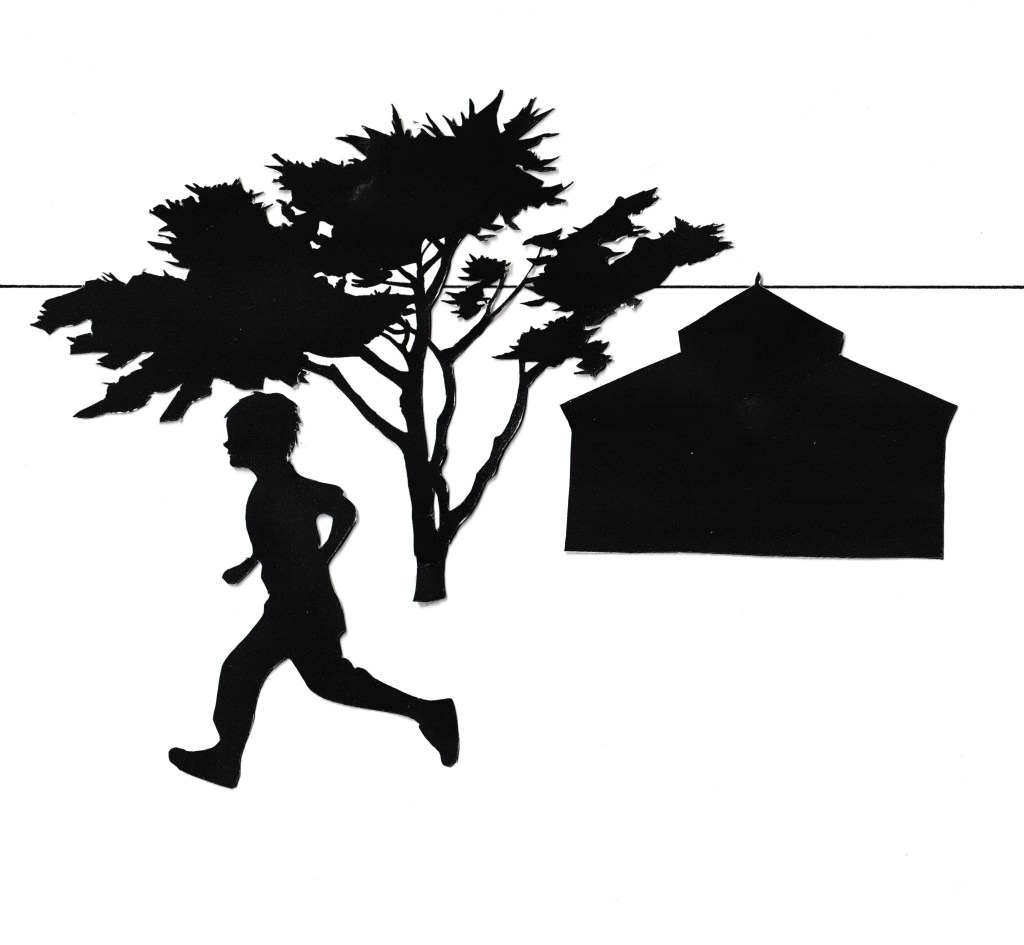
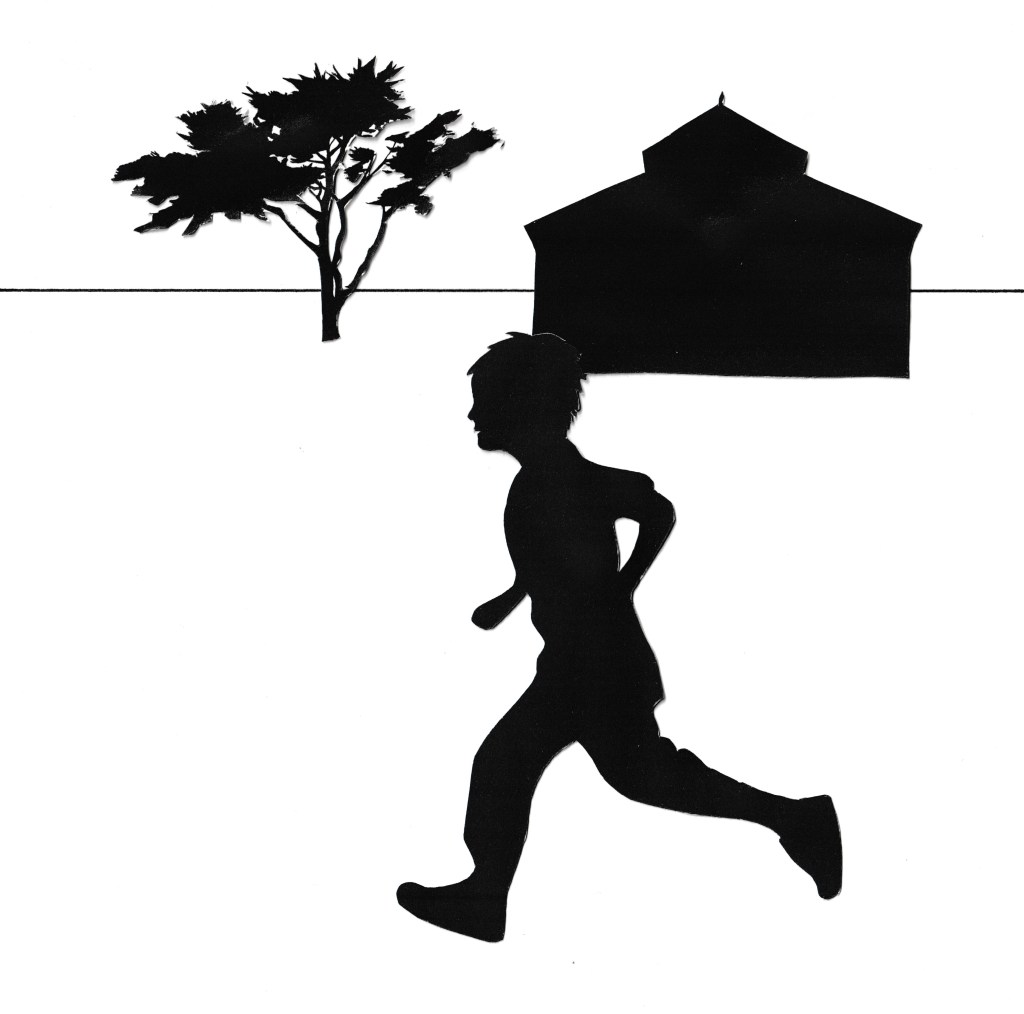
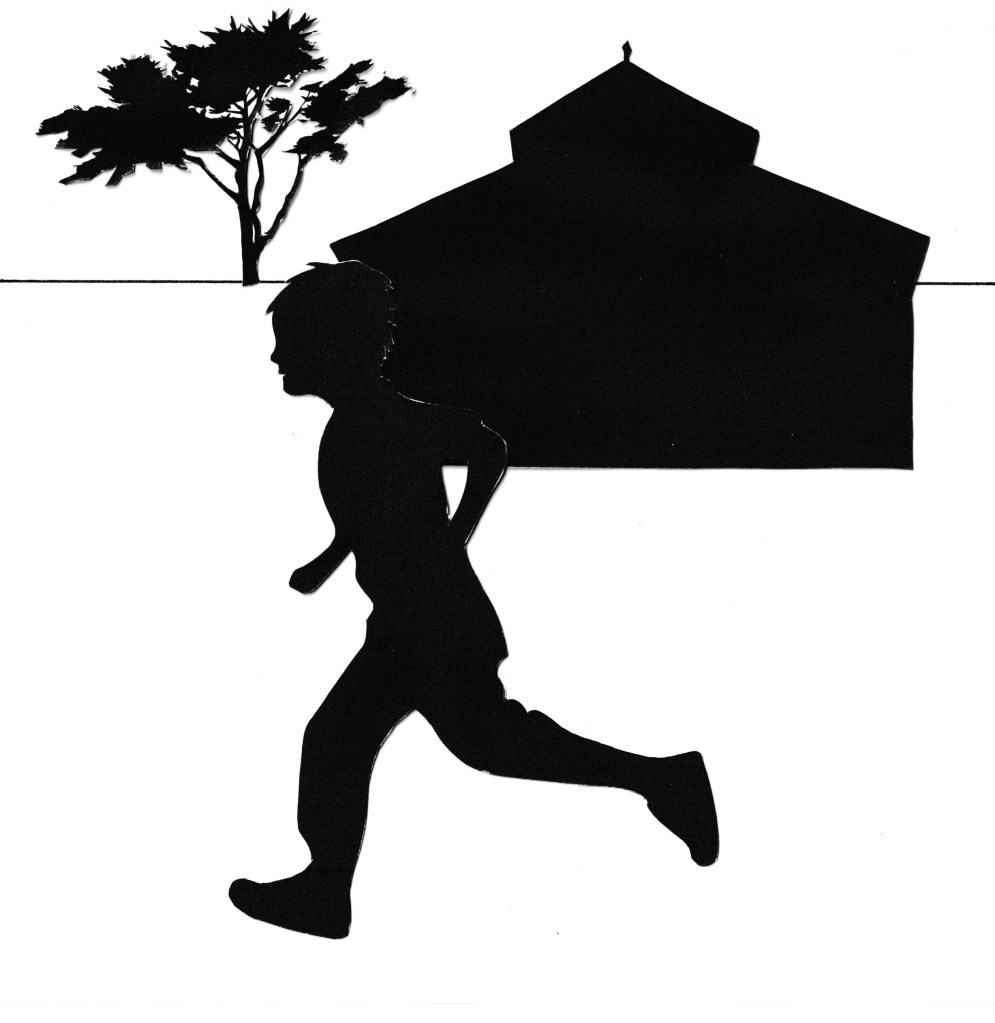
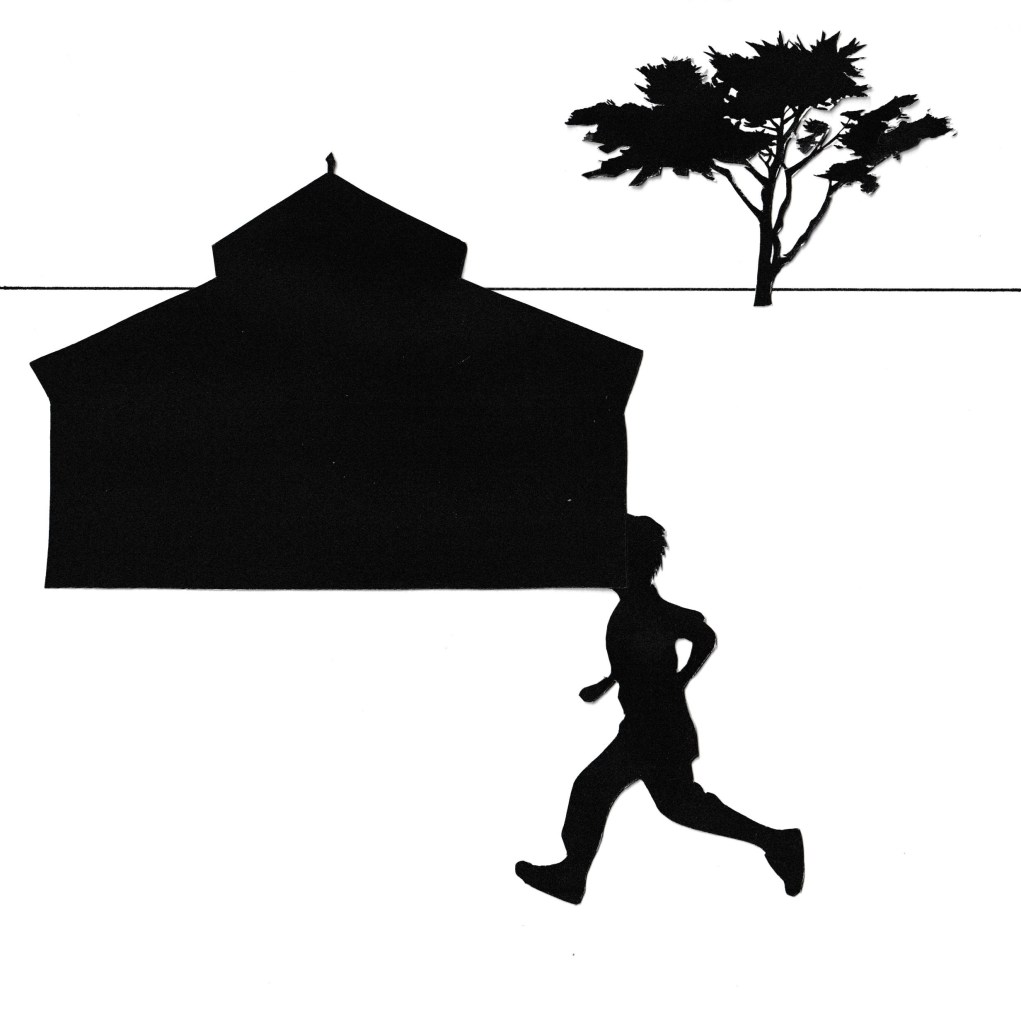
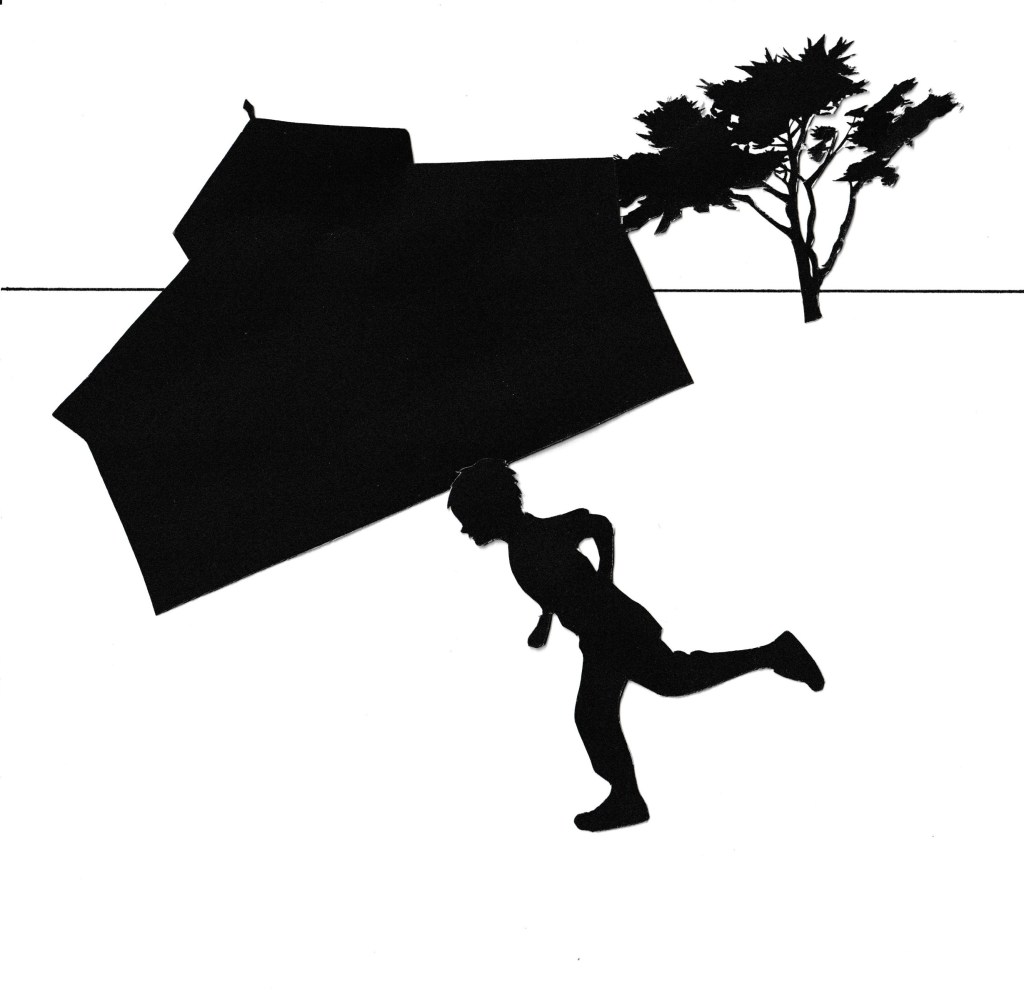
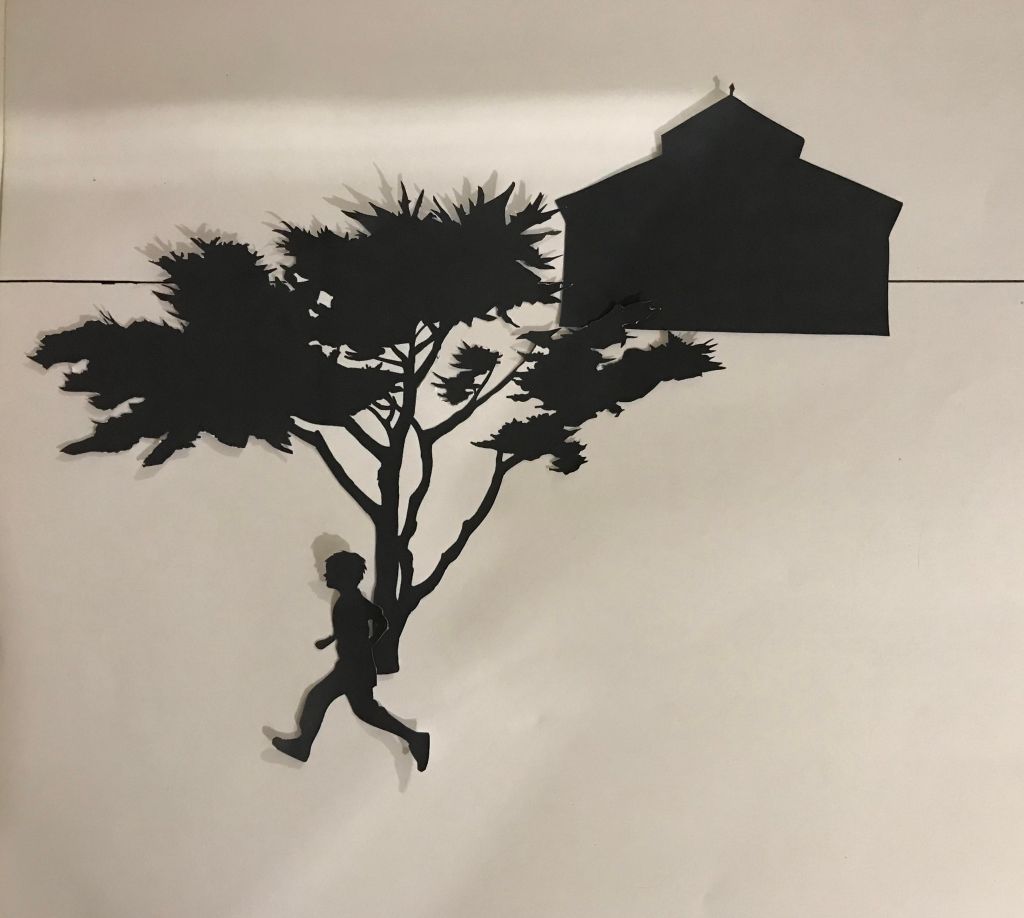
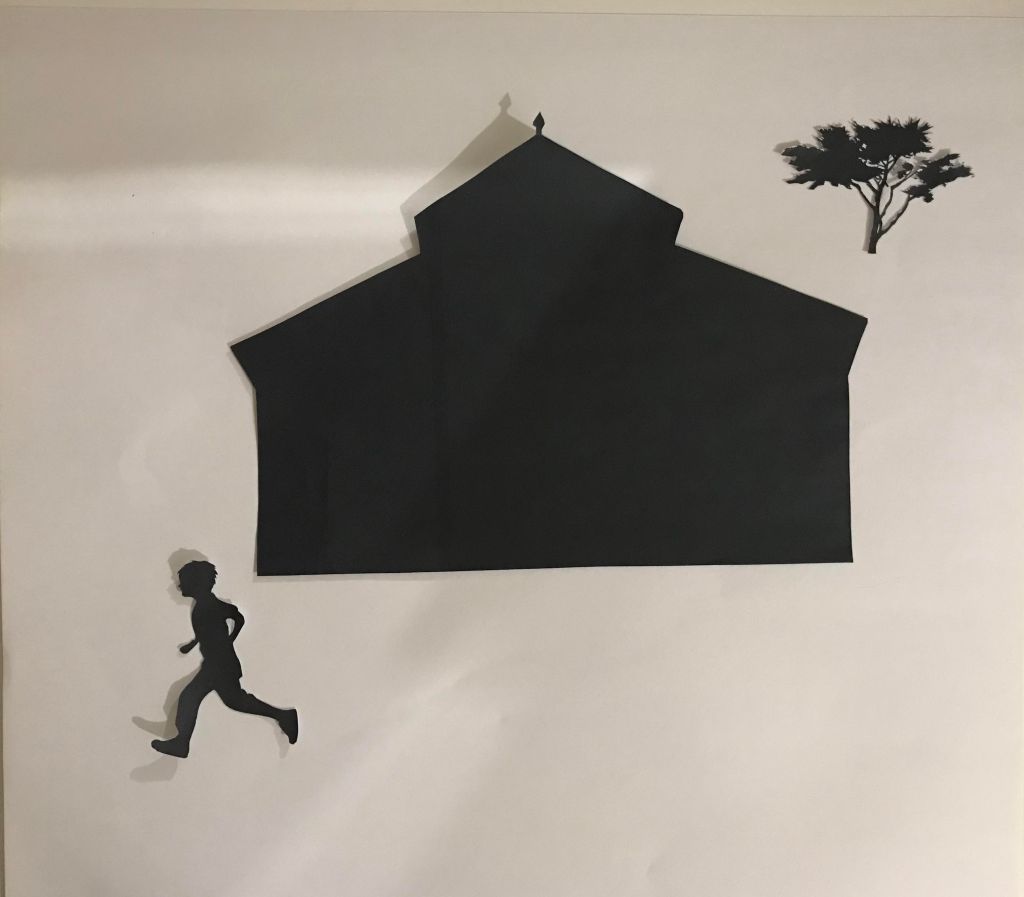
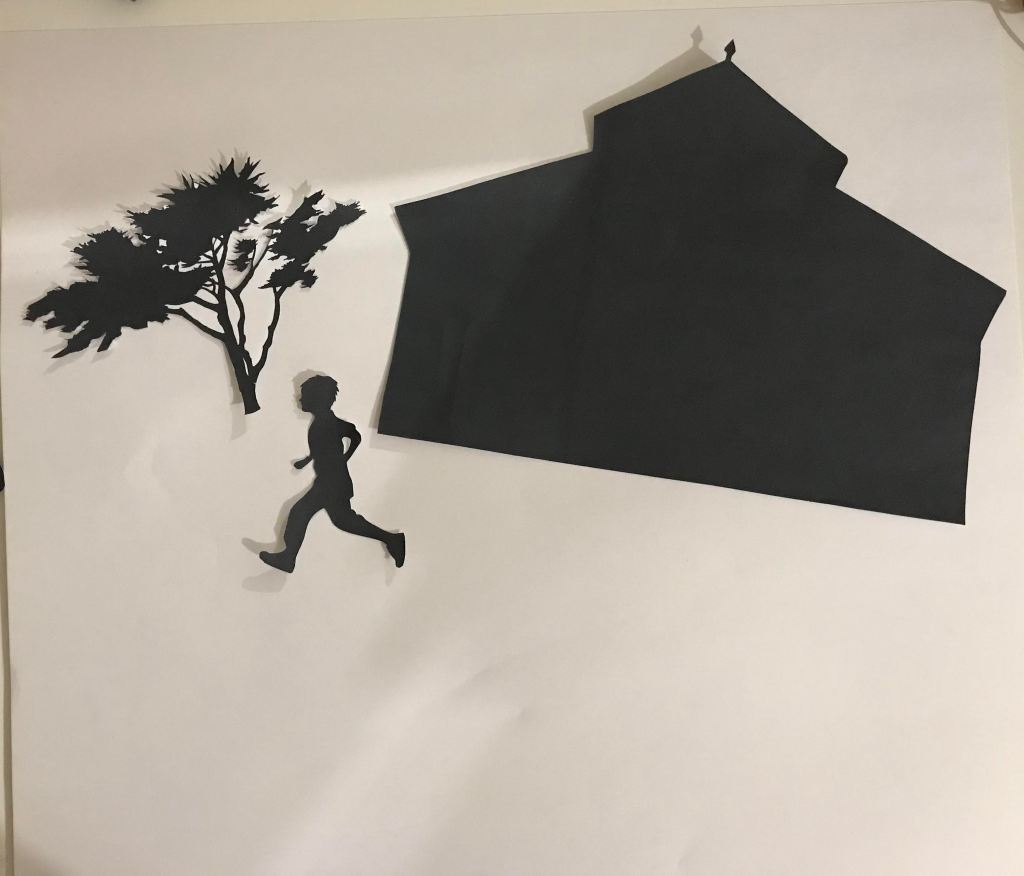
For this exercise we were asked to; use Internet searches or our own visual references for each of the following: a tree, a child running or walking, a building.
We were then asked to photocopy them in black and white in different scales and sizes, so that we have several versions of each image. Cut them into individual items with which to work.
Working the square format, arrange some of the cutouts to create a representational image. We may use the distortion of scale of one element compared to another to create an image which is interesting visually.
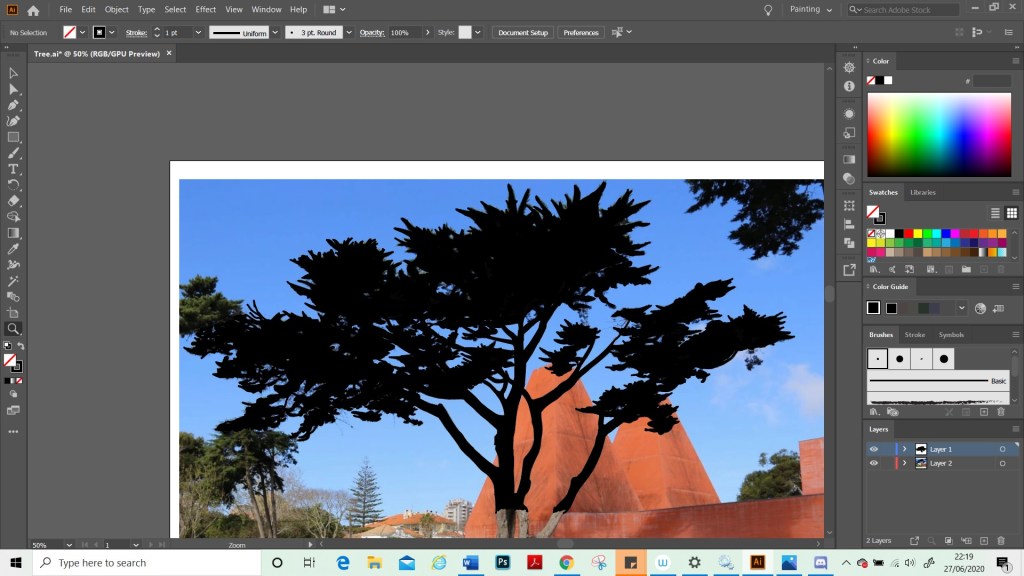
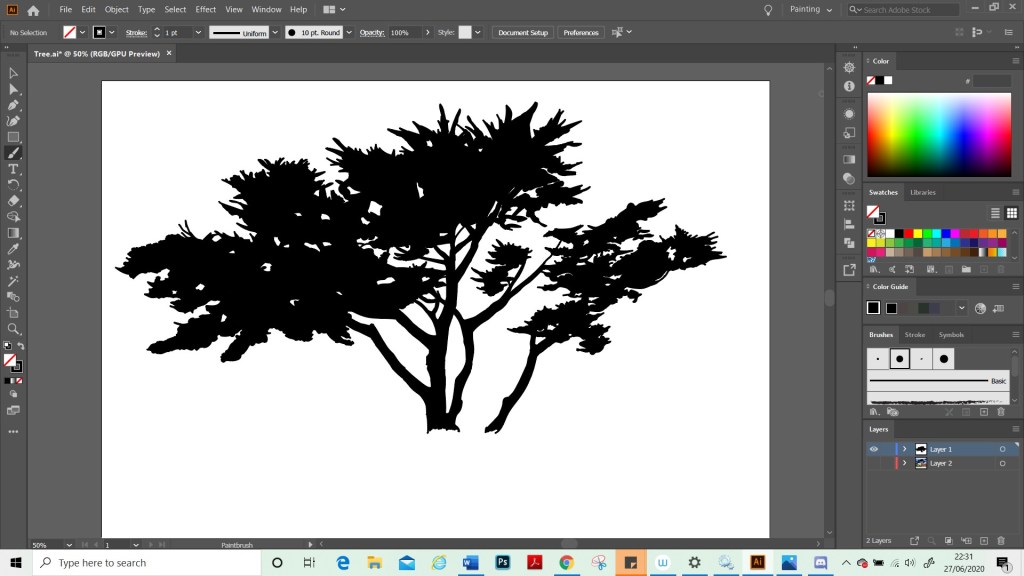
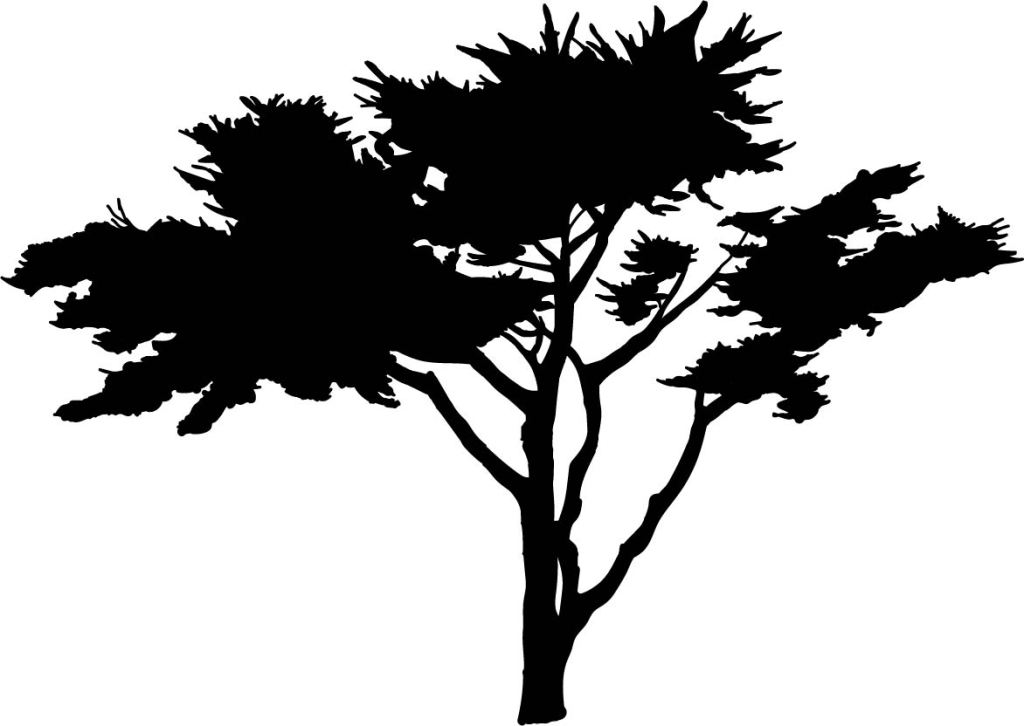
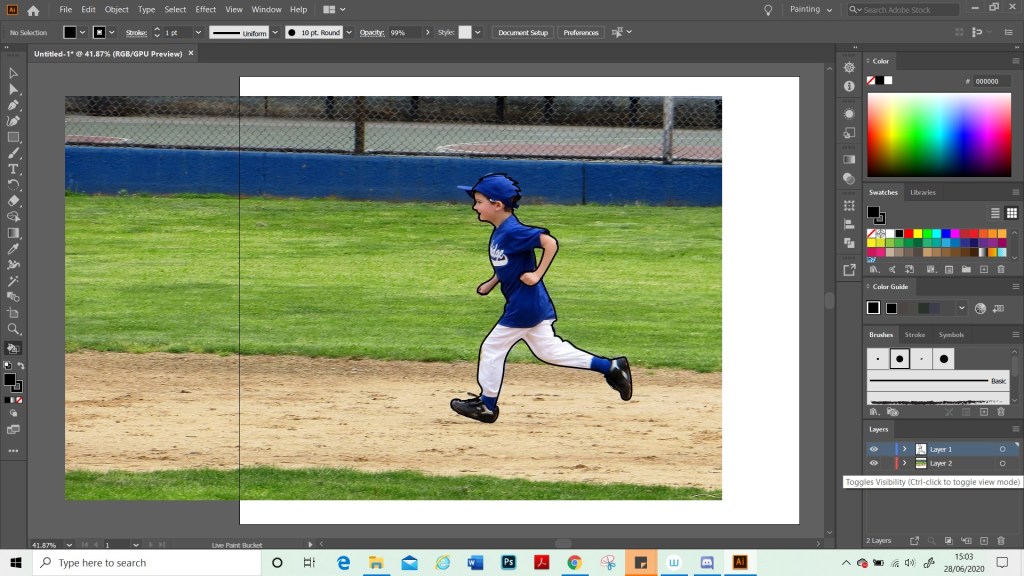
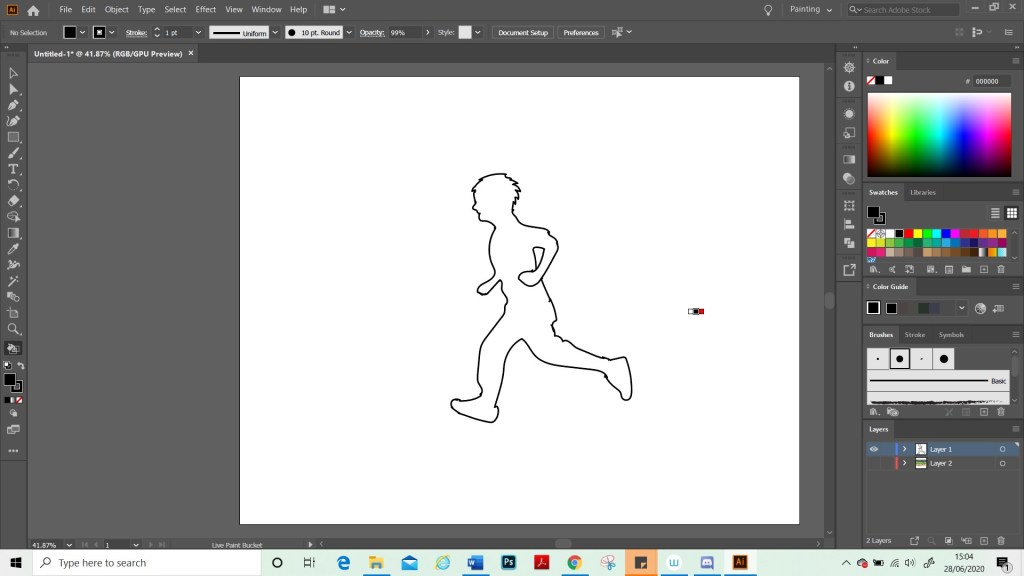
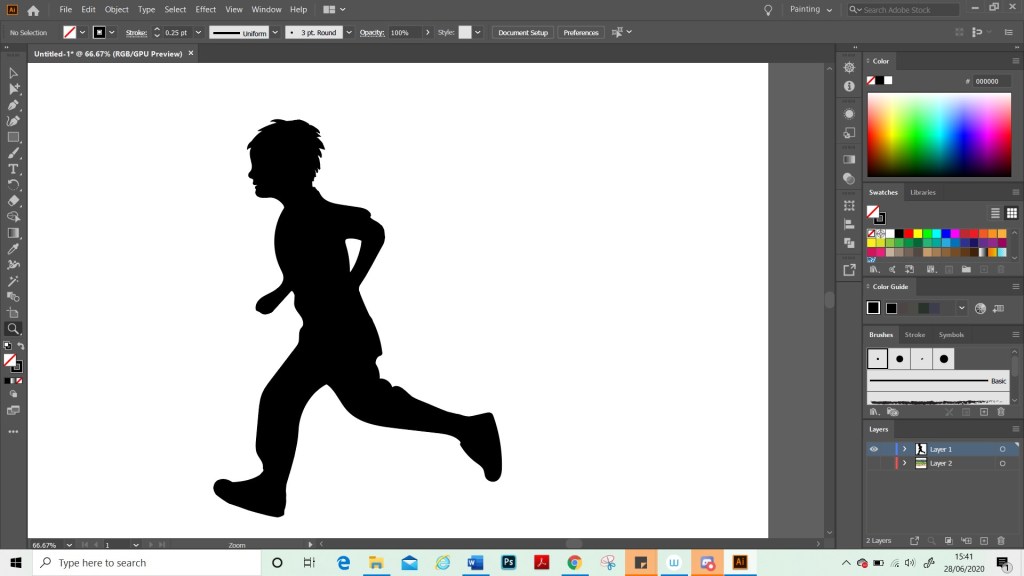
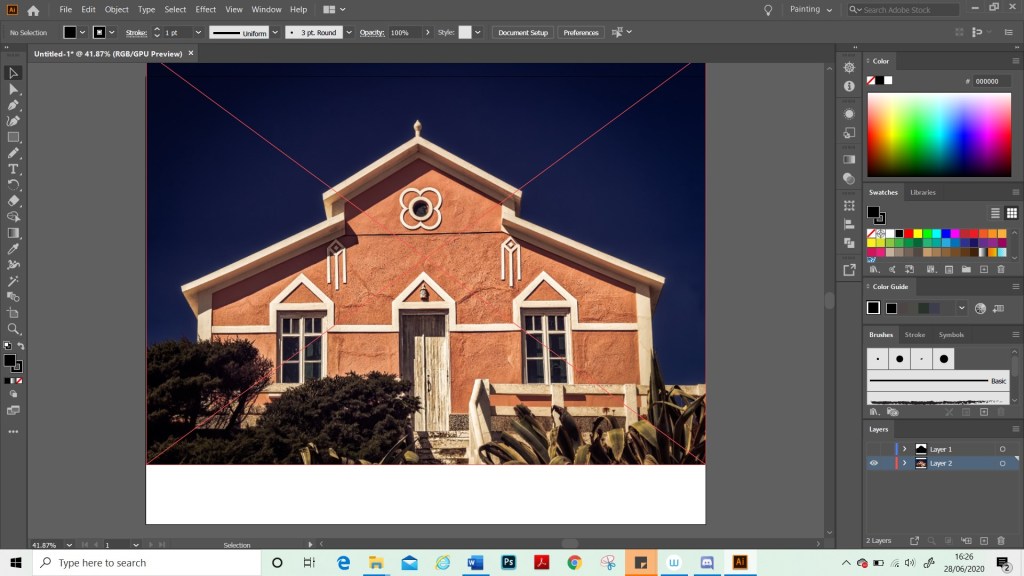
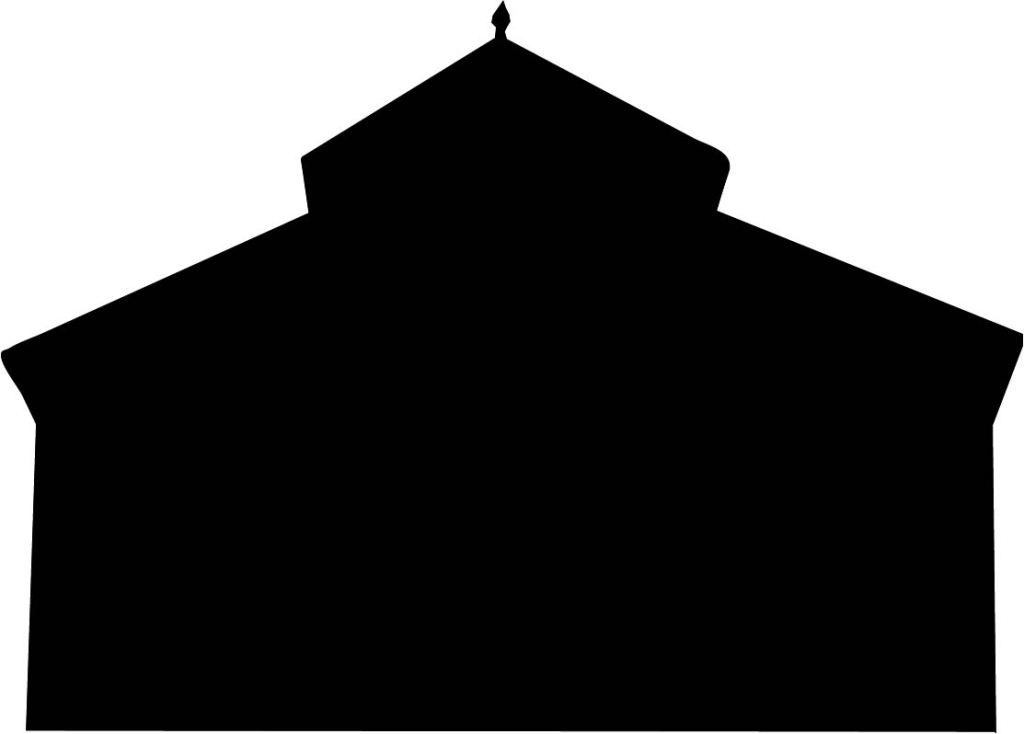
For this exercise I decided to try using Illustrator for the first time with my tablet as this is software that I would like to learn. I used a photograph that I have from my Lisbon trip and used it as a template and traced the tree. I really liked how the tree was coming out. However, I realised for this exercise that, as I have to cut out the tree I needed less detail. I saved a copy of what I had done and then on a new file, I filled in the gaps on the tree. Once I was done, I printed this out in different sizes. I then did the same with the boy and the house. However, these images I found on Pixabay.
I originally started working on a large format, but then realised I would not be able to scan these into my computer so I changed to a smaller format. I also realised that I had not fully understood the brief and that the images were meant to be black and white, not black on white. However, this still seemed to work okay for this exercise.
Test 1
Test 2
Test 3
Test 4
Test 5
Test 6
Test 7
Test 8
Test 9
Test 10
Test 11
Test 12
Test 13
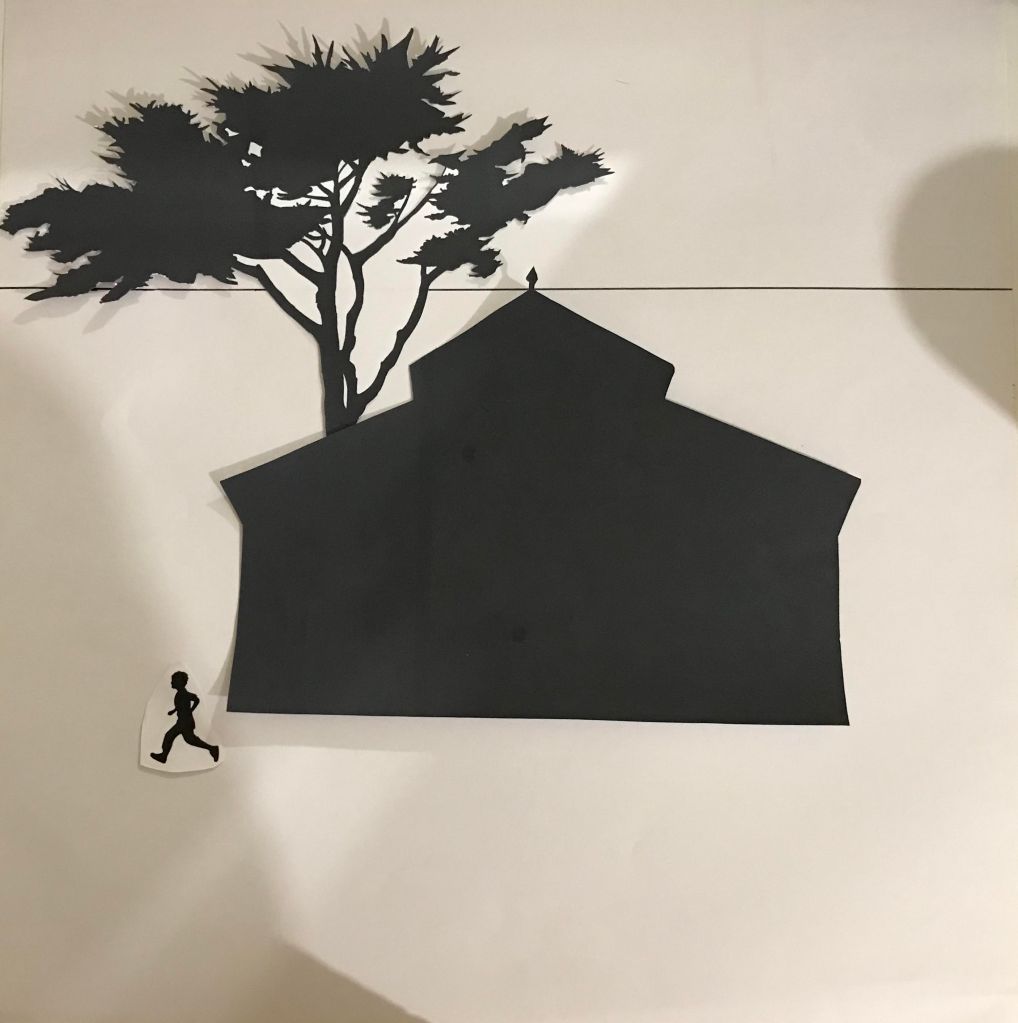
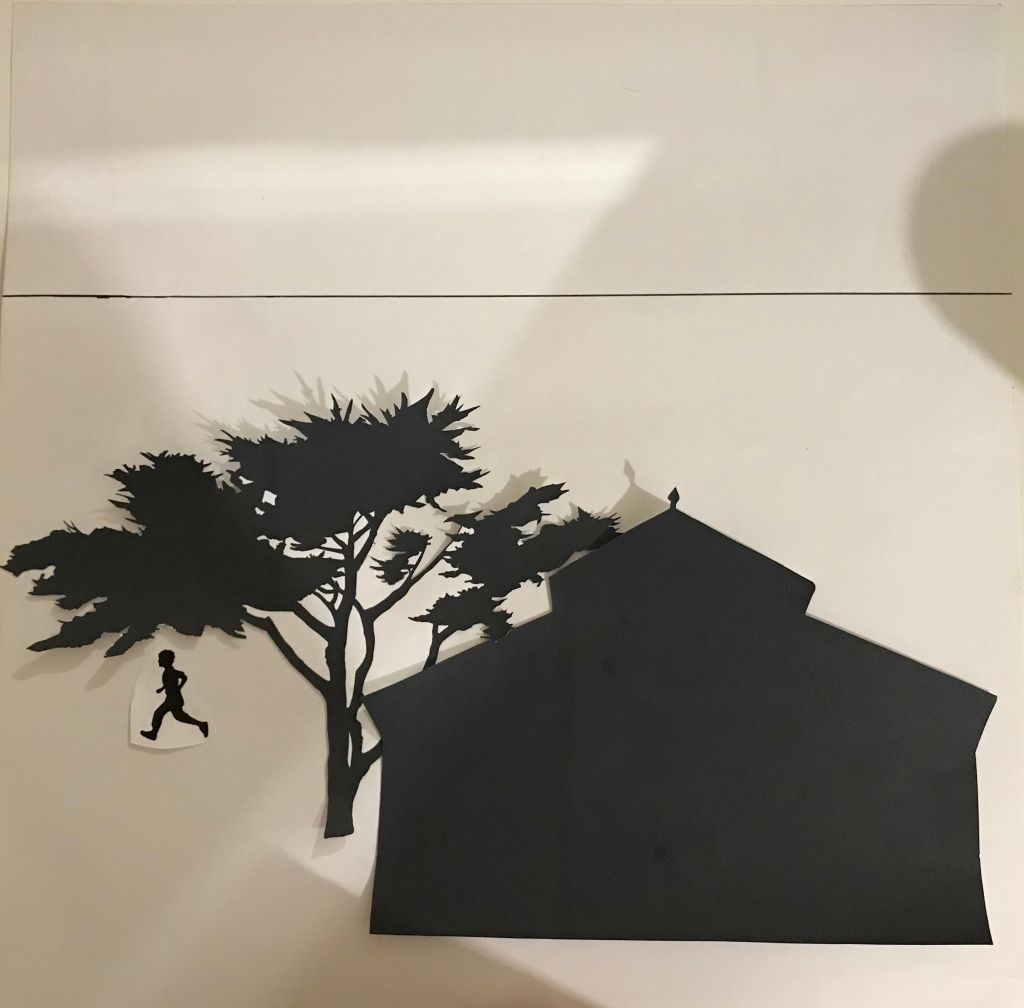
When the figure is smaller than the other elements. It makes me wonder what he is doing. It makes my eye travel across the page with him and adds a sense of intrigue. The figure may seem less significant and this gives the building and the tree more of an impression of grandeur and therefore they become overpowering in the image. In some instances, such as test 12, the figure would need to be a lot smaller, so that he would appear to be very far in the distance on the horizon. It was difficult, however, to print him so small, perhaps a tiny drawn figure would have worked better in this instance. When the figure is smaller, it looks as though he is perhaps just jogging or playing through the land around and pass the house. In contrast, when the figure is large as in ‘test 4’, he almost looks like he is running away from something. The large size of him seems almost to create a sense of urgency. Although, of course, he could simply be running for fun as well.
When the elements are right differing angles to each other and at an angle to the frame. This changes the dynamic. I struggled with this as I could not find a way to place my images that made sense. As in ‘test 6’, where it could perhaps suggest that the house and the boy are on a hill. However, I found that in this particular image, it just looked very odd and did not particularly give that impression. I imagine that with different elements such as a tall building that perhaps this would be more effective. However, I believe in test nine that giving the element a slight incline did work better and created the sense of the house being on a hill. Having elements at differing angles could also incite a sense of chaos or perhaps a different world.
When all the elements are completely horizontal and vertical in relation to the frame, the dynamic is one of being grounded and realistic. This makes sense to me and feels familiar to the and therefore does not suggest a different world to our own. Nothing seems out of the ordinary and a sense of realism is suggested. A sense of calm and order.
My favourite composition is ‘test 1’. I like the spacing in between the elements as I feel that this creates a sense of depth to the composition. I also feel like it adds to the story as it makes me wonder where the boy is going and if there is significance to the house and the tree in the background in relation to the boy’s story or if they are just passing elements. I like that the boy is the focus of the frame and I really like the way the tree is overlapped in front of the building to create a sense of dimension and interest. The tree and the building that I chose for this exercise are references from Portugal. I chose these as I already had the image of the tree that I thought was a very appealing shape so I wanted to match the building to the place to set the scene. I do not think that you can tell where this image is based on these elements, however, I do feel that it creates a more interesting composition when the elements are more varied in their shapes and this made it more fun for me to work with. The are a few other compositions that I like to, such as test 2, 4, 7, 10 and 13. I feel that these layouts are also interesting or at least work, whereas the others I am not particularly keen on as I feel they are a bit bland and uninteresting.
Reflection
By doing this exercise, It has made me realise that there are a lot more options that I can and should be exploring when I am coming up with compositions. And that by trying out different compositions, I may find one that works better than my original idea. It may also be that by exploring my options, I may find the composition that I was going to go with, reads in a different way than I had intended. Therefore, by experimenting more, I may find a better composition that presents my story in a more effective manner.
I think that I understood the brief. However, I feel like I was missing an opportunity to explore interesting compositions as I was not quite sure how to go about this with just my free elements and the particular shape of the building. I had, I do feel perhaps if I had had a different element will shape building, or perhaps a much smaller size of building that maybe then I could have created more compositions with the elements being at differing angles to each other and to the frame. I am glad that I got to use this exercise is a chance to start to learn Adobe Illustrator and I am feeling like I am learning a lot of different things at the moment, which is very exciting and I look forward to being able to incorporate the things I am learning into my future work.
The brief for this assignment was to create images which will be used within a campaign for a supermarket to package and promote a range of seasonal foods.
We had to create an illustration of fruit or vegetables. One illustration for each of the ranges; summer and autumn.
These images were to be objective and based upon direct observation. The brief asked us to consider putting ourselves in the place of the customer and asking, ‘does this look edible?’, ‘Would I like to eat it?’ They asked us to be especially conscious of the way we use colour to describe tone, shadow and surface marks as poor colour choices can result in good-looking, mouldy, battered or ultimately unappetising.
I considered these questions and remember reading or hearing about this topic before with making sure that colour and texture are considered in food illustration to make sure look appetising.
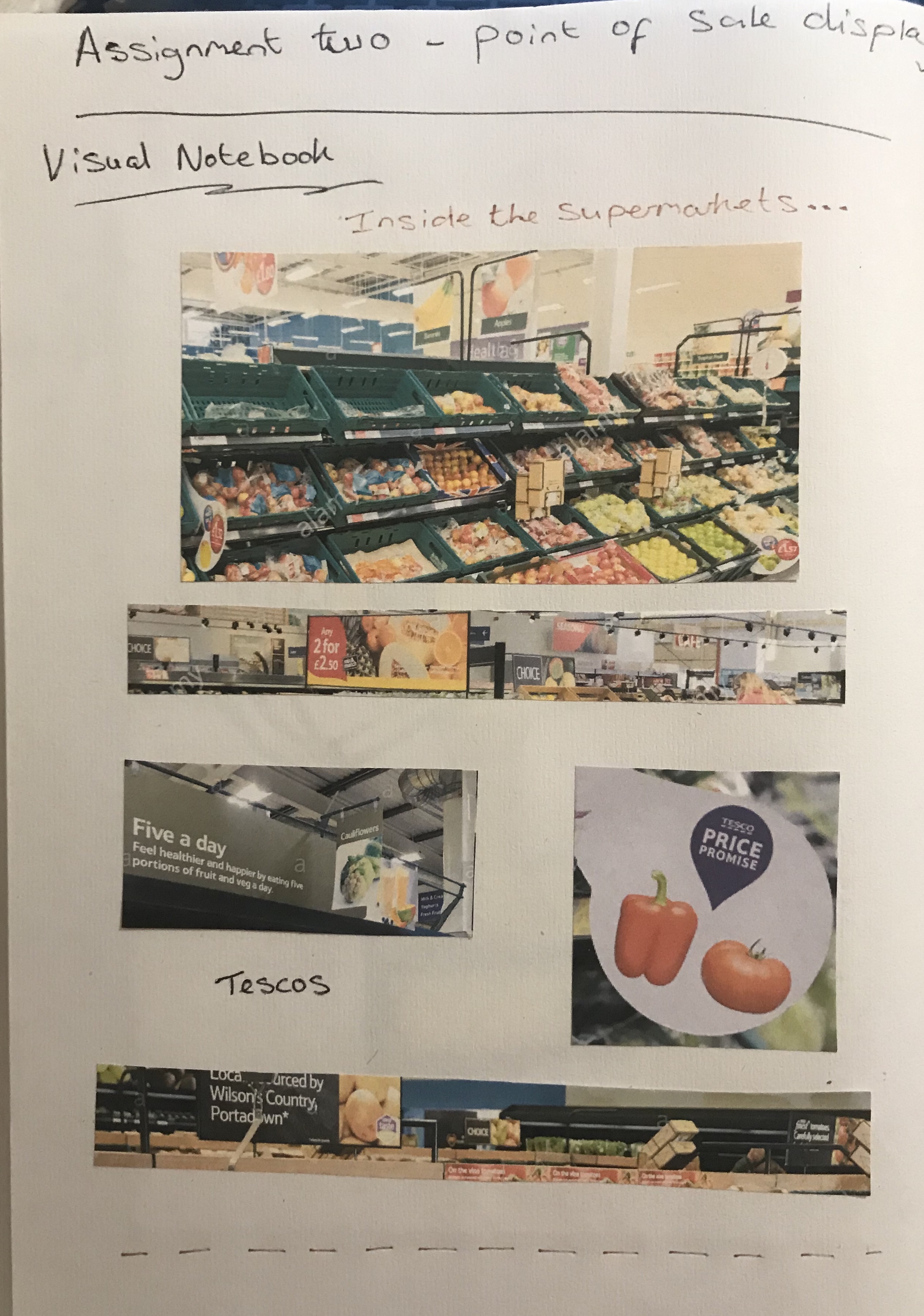
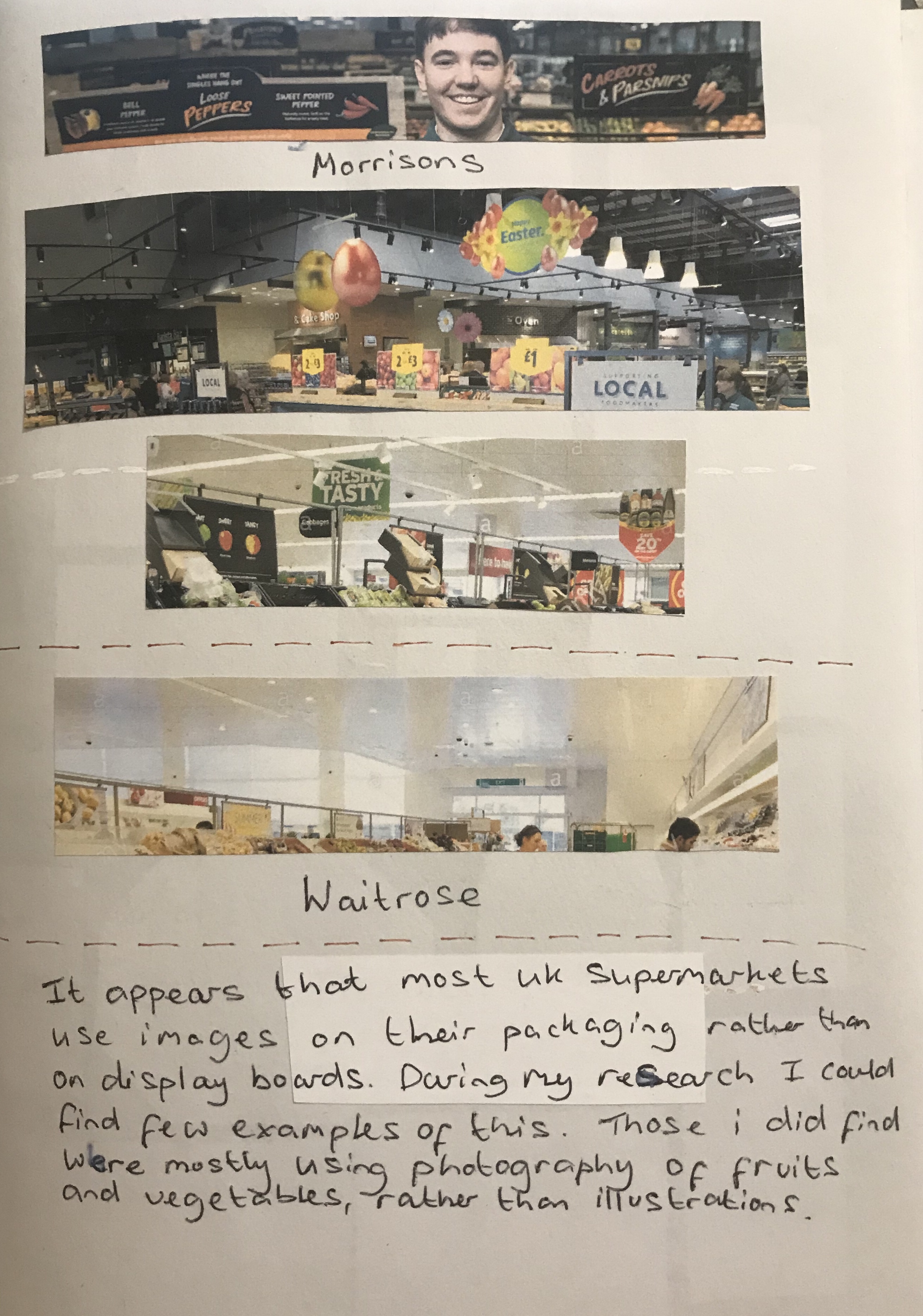
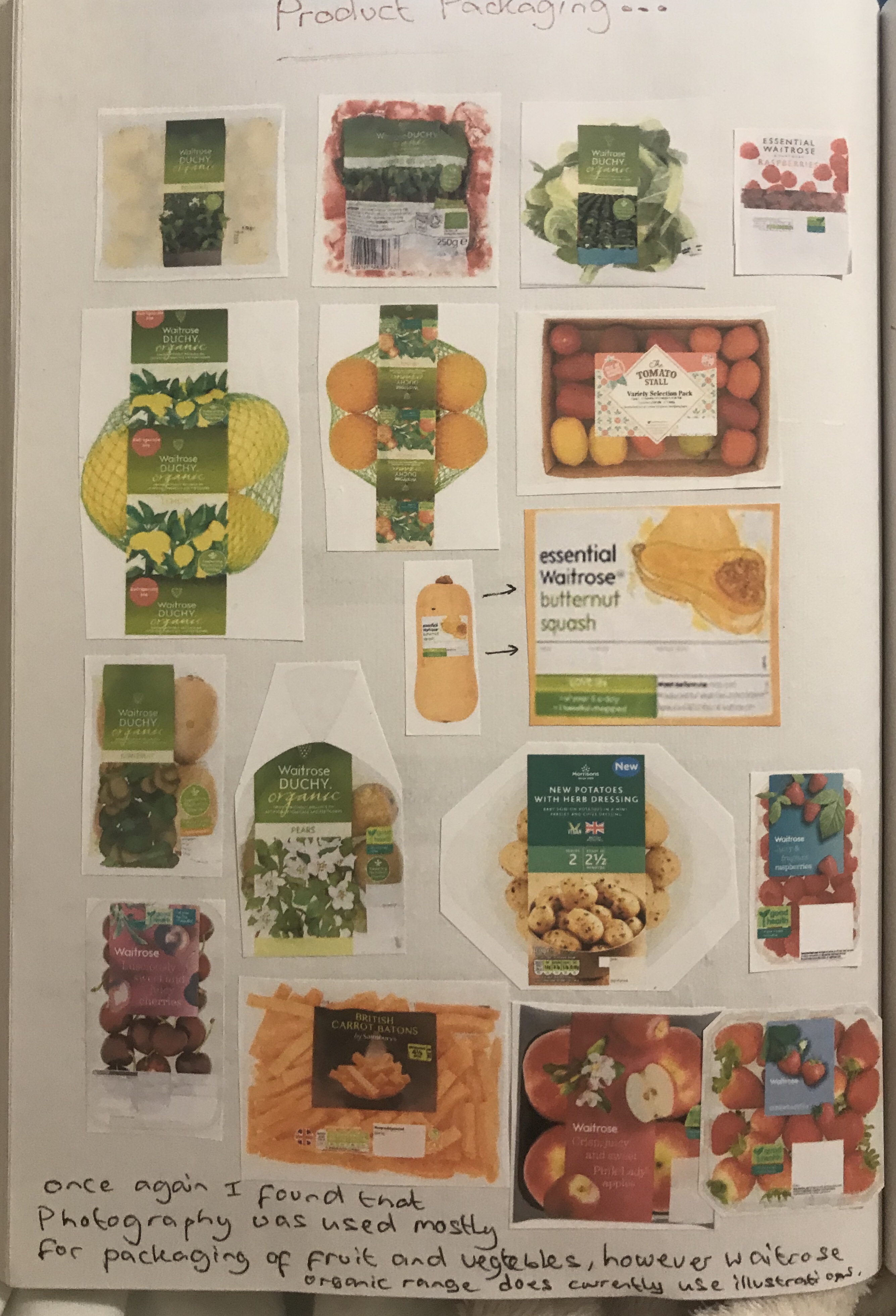
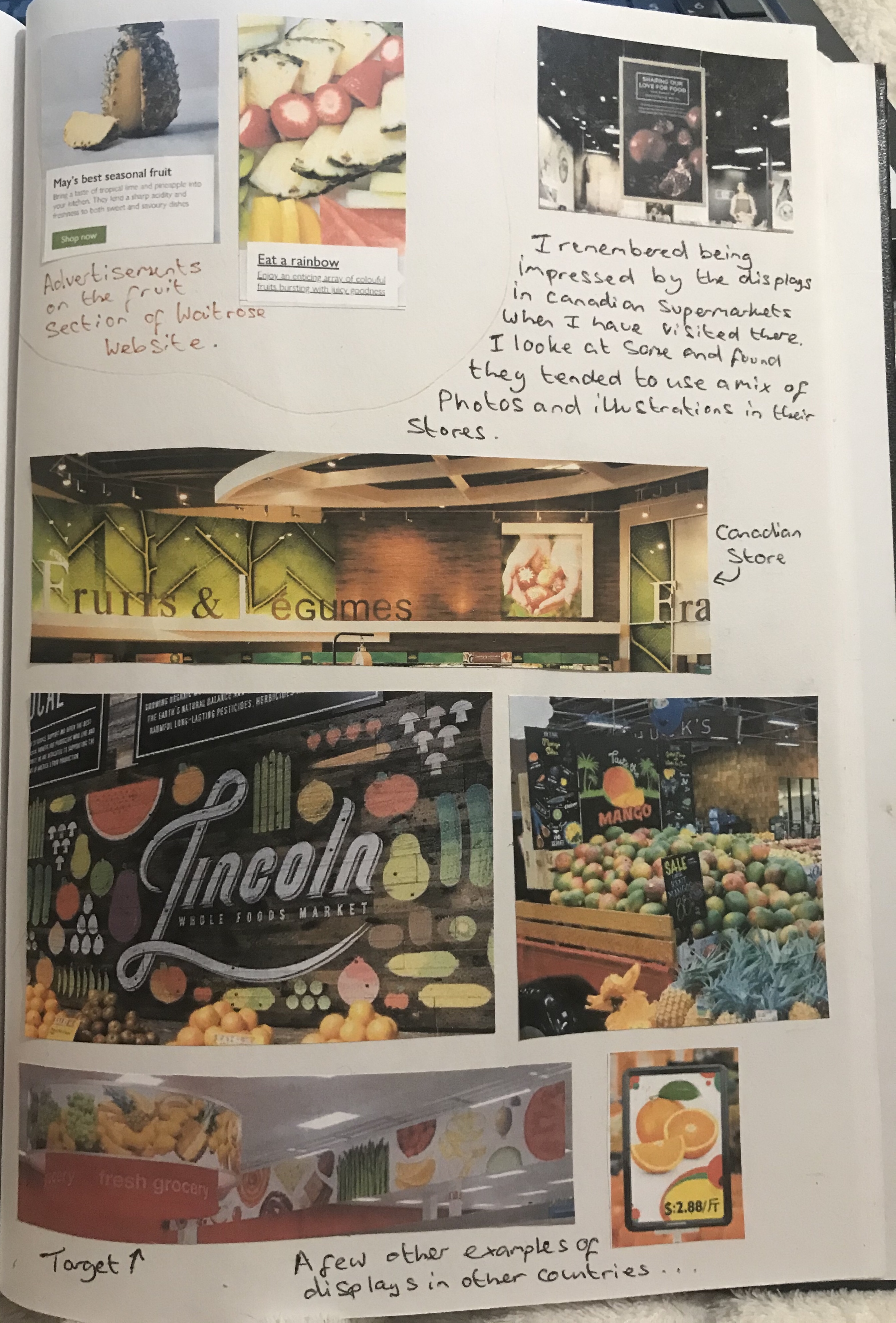
With a visual notebook and used the Internet to find photographs from inside supermarkets. I would have gone to visit some stores, but due to Covid this was not going to be practical and I was definitely not able to take photographs in store. I did struggle to find examples of display boards and illustrations on fruit and veg packaging in the supermarkets. Partly this was due to the fact that most of the supermarkets actually use photographs rather than illustrations for their display boards and illustrations in hand display boards are generally used for other items in store and other sections more than the fruit and veg aisles.
I did however find a few examples and found that Waitrose in particular does use illustrations on the packaging and I looked at the artist’s work on her agents website which showed these illustrations. The majority of examples of more elaborate display boards using illustration, I actually found in other countries such as Canada and America.
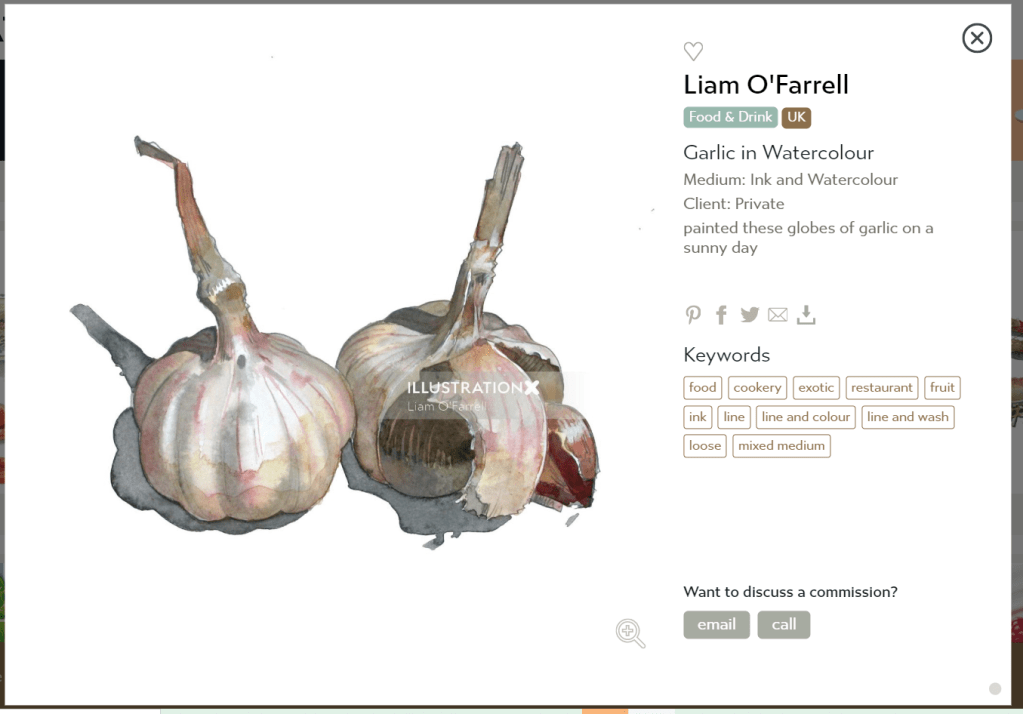
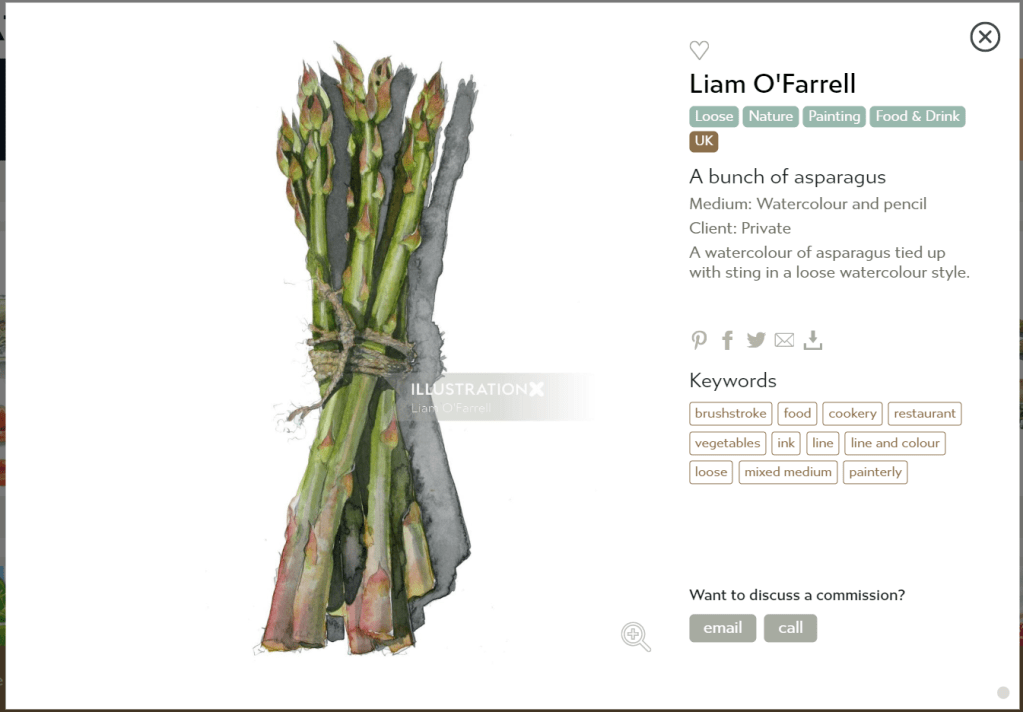
I looked at food illustrators work and found varying styles, some of which I did not like so much and some of which I really loved such as Liz Pepperell. Her colour palette is really rich and I love the way she makes food look tasty, particularly the one she did with the orange pieces that look really juicy. Another artist’s work that I loved is Liam O’Farrell. I really love the colour palette uses and the style of his illustrations. They remind me of another artist named Holly Exley that I have seen do food illustration, amongst other types of illustration. She tends to use lots of blues and purples in her shading, so her images are not realistic, but the colour palette is very beautiful and interesting.
I had a go at copying a couple of the artists illustrations or illustration style. However, this did not go well. I found it extremely difficult to decipher what it was they were doing with their paint and realised it was better that I did not try this and just tried my own being inspired by their colour pallets rather than trying to use too much of their styles.
My failed attempt at studies of the artists work.
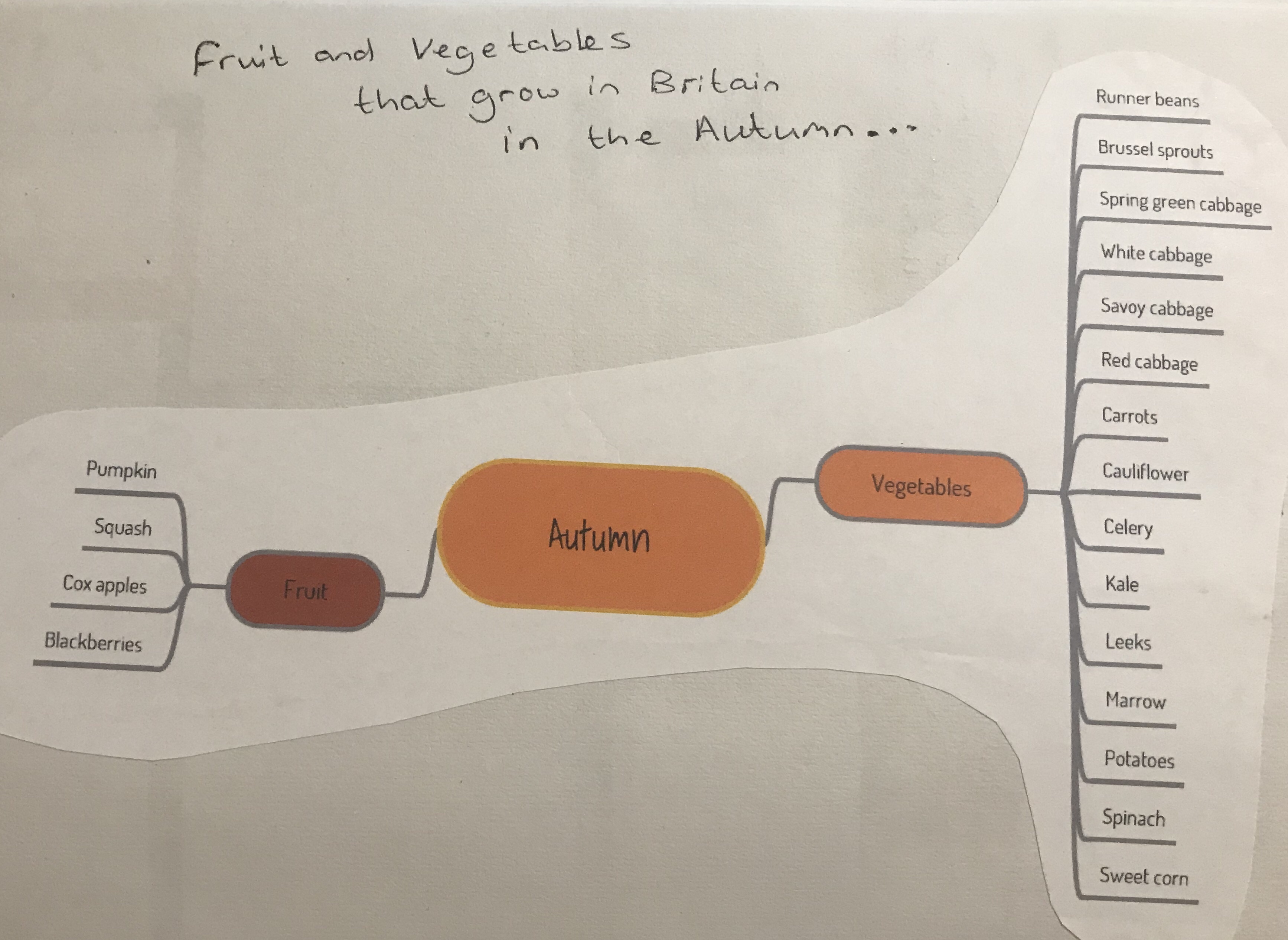
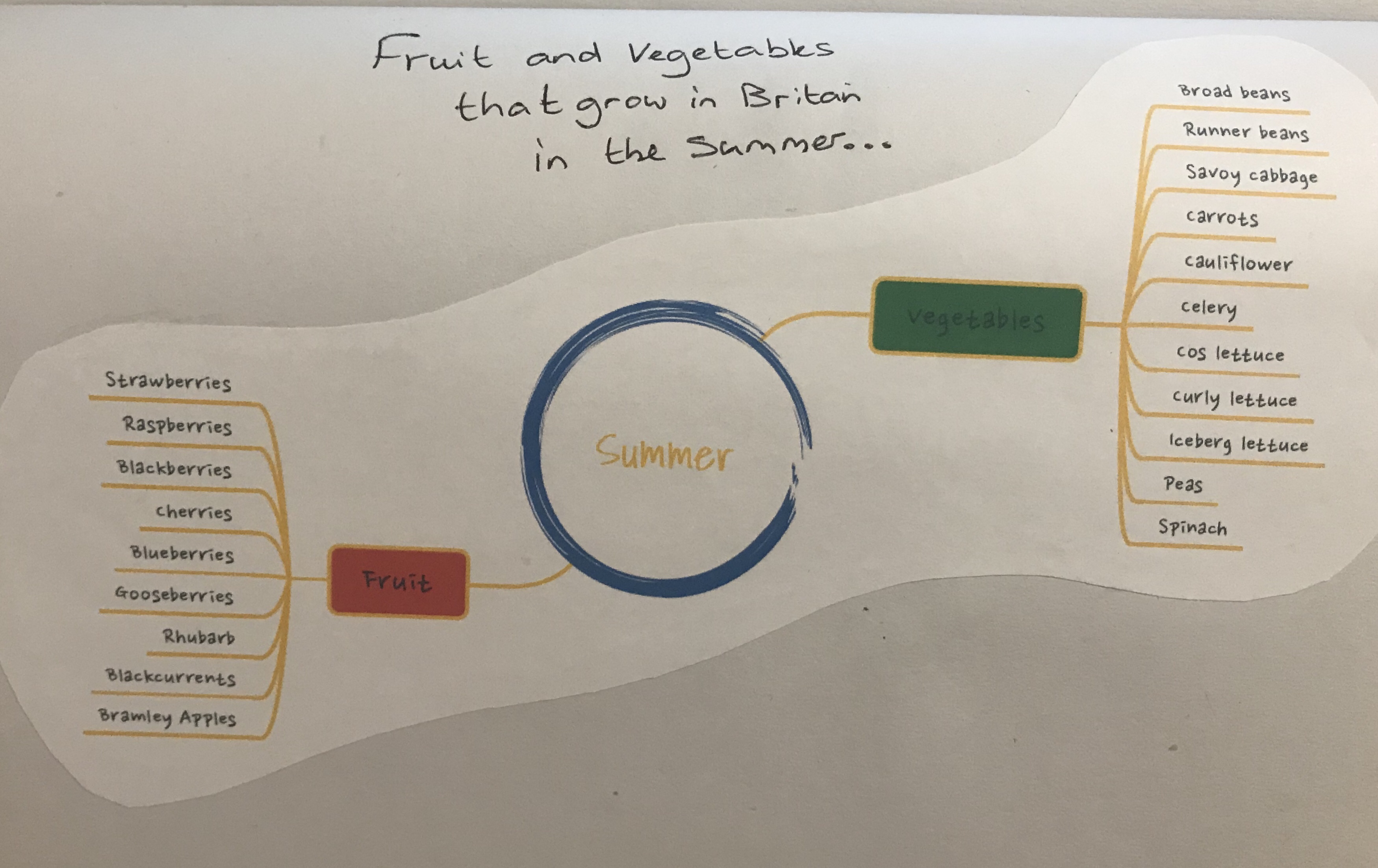
I did some mind maps of both autumn and summer fruits and vegetables to find out what grows in Britain during each season. From this I selected the fruits and vegetables to include in my mood board. I decided to go with summer fruits and autumn vegetables. This is because the autumn fruits list is a little sparse, whereas the autumn vegetable list is very long and therefore it made more sense to do it that way round. I was also quite keen to do fruit for my summer illustration.
Moodboard for Summer Fruit
Moodboard for Autumn Vegetables
My tests of painting autumn vegetables – Watercolour and Gouache.
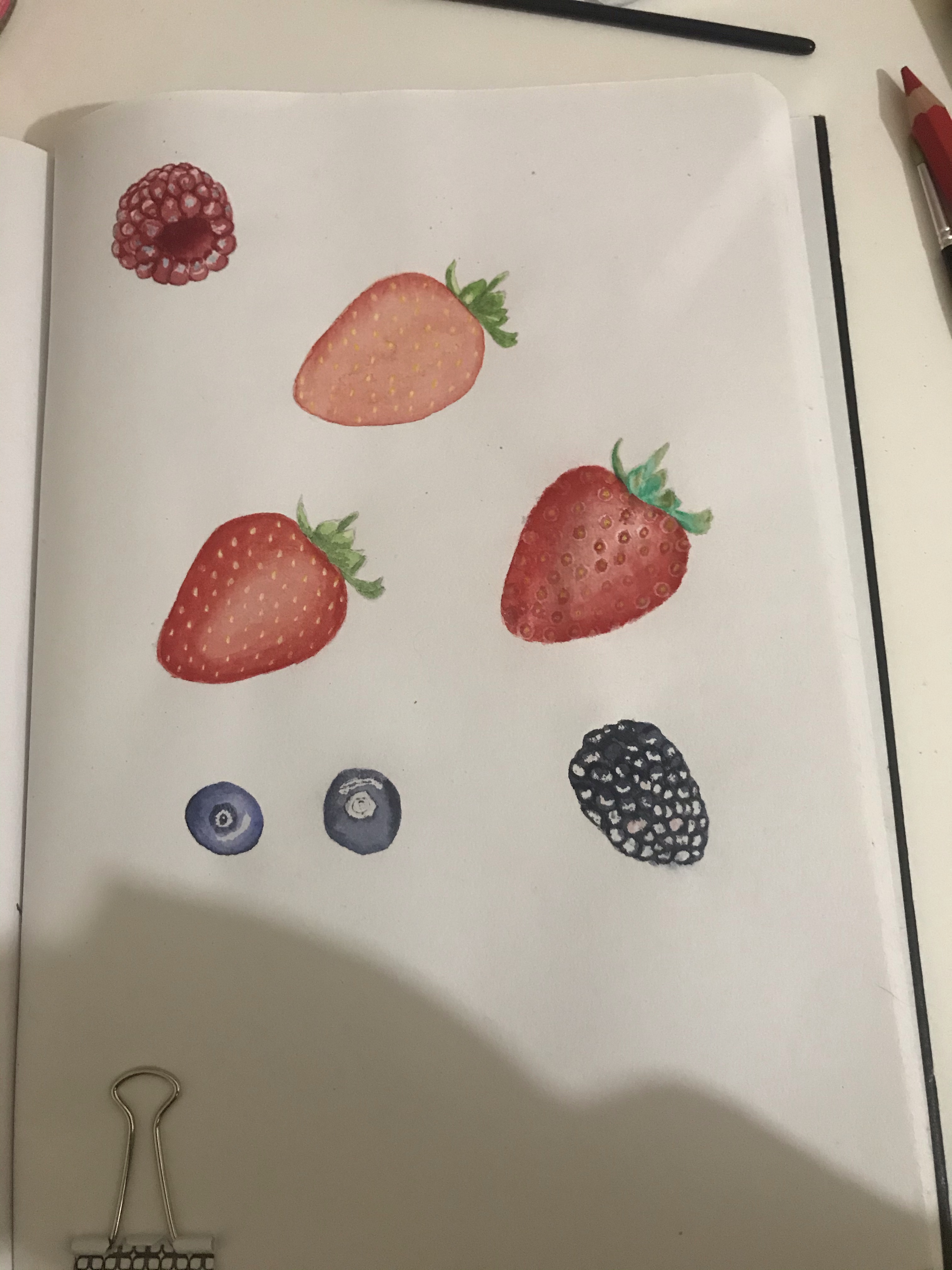
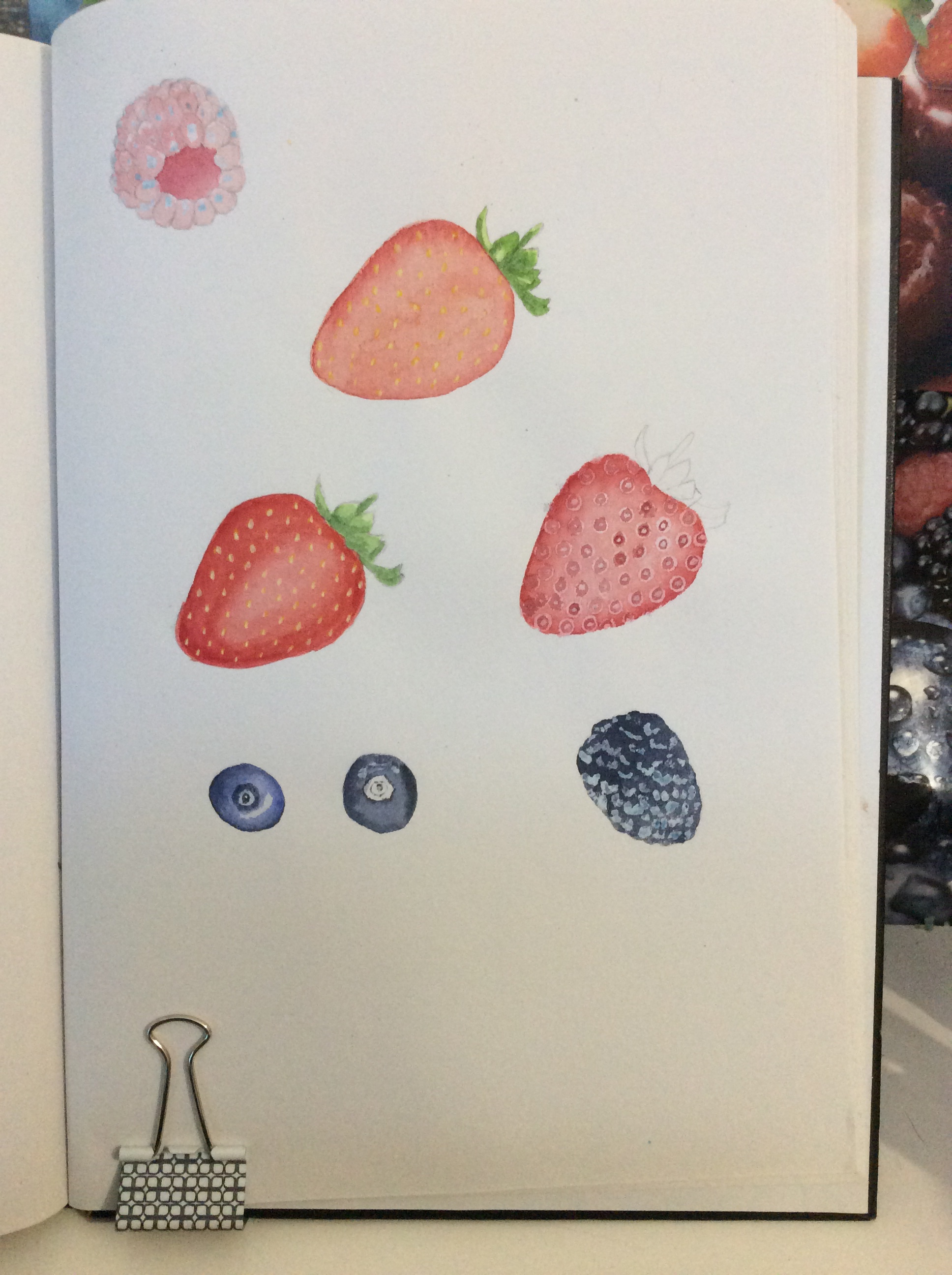
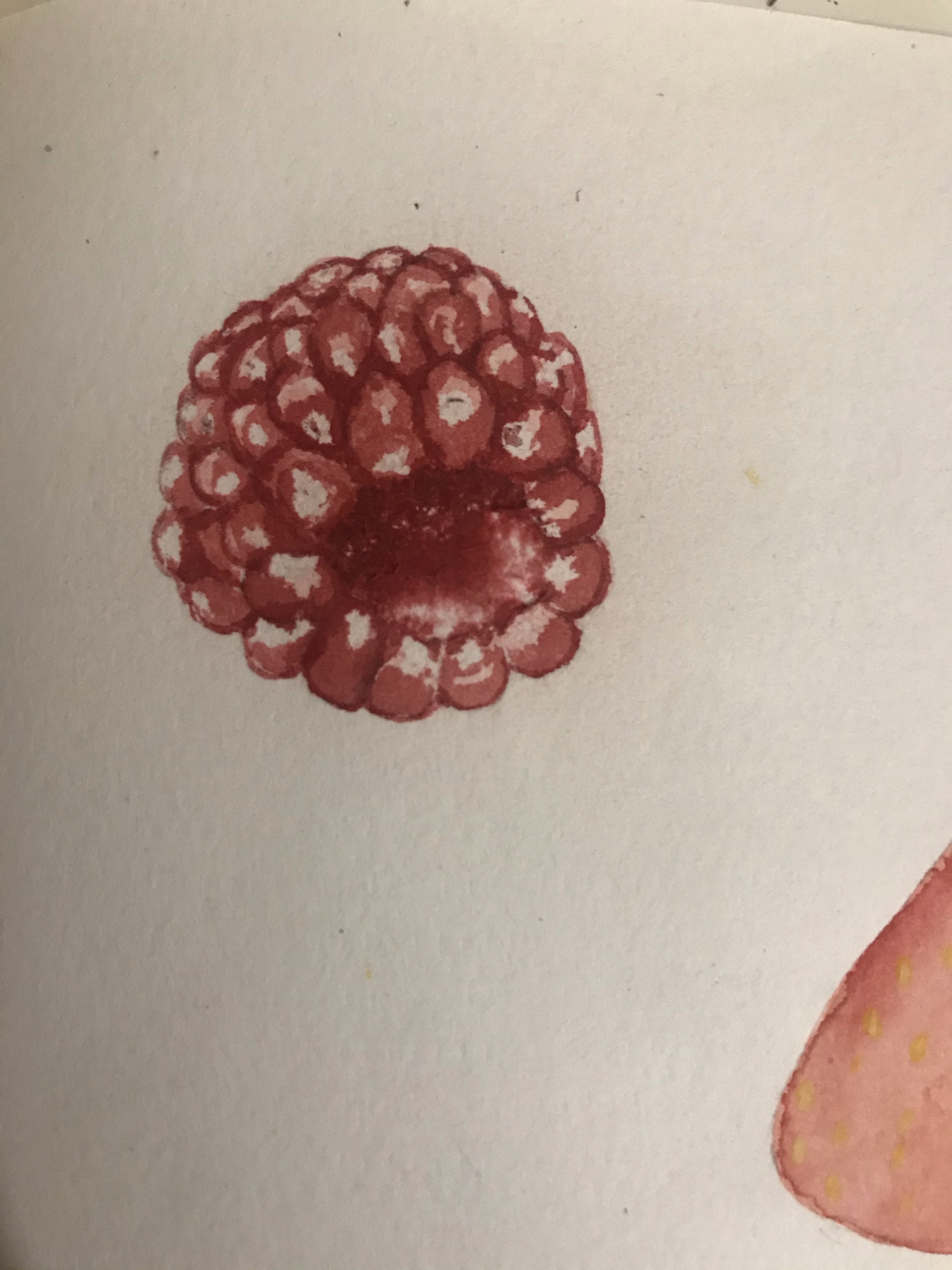
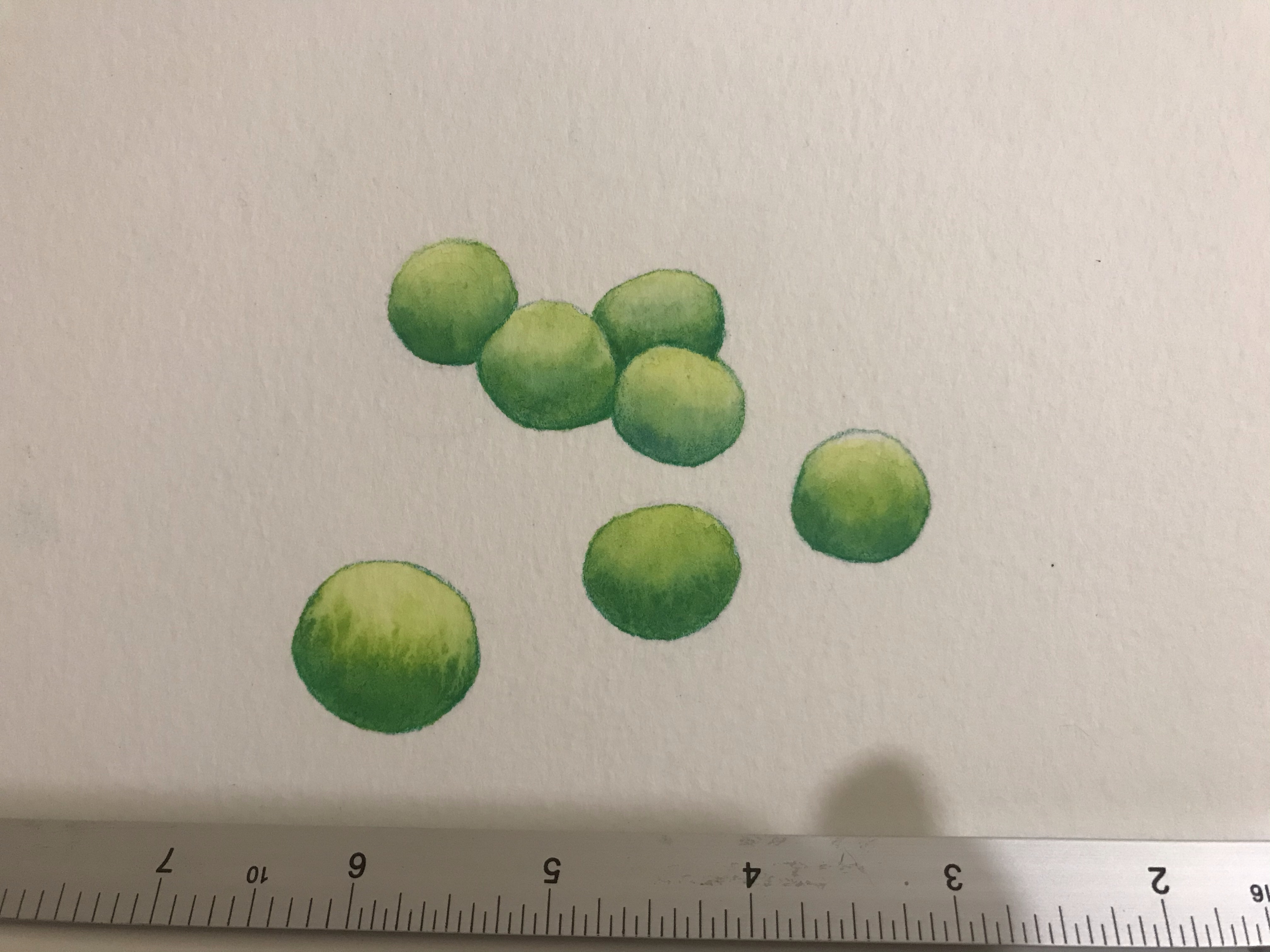
My test paintings of the autumn vegetables went quite well. I was happy with how they came out. I participated in a group session with OCA tutor Bee Willey and after showing her these images and discussing with her. She suggested that I work a lot larger so that I am able to create fine details easier and also to try acrylic inks to paint as I mentioned that I was concerned with watercolour and gouache that it will sometimes struggle to get the paint colours as bright as I want them to be. I said that I do have a tendency to work very small and that this is a habit that I would like to get out of, but also that I really would like to experiment with working on a bigger scale to see how that affects my work. For my test paintings. I used masking fluid on some of them to keep the highlights and then painted over the top. I did a few different versions of the strawberries until I found one I liked the look of. However, I did quite like my Rasberry, but I wasn’t sure about how strong the highlights were. I decided that I would work on a large scale for my final piece, so I would not use masking fluid. I would just leave out the highlights.
My tests of painting summer fruits – Watercolour and Gouache.
Small test painting with FW acrylic inks.
I have acrylic inks in my supplies, but I have only used them to paint on a very small scale. I hadn’t considered them as an option for this project until it was mentioned by Bee. I therefore did a small test with them before I started painting my final piece, and I found them to paint very smoothly and will easily blendable. After my test I was very happy with how it looked and was now confident that acrylic inks would work for my painting.
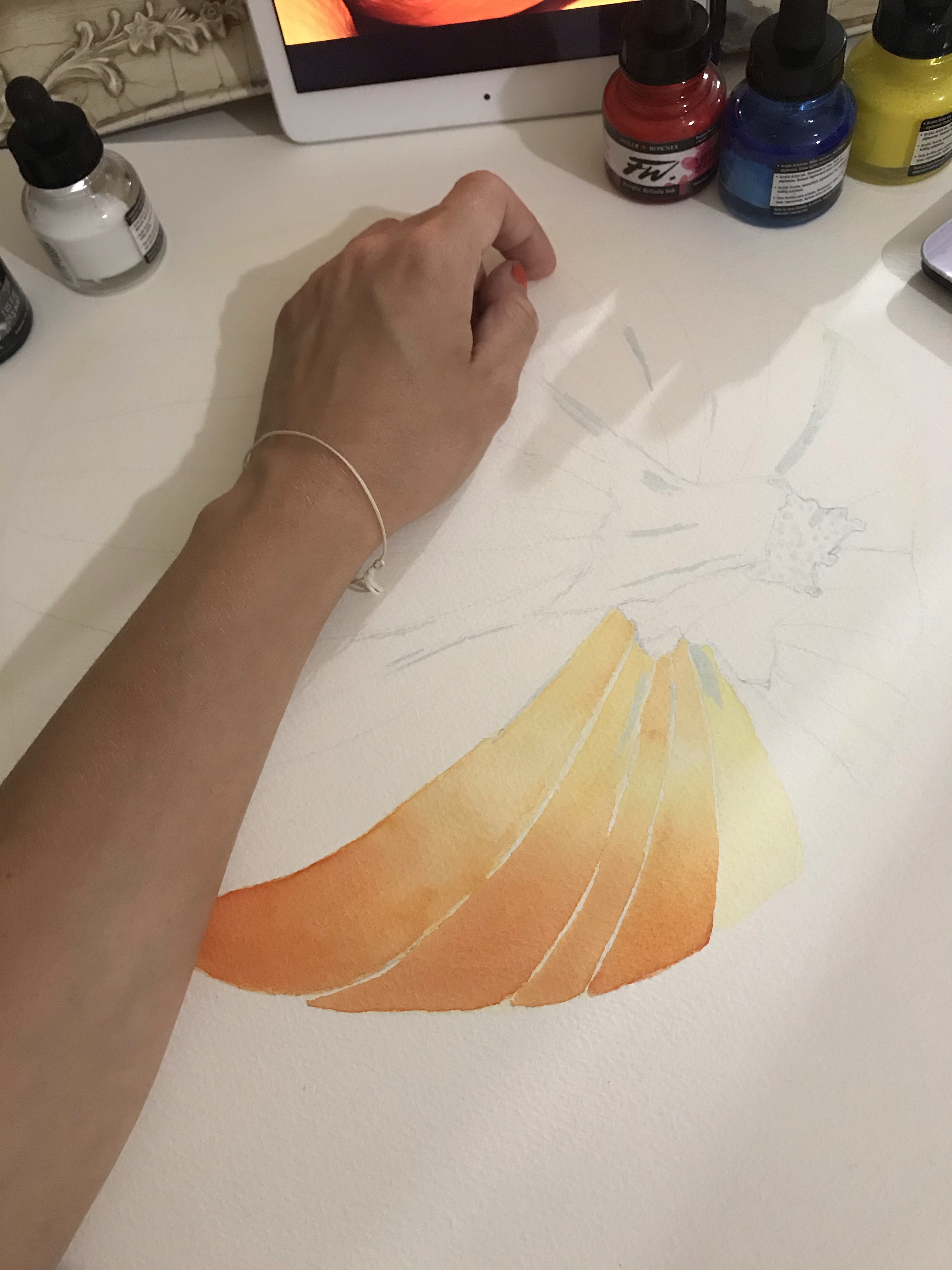
To show the scale
Failed attempt
2nd attempt
2nd attempt
Testing the composition
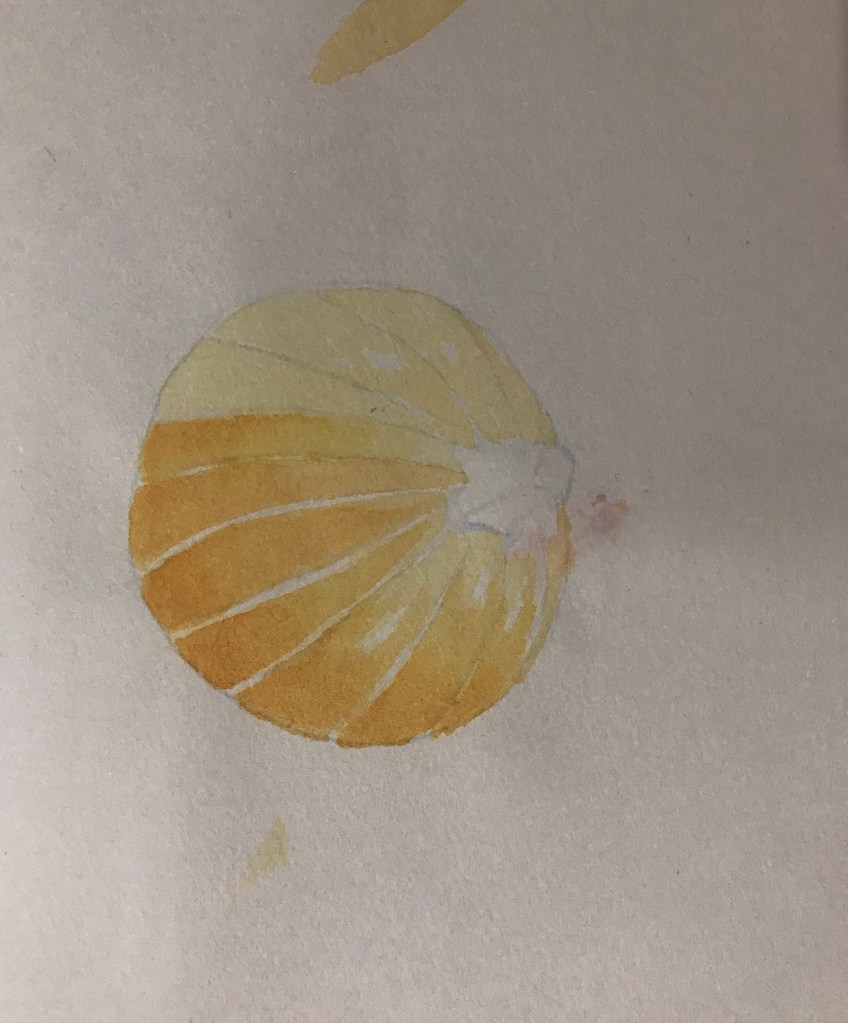
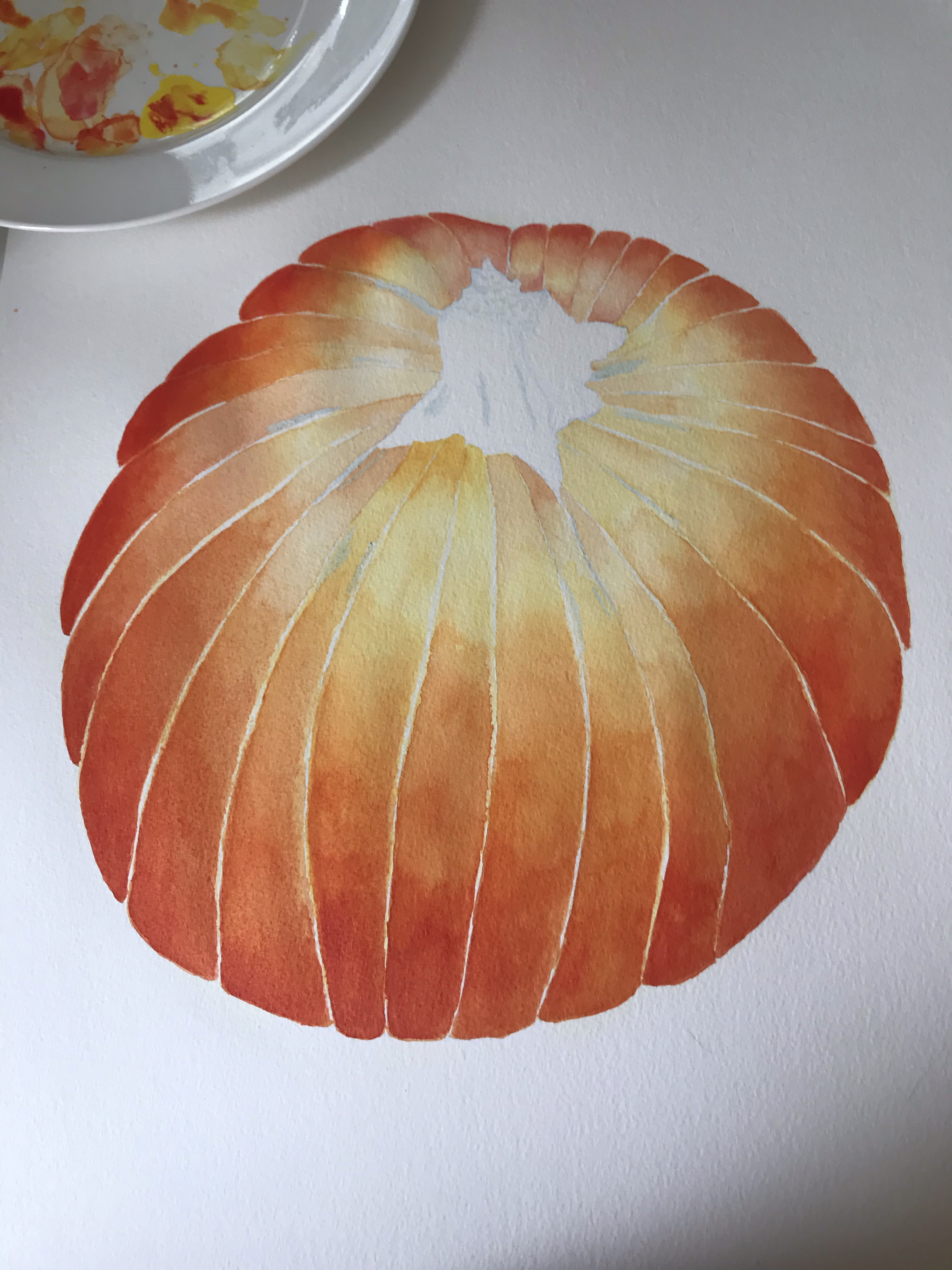
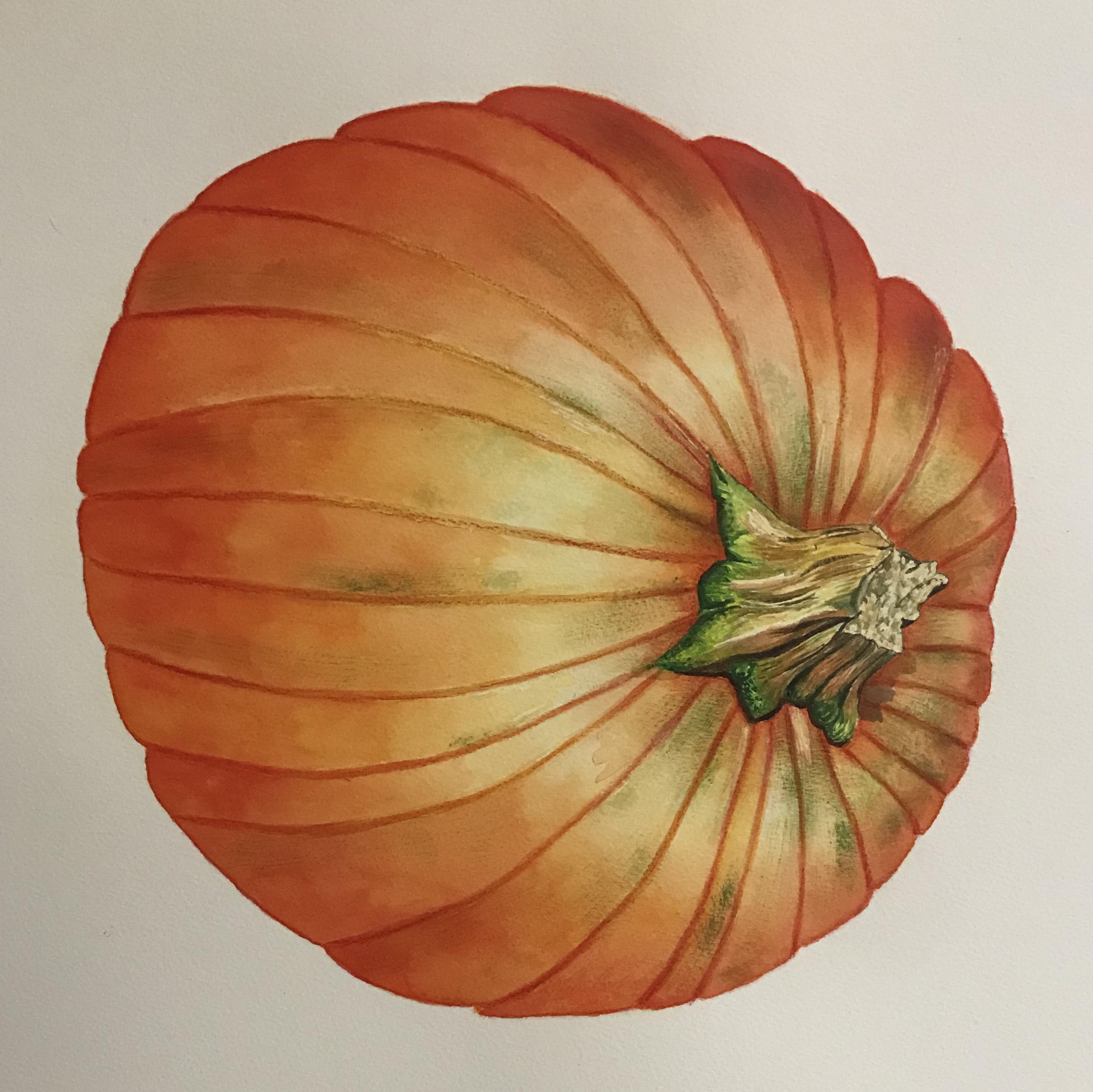
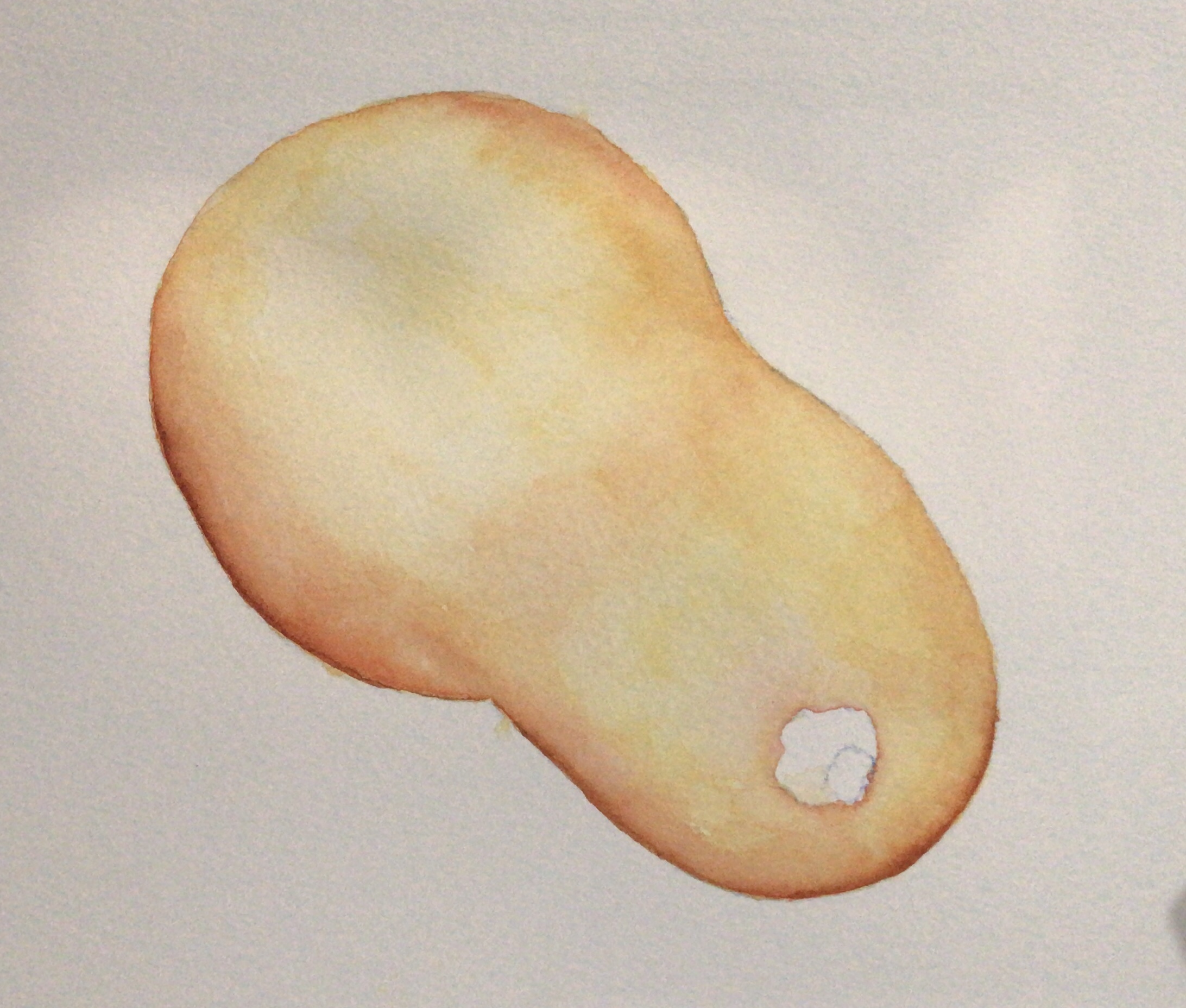
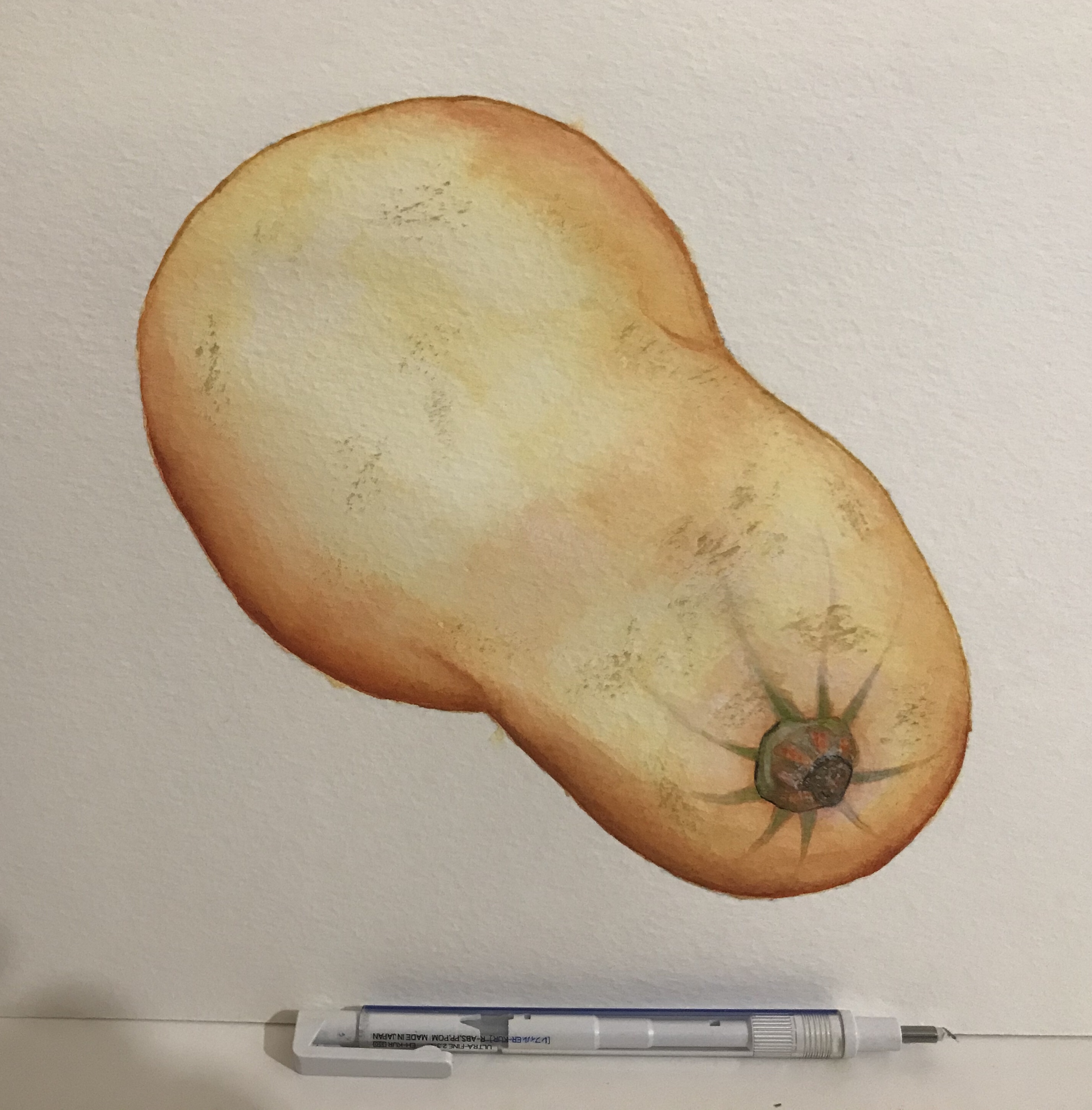
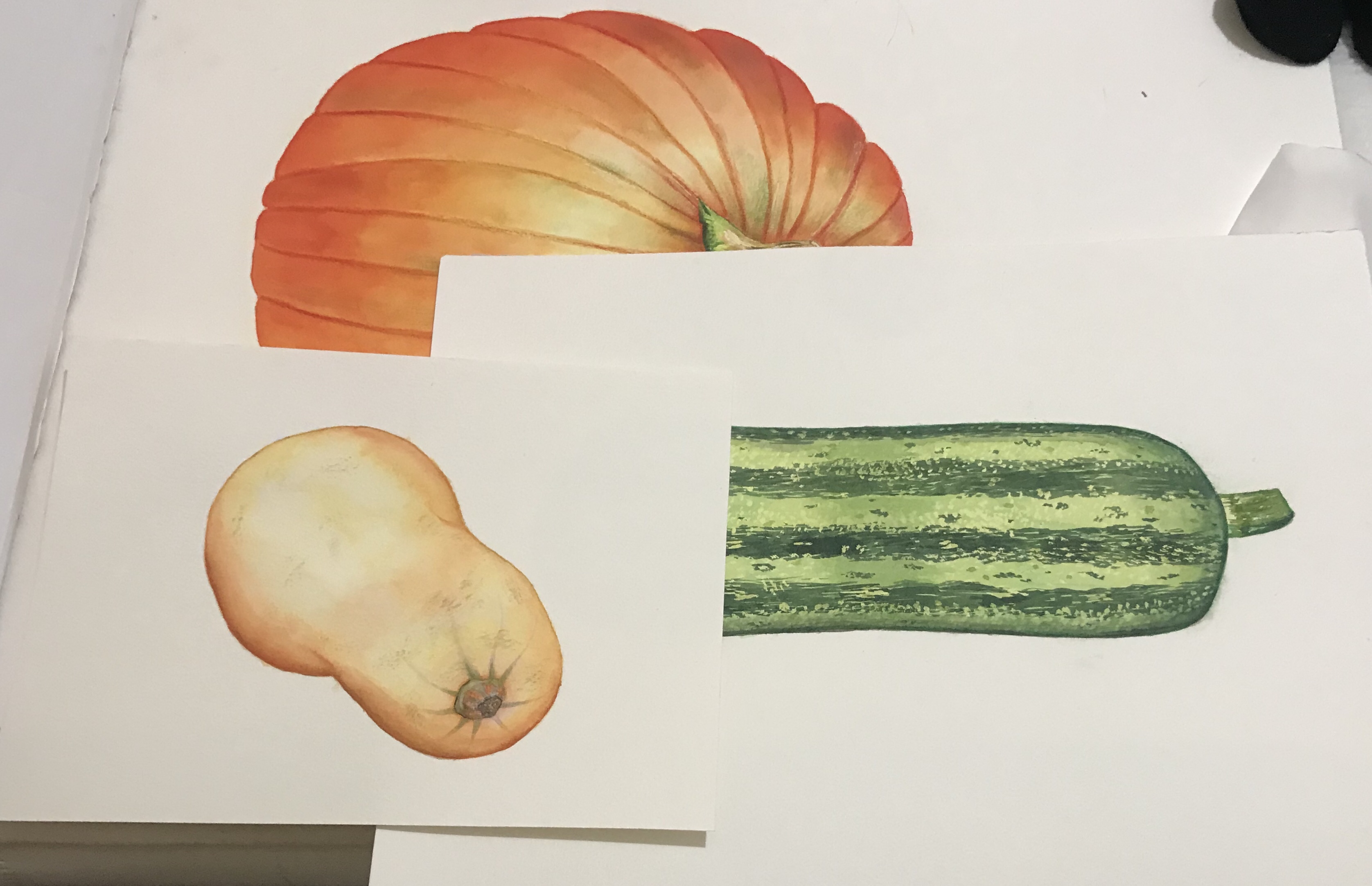
I decided to work on each vegetable as an individual painting rather than altogether, so that I could work on a larger scale and because if I was to make a mistake on one of them. I would be able to redo them without having to redo all of them. I only had to redo one of them, which was the butternut squash that was because I was not happy with how it was coming out and messed up with the shading. This resulted in the image looking muddy and the shading harsh and not blended well. This took quite a long time to paint, but I did enjoy painting them. I was happy with how they turned out, especially as apart from my practice pieces. This was the first time I’ve ever painted vegetables and I was using acrylic inks, which are not particularly familiar with. I do really like the vibrant colours and was sure to not use black unless I really had to, to darken the colour so that they did not become muddy and caused the food to look mouldy or unappetising.
Once I had painted each of the vegetables. I then layered them to test roughly how they would look to see if it was going to work. I then started to photograph them and put them into photoshop as raw files. At this point I was mainly just removing the backgrounds and correcting the colours so that they matched the original colours. I edited each of the paintings individually 1st to remove the backgrounds and then I compiled them onto a 12 x 12 image and move them around to find a composition that I liked. I did struggle with this a little bit as I realise that perhaps I should have done the marrow on a slight angle as it looks a bit flat just being on the side. However, I found a composition that was not too bad and that is what you see below.
I then started to play around with background colour to try to find one that would not overpower my paintings. It took a little while as the colours I would associate with autumn that I would ordinarily have used were already in my painting. When I used a green or an orange, for instance, it did not enhance the image and I could not seem to find a contrasting colour that worked for this image. I eventually settled on the light peachy colour as this did not overwhelm the image.
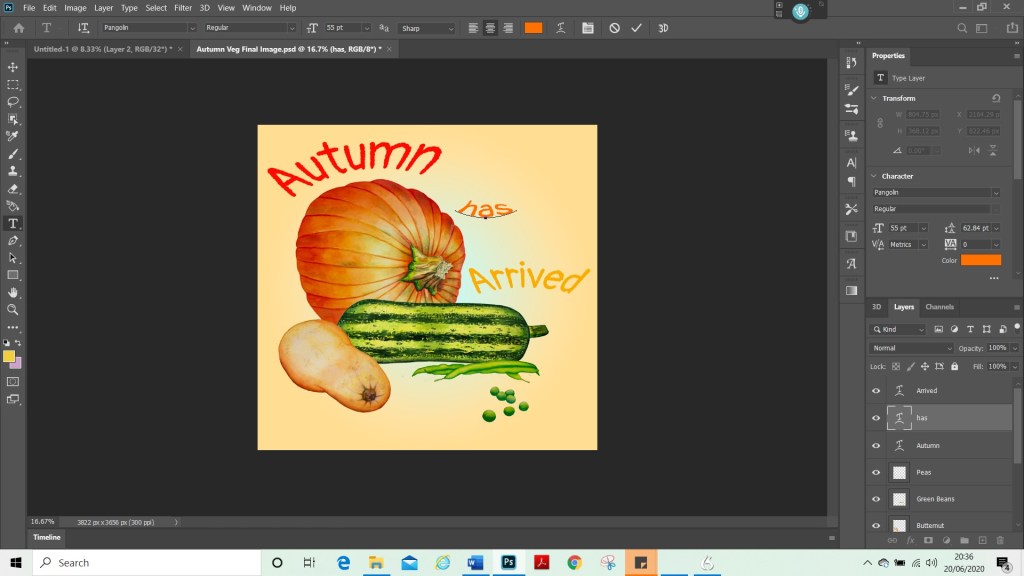
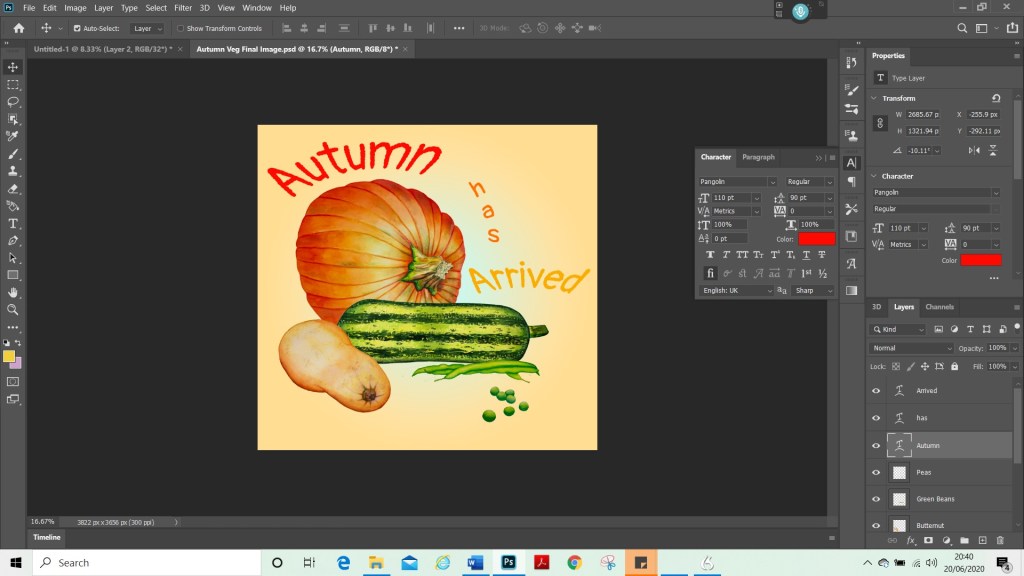
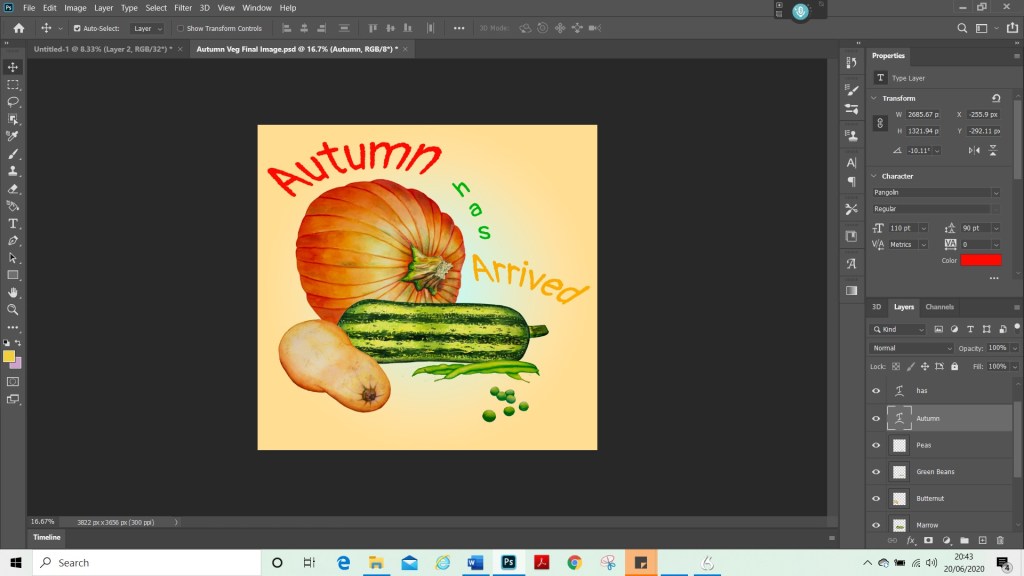
I needed to find a way to fit some text into the empty space. There wasn’t quite enough space to have the text horizontally as this would have resulted in it being quite small. Therefore, I decided to try carving the text so that it fit with the shapes of the vegetables. I also wanted it to be clear and readable, so I did not want to go too elaborate.
My Final Image
For my final image above. I learned how to add shading on Photoshop, although I’m not entirely sure how successful that was, for this particular image, it is now a new technique that I have in my skill set that I can use for later projects.
Composition Sketch for my fruit painting
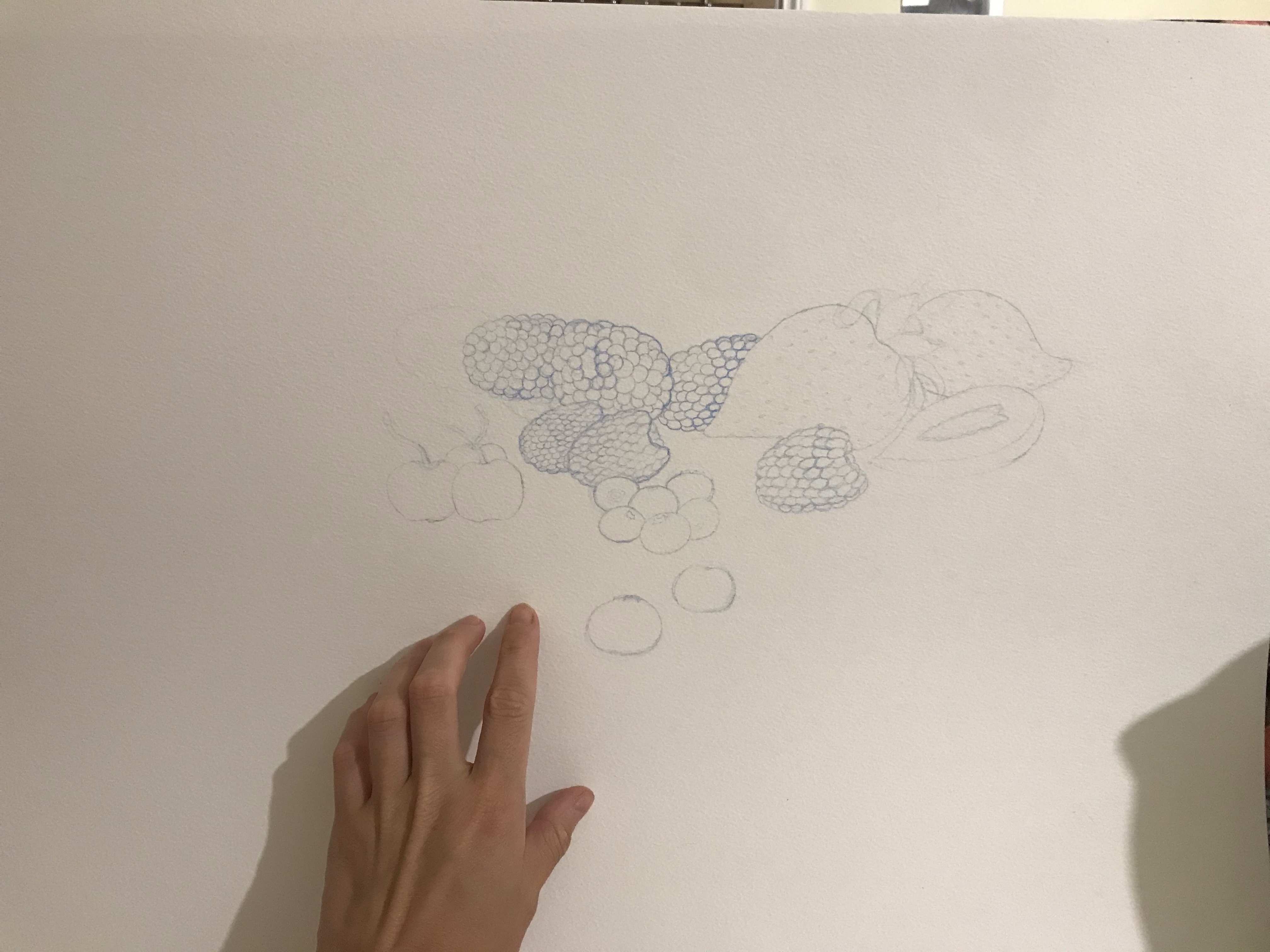
To get started on my Summer Fruits project, once I had collected all my research and did some tests, I started to sketch out a loose composition sketch to try to plan how my painting should look. Once I had done this, I used the reference material and moodboard. I had collected and begun a fresh sketch on A3 watercolour paper. For this I used a watercolour pencil, so that my colours did not become grey or muddy. Once this was done, I started to paint with acrylic inks as I had done with my vegetable paintings.
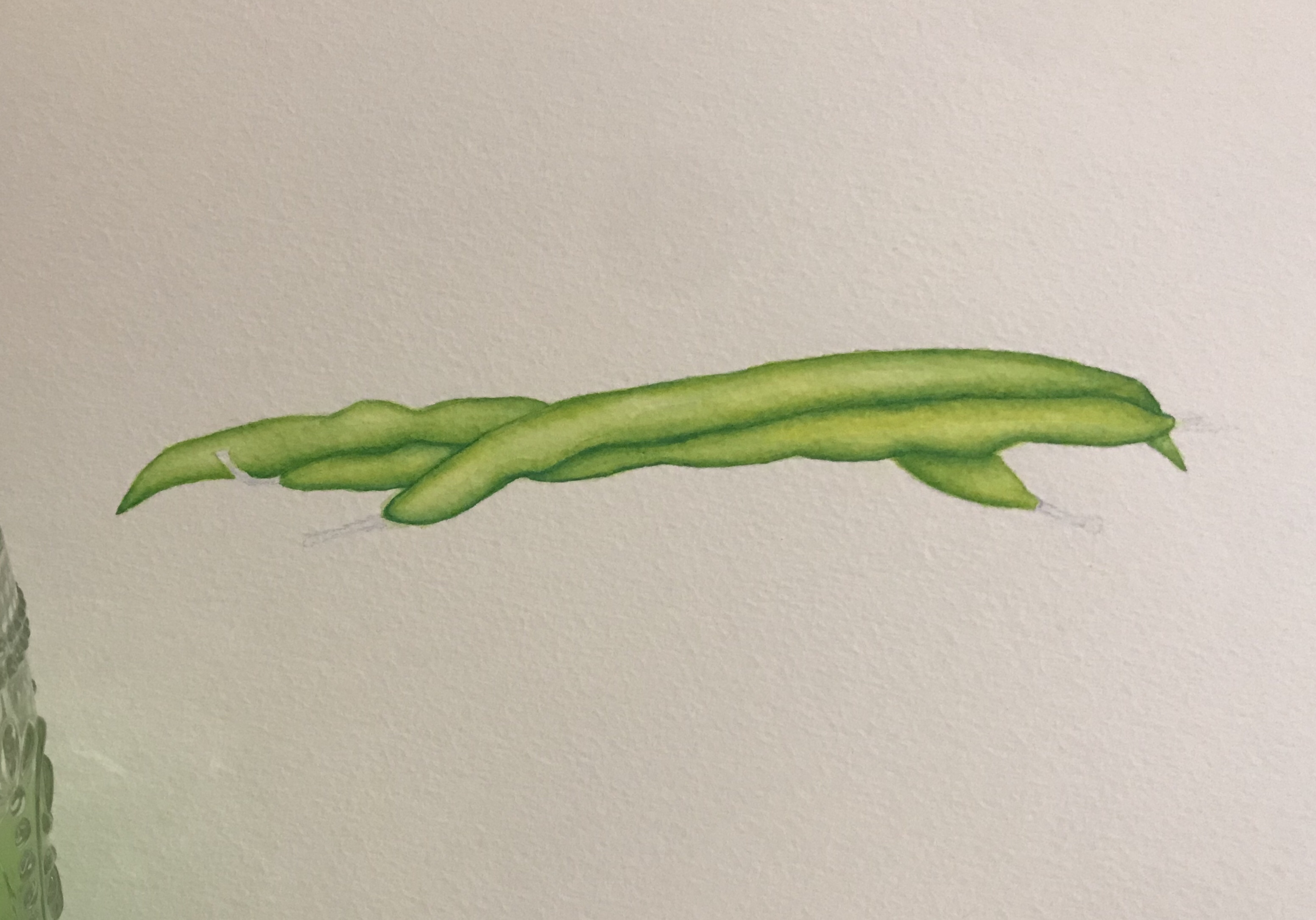
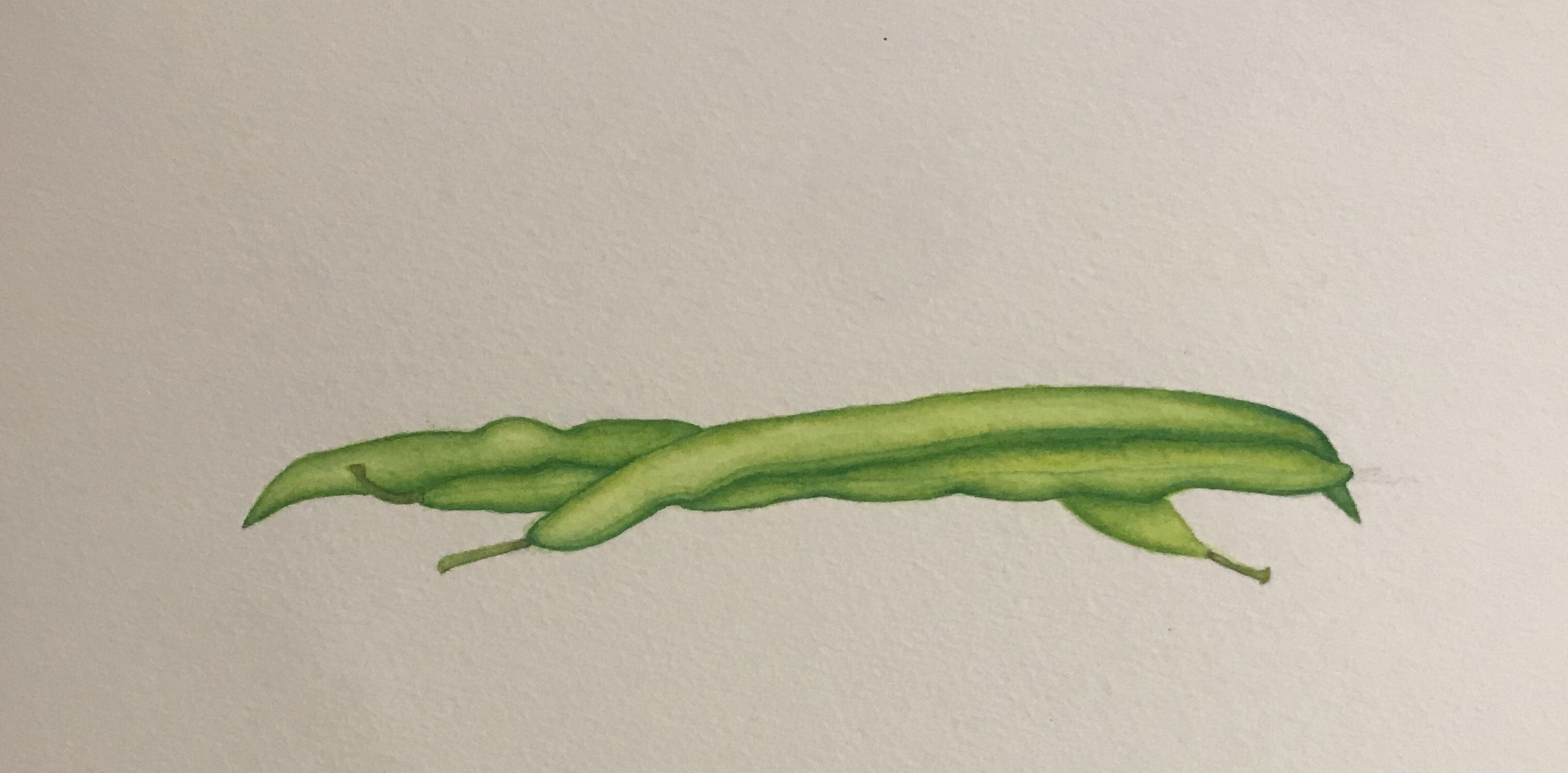
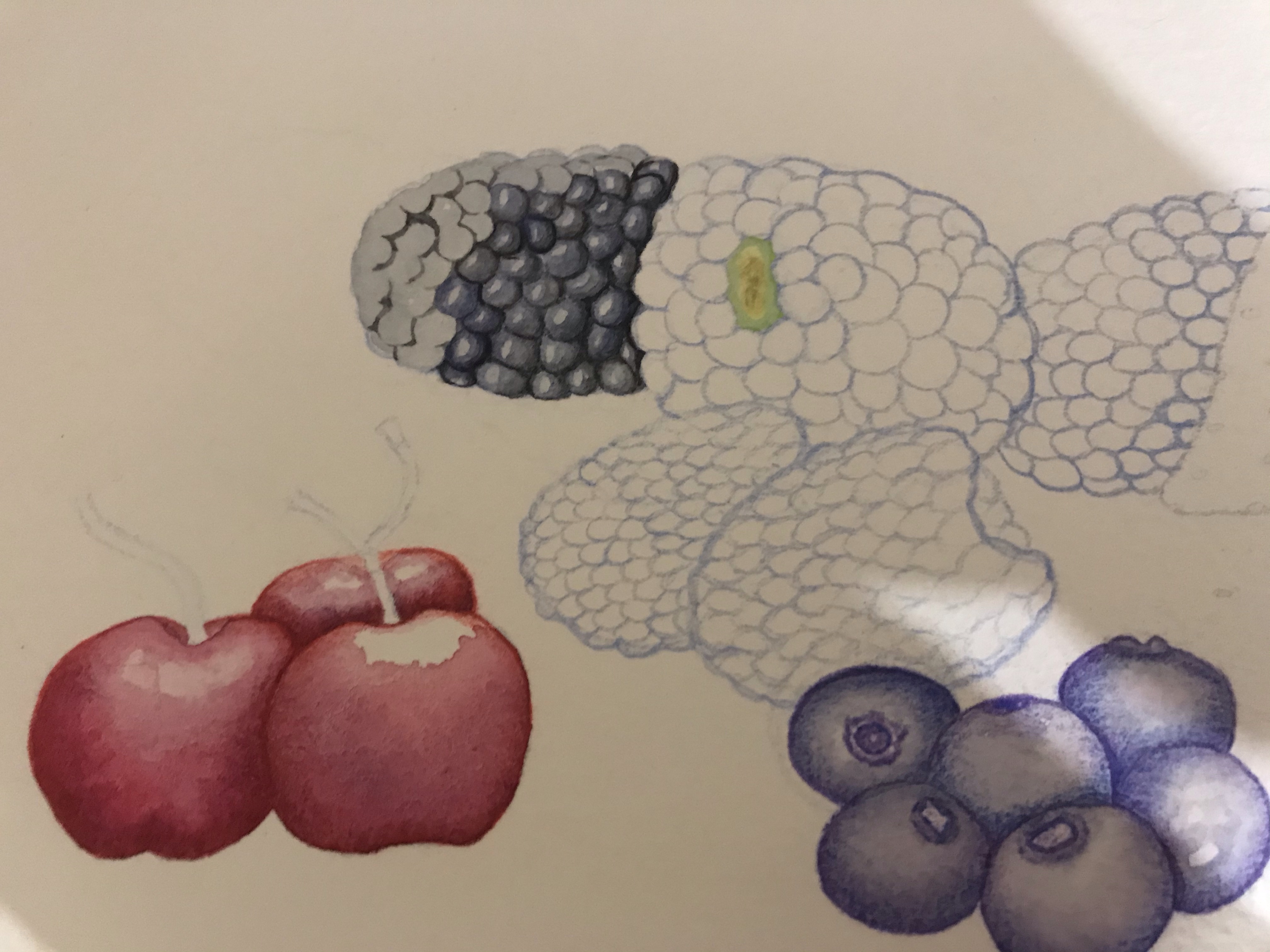
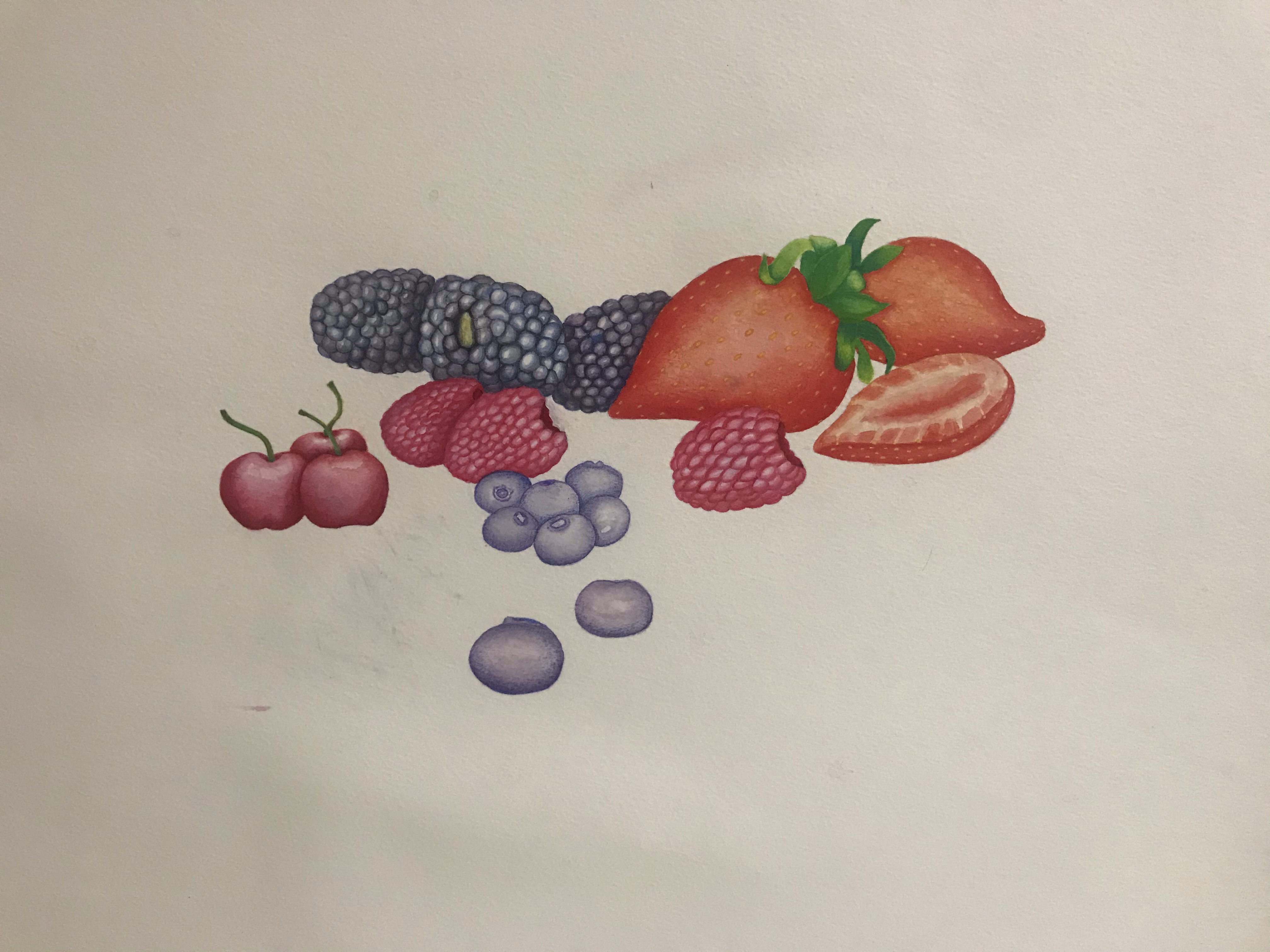
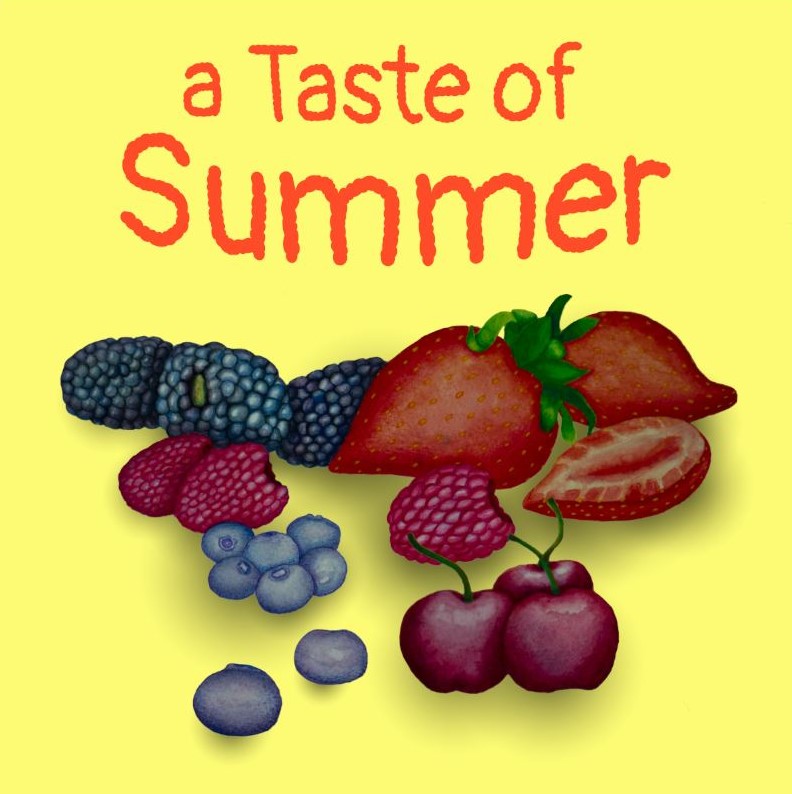
I decided to paint the fruit as one piece, rather than individually. I had hoped that this would save time, however, in the end, I think it took just as long as the vegetables did. Maybe even longer due to the fact that the objects were smaller, so the details were trickier to paint. The berries were generally much more time-consuming and difficult to paint and the vegetables, as it took some time to paint the blackberries, for instance, due to the nature of their make-up. I was trying to give them a 3D effect, however, I was not aiming for them to be realistic and was trying to strike a nice balance.
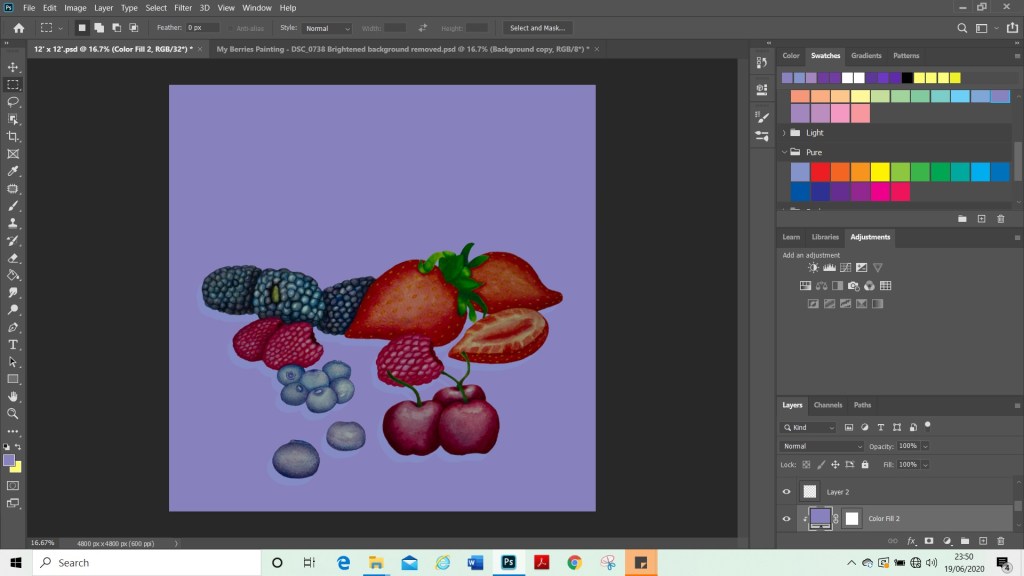
I had to change my composition a little bit once I had put it onto Photoshop because it was not going to work with the square, 12 x 12 format. I therefore moved the cherries so that they were in a different place. This also gave me the chance to resize them as I felt that they were a little small on my original painting.
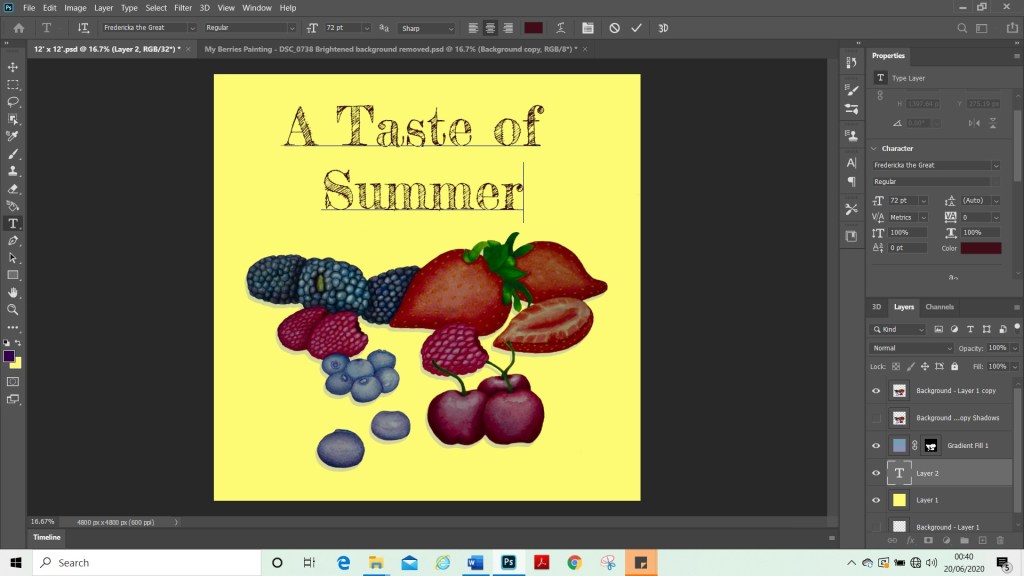
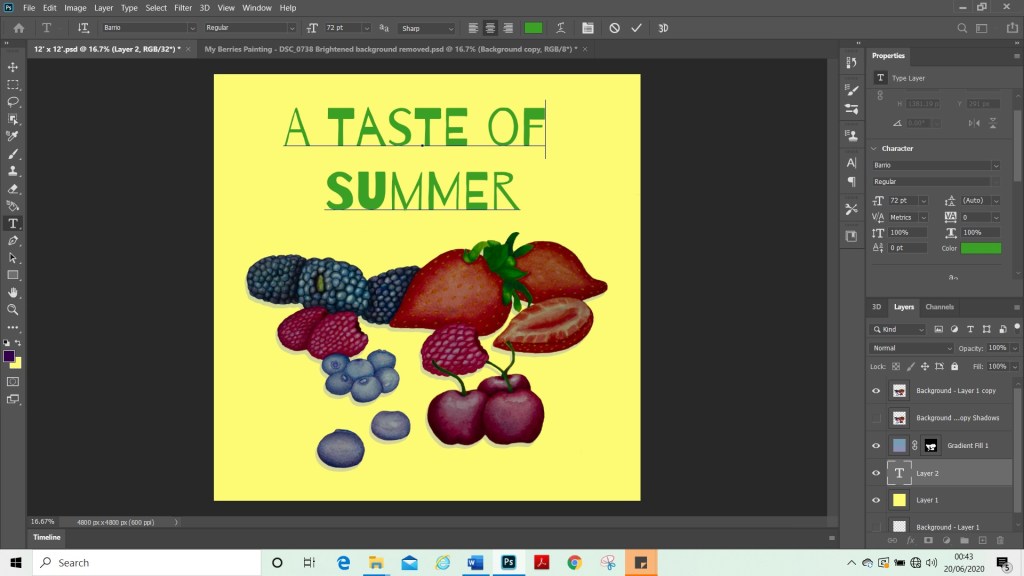
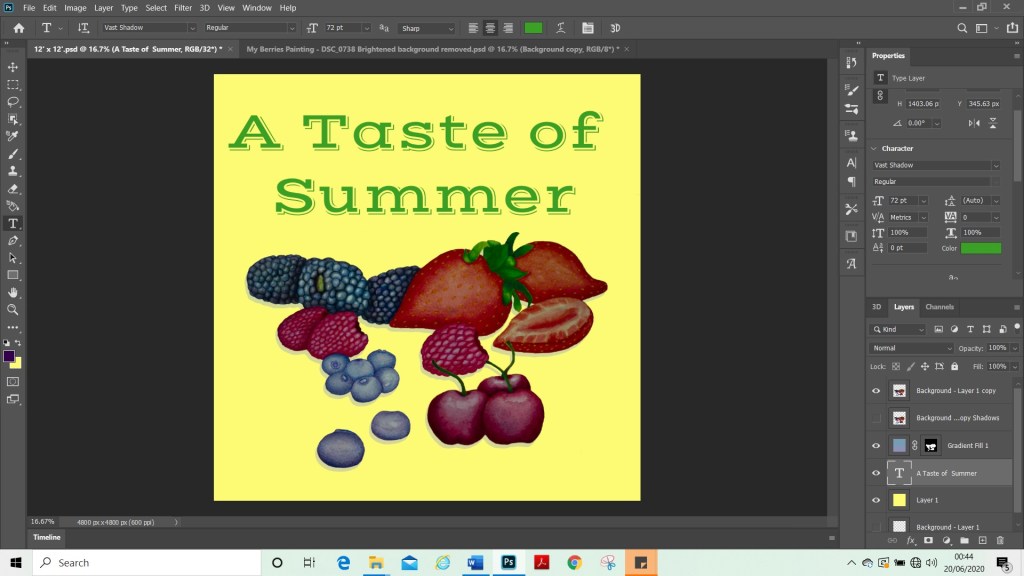
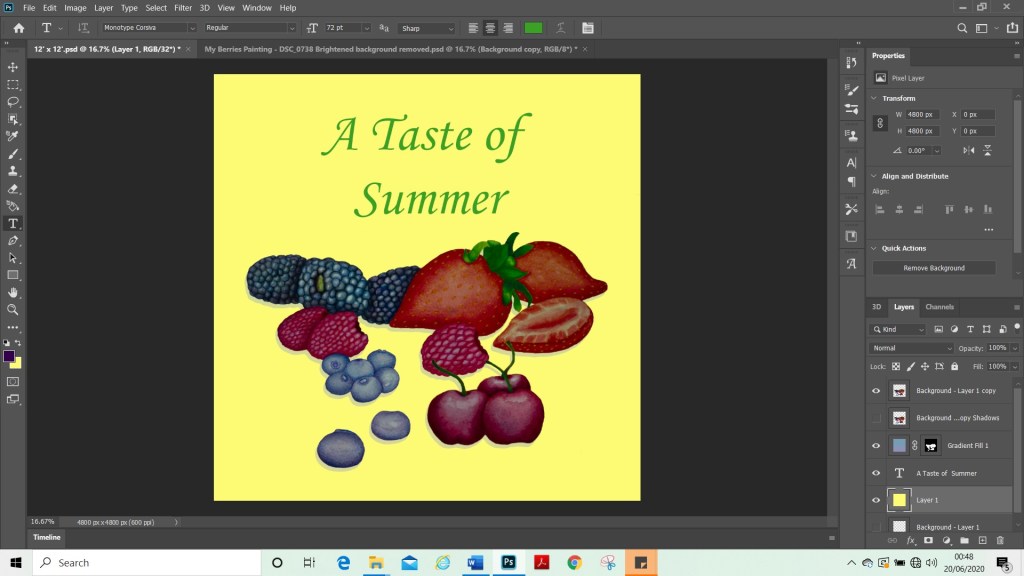
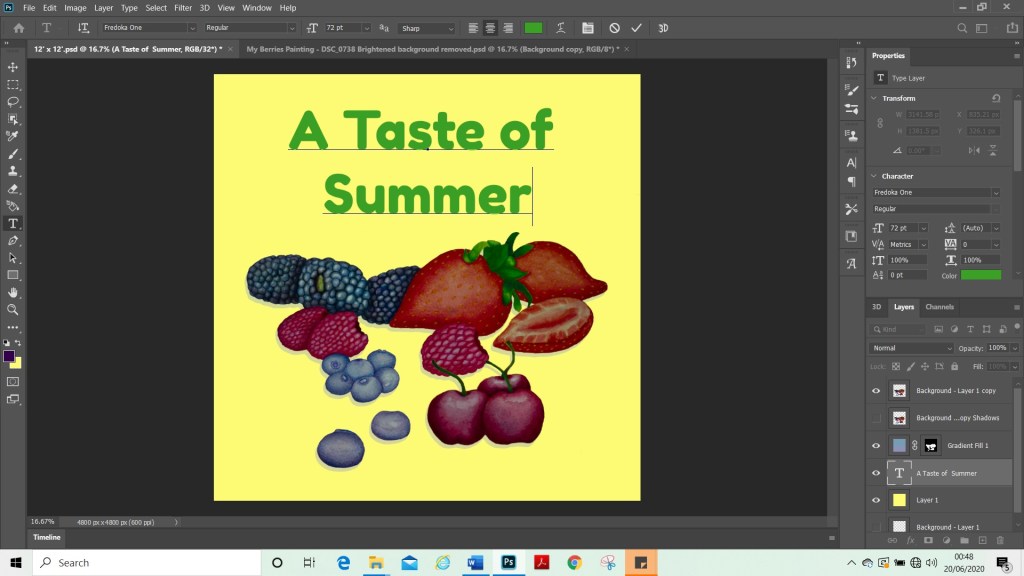
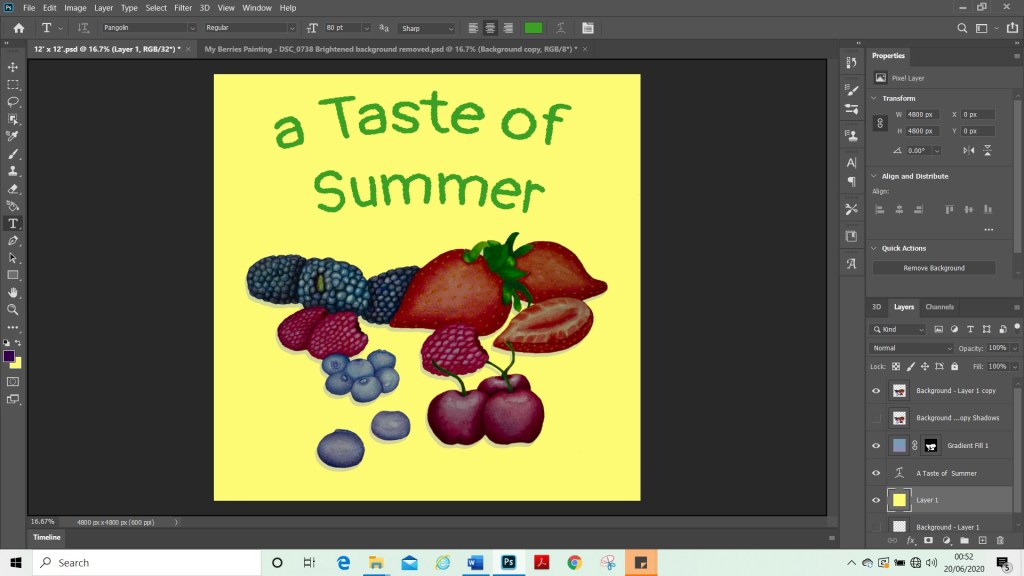
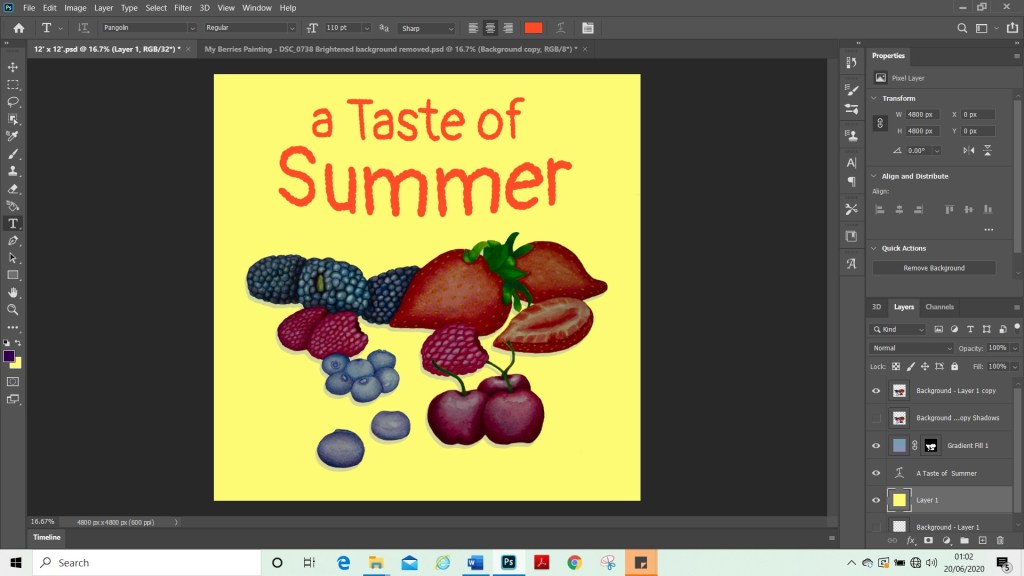
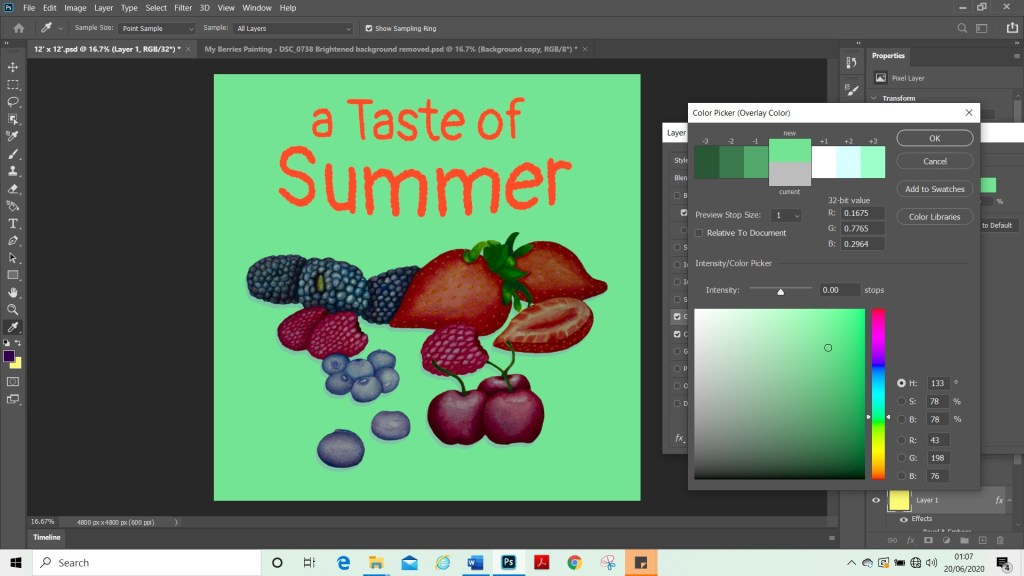
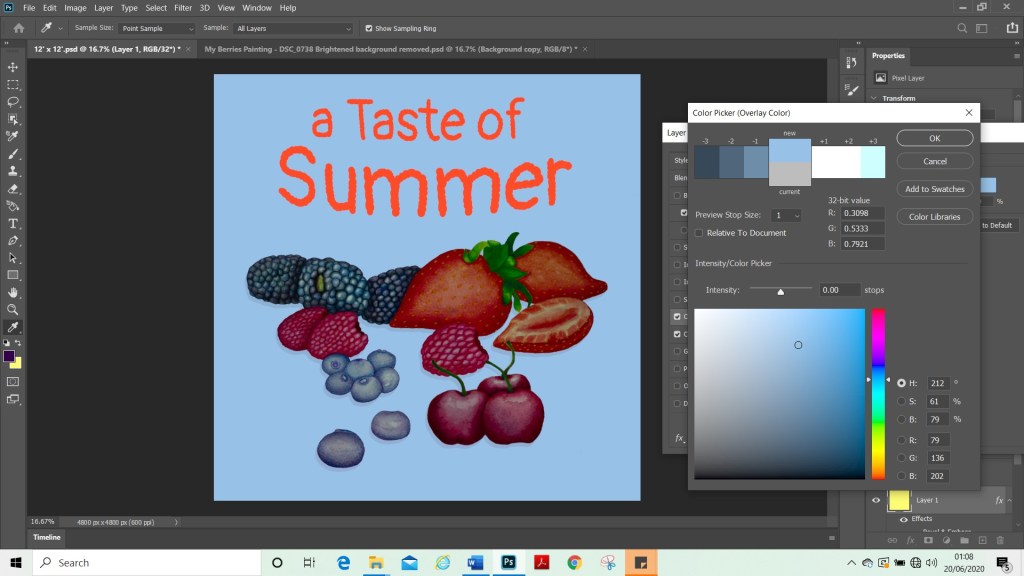
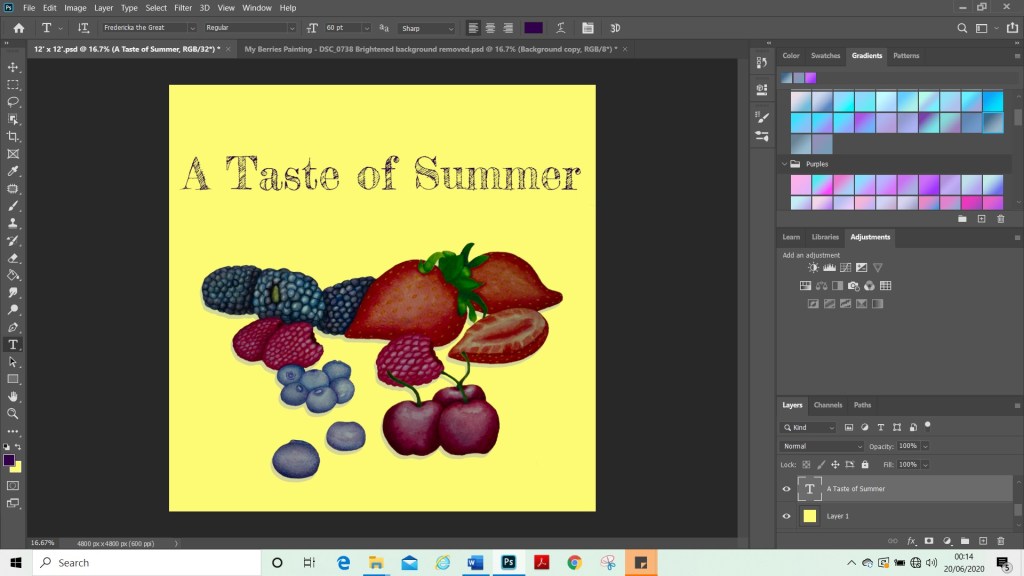
Once I was happy with my composition and had adjusted the colours to how I wanted them. I started to add a background layer and try out colours. I added the text and tried different fonts and sizes to see what would work alongside my image. I tried various colours and fonts until I found one that I was happy with. Above are some examples of these.
Final Image
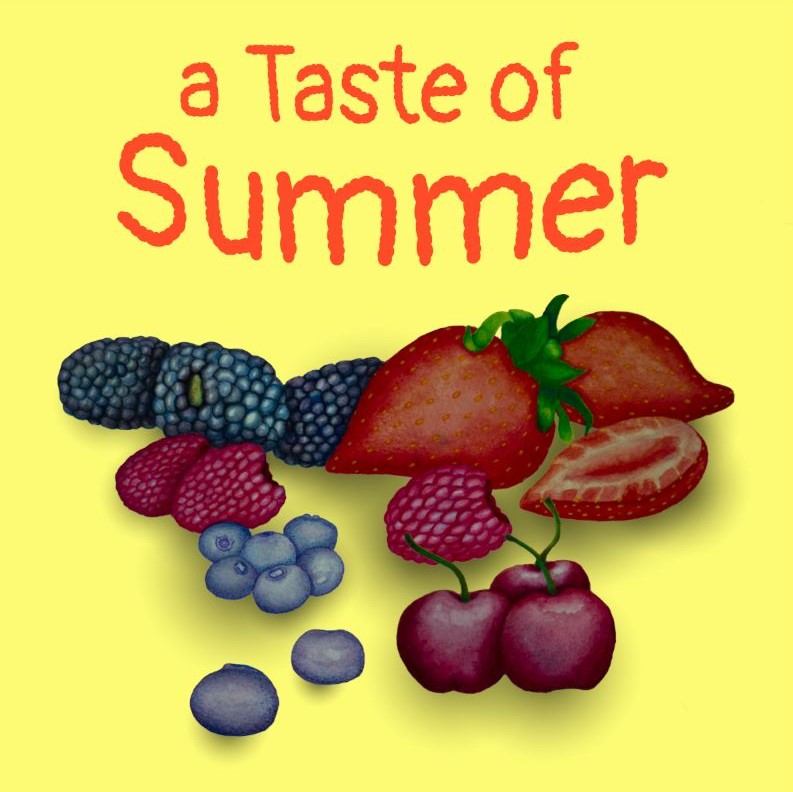
Final Image with lighter shadows
Reflection
For my final image. I added shadows in the same way I had with vegetables. This was to try to ground my painting so the berries did not like they were floating. I wonder if they would have looked better if they were a blue or purple colour rather than black shadows. I would have done this if I was painting them, but as I was following instructions and learning how to do them for the first time, I did not change the colour. I realised during this assignment that my computer does not have a good screen as I really struggled to see the shadows as I was adding them. And yet when I viewed them from another angle, they looked very heavy. Also, once I had transported my final image into another format and viewed it on my phone, the image background was a lot brighter than it had shown in Photoshop.
Overall, I am happy with my images and I feel that I met the brief. I did find this assignment challenging, as I am still new to Photoshop. Therefore, once I had put my images into Photoshop, I found that my skills limited my possibilities for what could be done with the final pieces. I am happy that I learnt some new techniques. I also learned my current limits (or some of them) for using Photoshop. I did try to use the 3D tool to create more interesting text. However, I was unable to do so as my computer could not run it and unfortunately just froze. On looking at my paintings. I am happy with how they look, in particular with the fruit. I really liked the biggest strawberry and I liked the way the blackberries came out. I did not manage to capture the juiciness of the berries which is something, perhaps, that is lacking in my image and could have improved it. This is something I could explore further with my painting and perhaps do some tutorials to learn how to do this.
Key Steps Part Two – In Summary
Key steps part two has been quite a challenge and I have enjoyed the exercises and doing this assignment. I have learnt many new skills and techniques, that I can now take on to other projects. I finally feel like I have found a pace for my course and feel like I am progressing. When I look back over the past two months I have done a lot of work in a short space of time and feel quite a sense of achievement about this. This makes me excited to continue on to part three and I am looking forward to the next set of challenges and opportunities for growth in my learning.
Key steps part two has been quite a challenge and I have enjoyed the exercises and doing this assignment. I have learned many new skills and techniques, that I can now take on to other projects. I finally feel like I have found a pace for my course and feel like I am progressing. When I look back over the past two months I have done a lot of work in a short space of time and feel quite a sense of achievement about this. This makes me excited to continue on to part three and I am looking forward to the next set of challenges and opportunities for growth in my learning.
This year and especially since my study trip to Lisbon. I have really immersed myself in my course and in OCA life. I have really enjoyed having a group of peers that I can talk to. This gives me a sense of community and support, and I do not feel isolated in my studies anymore. We keep in contact via a WhatsApp group and have a second Lisbon catch up session coming up with the tutors in August, which I’m looking forward to. The Lisbon students are from a mixed range of disciplines and I am the only illustration student amongst the group. I have been very inspired by their work and they have helped me to view art from different perspectives and not be scared to try new techniques and make a mess. I have also been participating in group sessions with OCA tutors, which have been very helpful and once again build a sense of community and help me connect with fellow students. I have been connecting with my fellow illustration students a lot more, this past month, which is very helpful and nice to feel like part of the OCA community and no longer just an impostor. (Now that I am actively studying.) I do struggle a lot with self-motivation and communicating with my fellow students and tutors has really helped me find motivation and purpose.
I do tend to struggle at first understanding the briefs and have to re-read some of them over and over and ask others how they interpret them, to see if I am understanding them correctly. This does cause me to hesitate on starting a project and I really have to push past my fear of failure and perfectionist tendencies. Although helpful in some instances, it does tend to hold me back. I am finding, however, that now that I have processes in place. I find it easier to start projects, as I have steps that I can follow i.e. Research, moodboards and mind maps. These steps, stop me getting stuck procrastinating and mean that I know what I need to do to get started. Once I have started, I have no trouble continuing. It is just the initial starting of a project. I am happy that I am finding a way around this and I hope that this will continue to improve as time goes on.
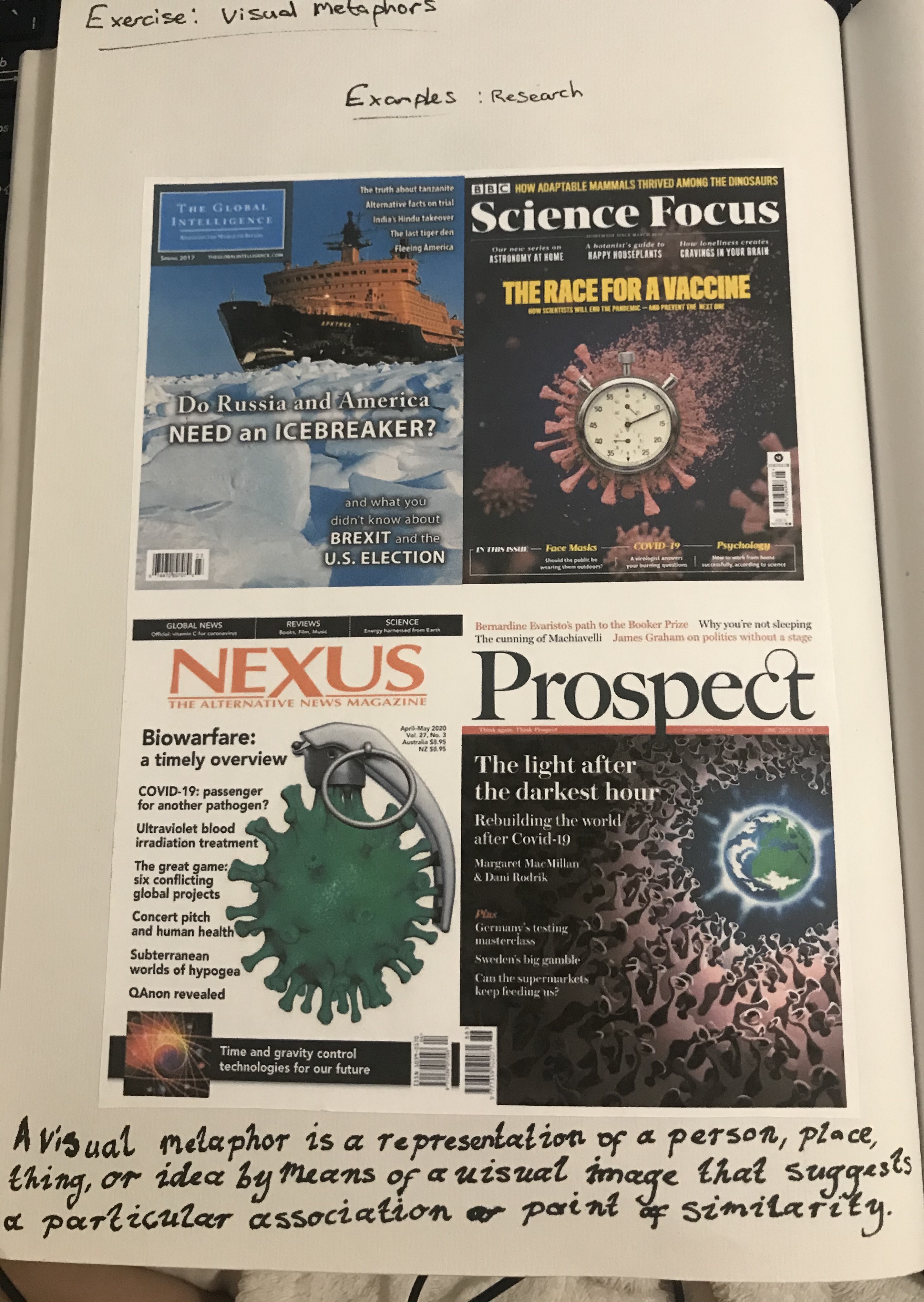
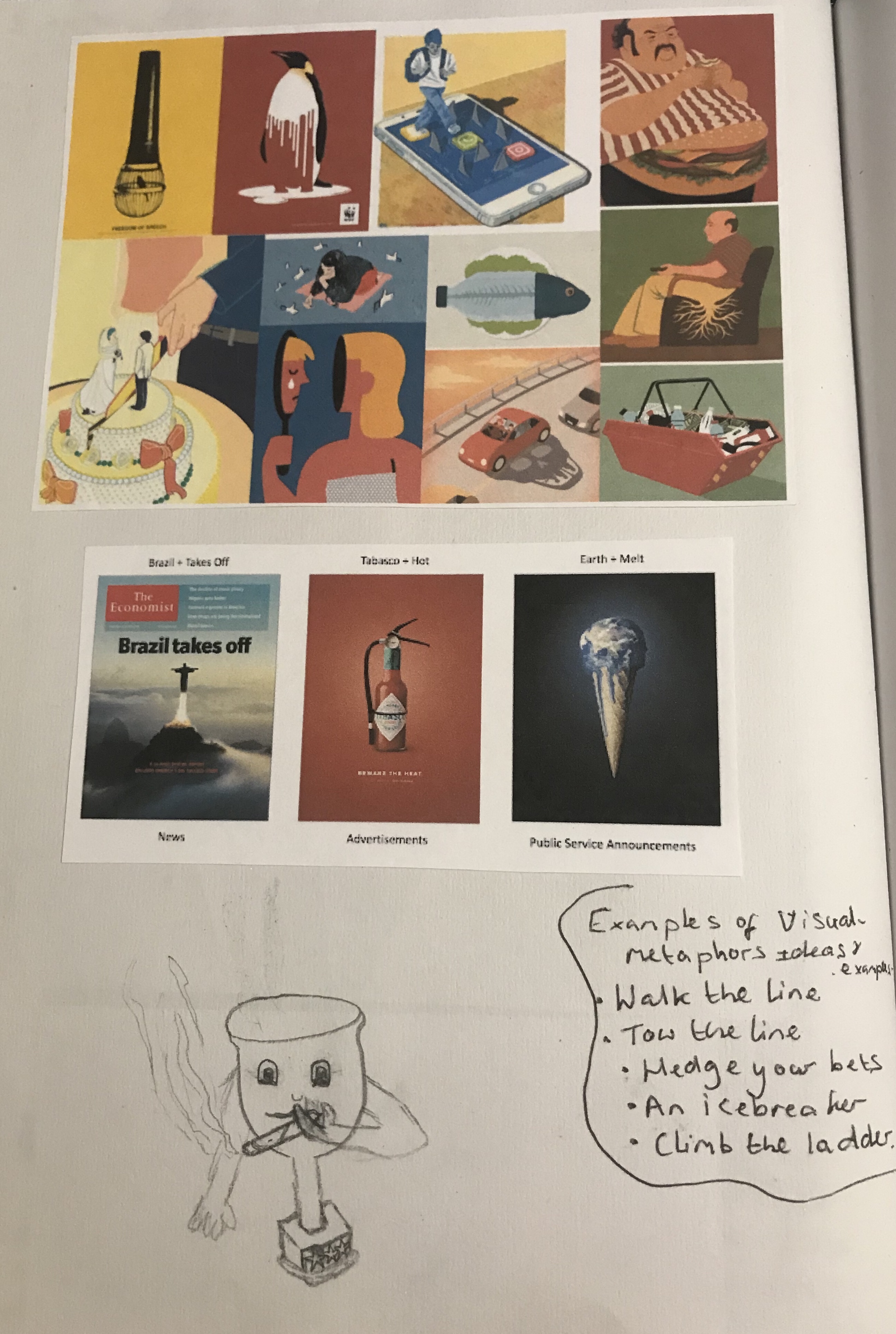
For this exercise, we were asked to collect as many examples of visual metaphor as we can find. I used a thesaurus to look up the meaning of a visual metaphor. I then started to collect images I found on the Internet. My research was a little limited due to co-feared and as I have no magazines in the house other than travel magazines and no newspapers, and I feel that these would have been good sources of visual metaphors. However, I did find a variety online from different magazines and advertisements. As well as some examples of some illustrations from an unknown source.
We was asked to choose from one of the following phrases; reaching retirement, dreams of romance, broken relationship, censorship of the press, high achievement, economic catastrophe.
After trying to think of ideas for each of the six I decided to go with high achievement as this is the only one I could think of any ideas for. It was asked to create a drawn visual list of objects and subjects which could be used to symbolise them. The brief does say not to be overly concerned with the aesthetic quality or technical accuracy in the drawing, and to see this is the an extension of your visual shorthand.
I found this exercise extremely difficult, as I just could not come up with many ideas, even though I had looked at examples. I feel like this is something I am not particularly skilled at, and my mind would just go blank. I wonder if this is possibly due to my dyslexia. Even now as I write this in my learning log no new ideas or understanding of this exercise comes to me. I asked my family if they could tell what my drawings were meant to be. They were aware that they were meant to be visual metaphors. I received mixed feedback on these. They tried to help give me ideas of what I could do, so I tried these out too. In the end, I ended up going for the word high achievement and created the image below.
Reflection
I was very frustrated with how much I struggled with this exercise, especially as I understand its importance in illustration. However, I hope that as my skills develop during my course that perhaps this is something that I can try to improve or that will improve naturally as I progress. I’m not completely dissatisfied with my image as I feel like he could be developed into an interesting image or at least a fun image. But I feel like so much more could have been achieved and explored with this exercise had I been able to grasp the concept better.
For this exercise with asked to read an extract of a book by Michael Innes adapted from the Daffodil Affair. We were then asked to make notes on the following questions:
If this were to be made into a film. What would the main character be like?
Firstly, I decided that my character was going to be based in the 1940s as the text said during wartime London. However, it did not specify which war. I answered this question based on the facts from the extract and then imagined my own character traits. The facts were that he is a middle-aged man, described as having a fixed contraction on his brow. My ideas without he had his hair neatly gelled back into the side parting is clean-shaven, stern -looking and serious with lines on his face showing years of seriousness and worry. He is clean and neat with a London accent and is a family man. The character is a man that works in Scotland Yard, it does not specify as to whether he is a detective or not. But it says that he controls ‘the file of police papers which dealt with the abduction and subsequent history of feeble minded girls.’ It was quite easy for me to imagine his style due to my extensive knowledge on this period due to my background as a make-up artist. Details like having a man’s side parting on the left is considered to be a defining feature of hairstyles of the period. This meant I had quite a clear image of my character in my head just from reading the story and by deciding what decade he was from.
What clothes with the character be wearing?
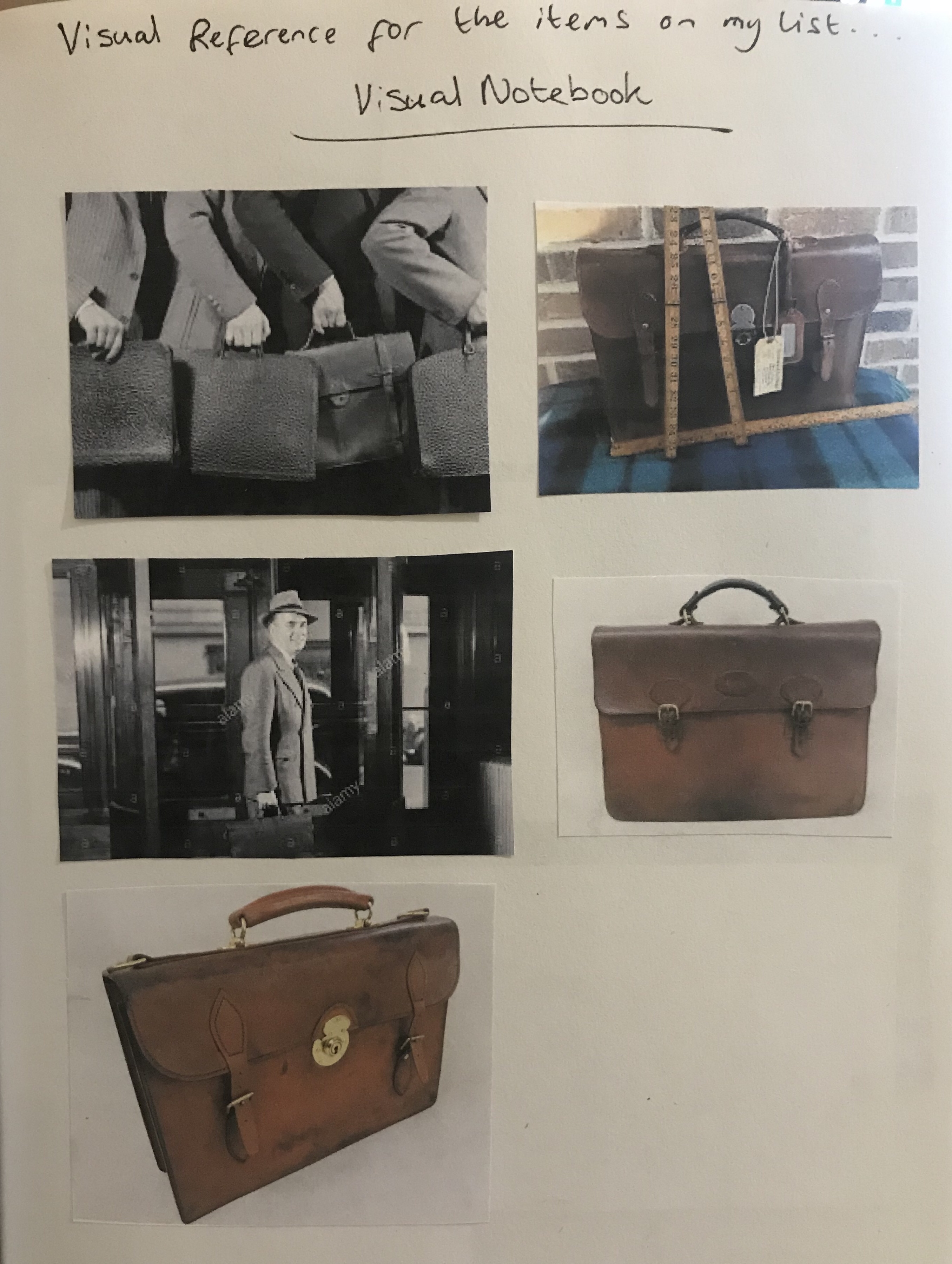
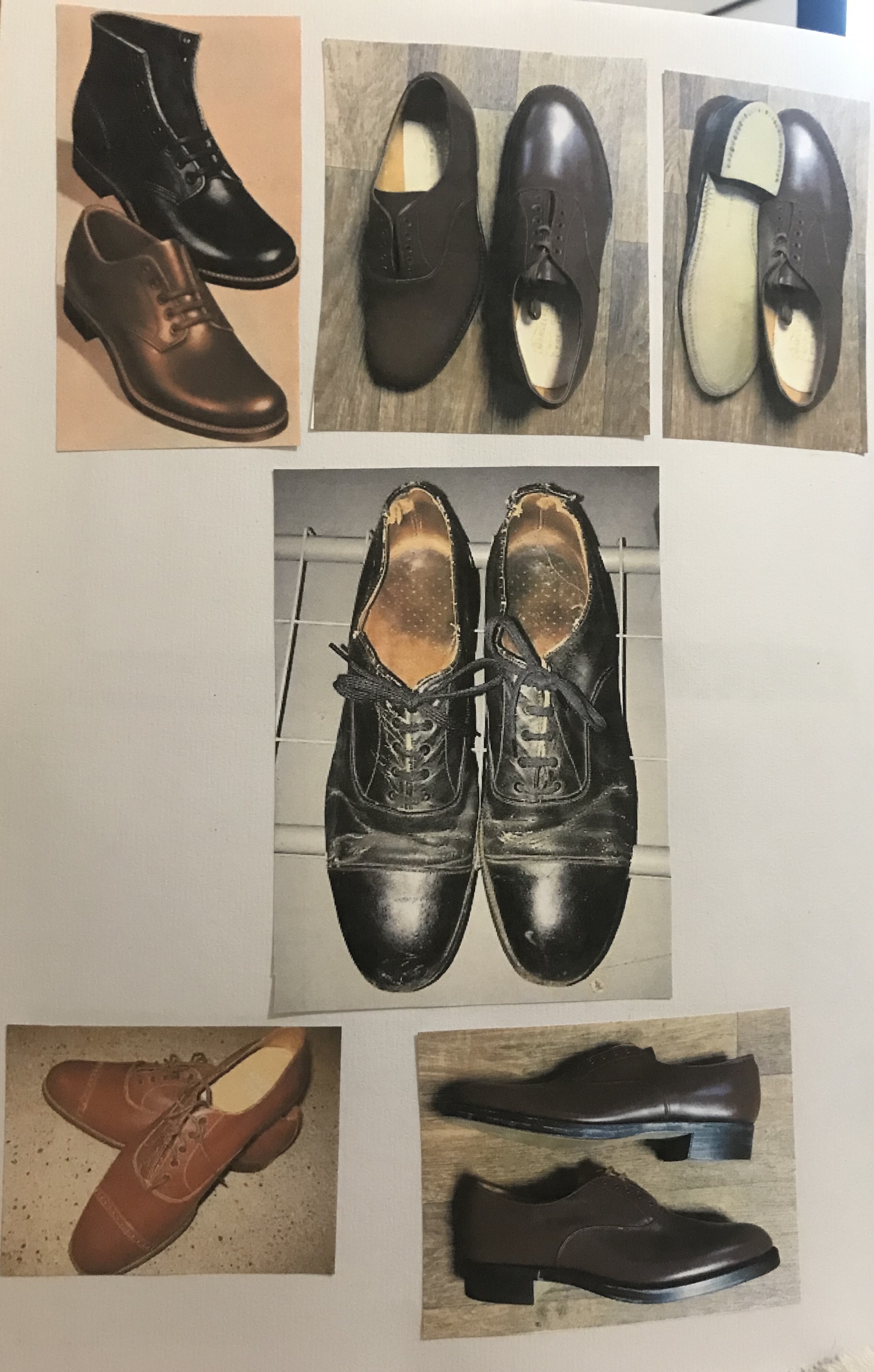
Brown suit, tie, polished shoes. Briefcase (on his desk). Smart/office worker.
What furniture is in the main area in which the action takes place?
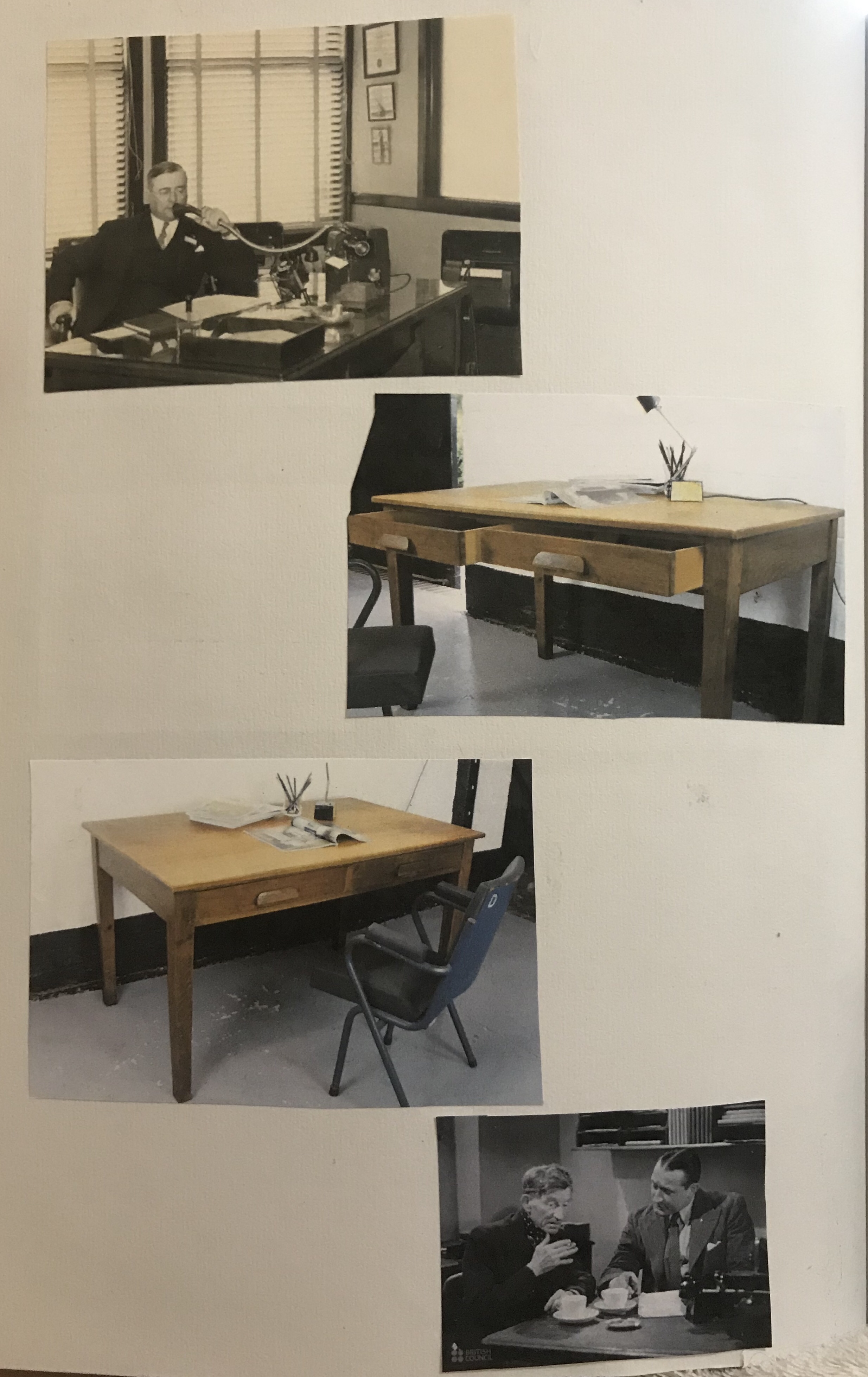
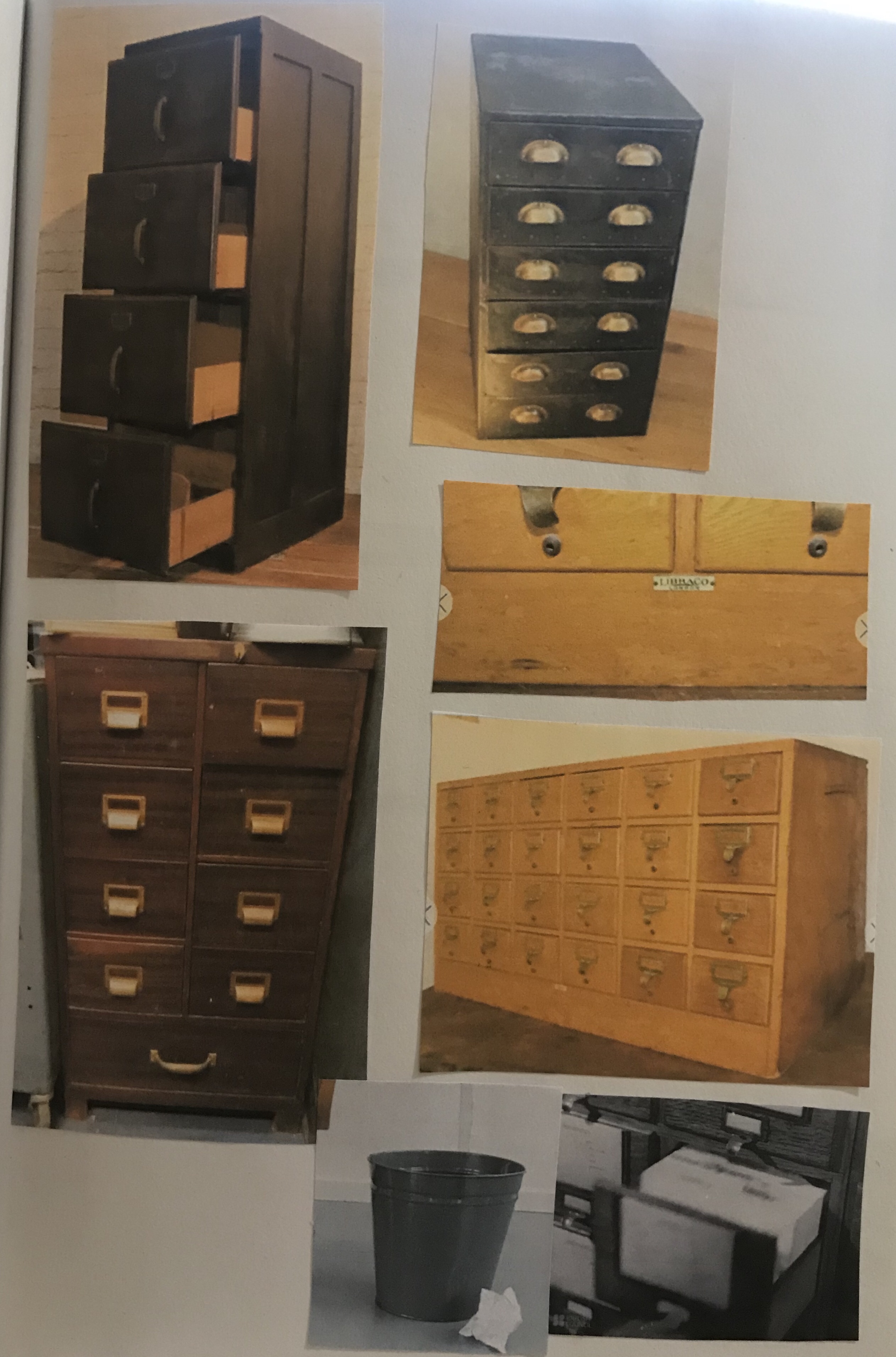
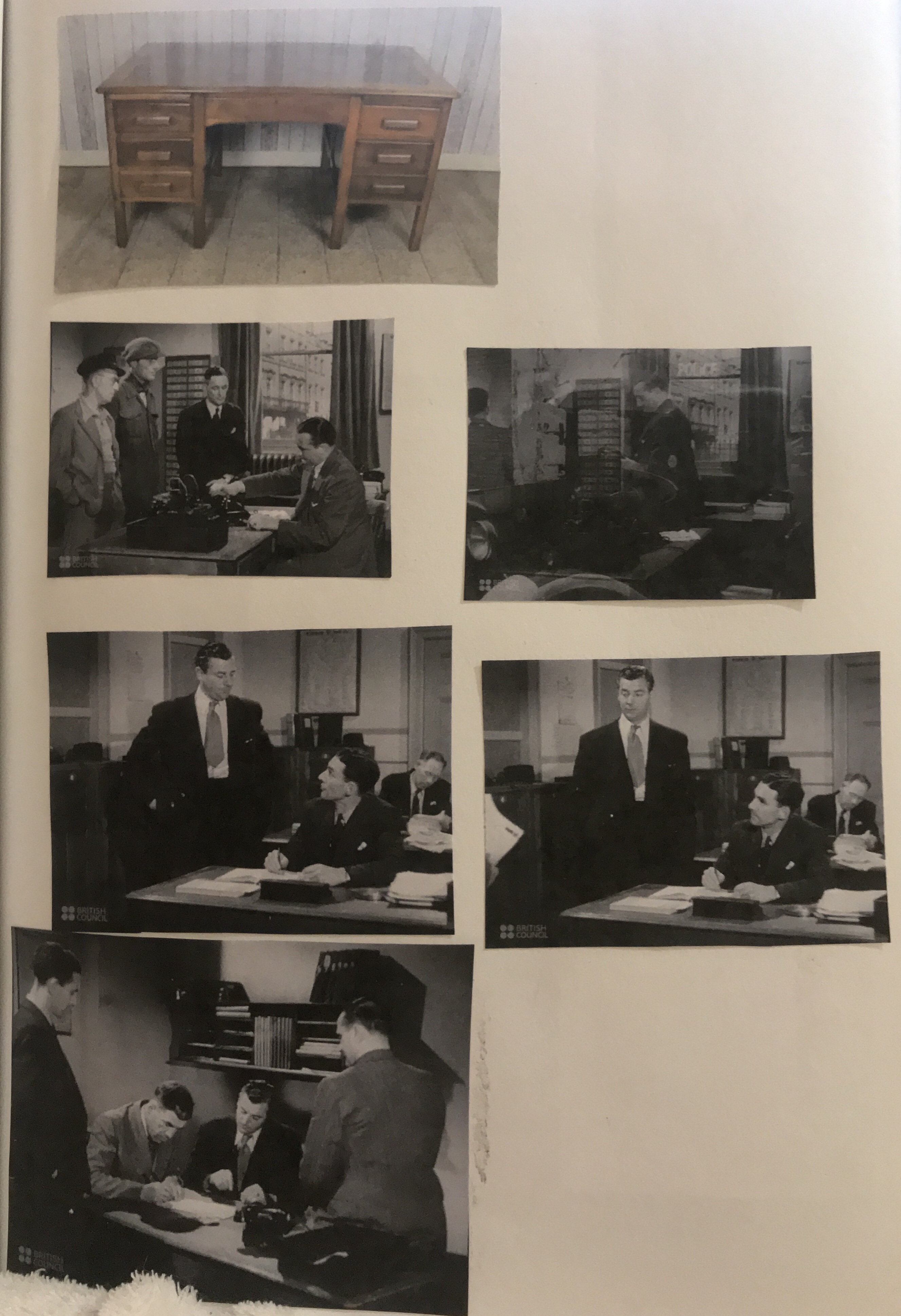
In the excerpt, a big desk is mentioned. I also imagined some filing cabinets and file boxes as the man keeps files as part of his job. However, I did not imagine there to be anything else in the room as the description does say that the room is empty except a big desk.
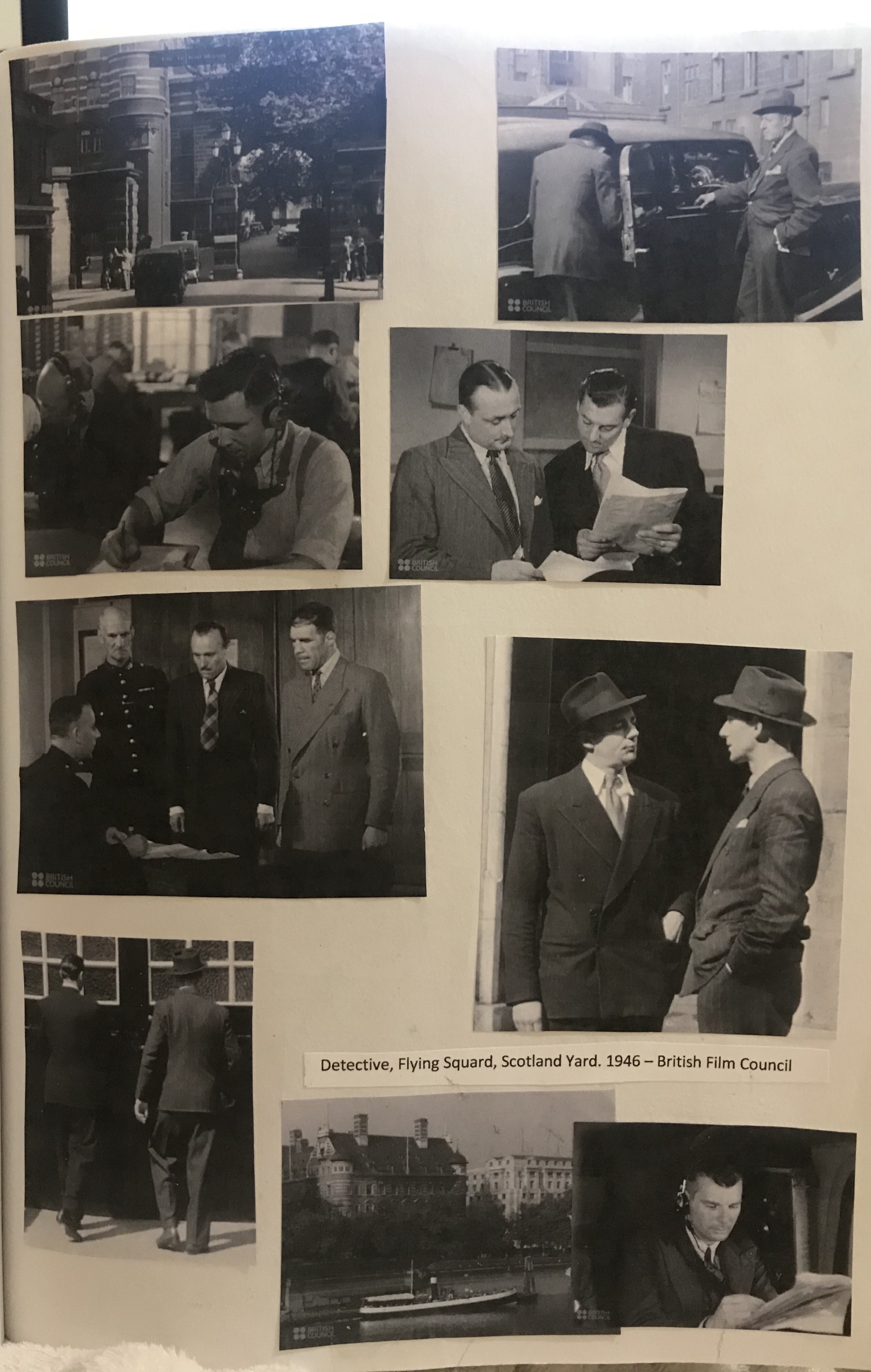
For the next part of the exercise was asked to: Collect a visual reference for the items on our list. Find a reference book or website for this era. Use the Internet to do an image search. Be selective. Don’t go for the first image and counter try to remember your own vision of the story and reflect this in your choices. Stick these images onto a large sheet of paper or individual notebook. I did my visual notebook in my sketchbook and started finding images for the items I had on my list for the character either to be wearing or items of furniture in the room.
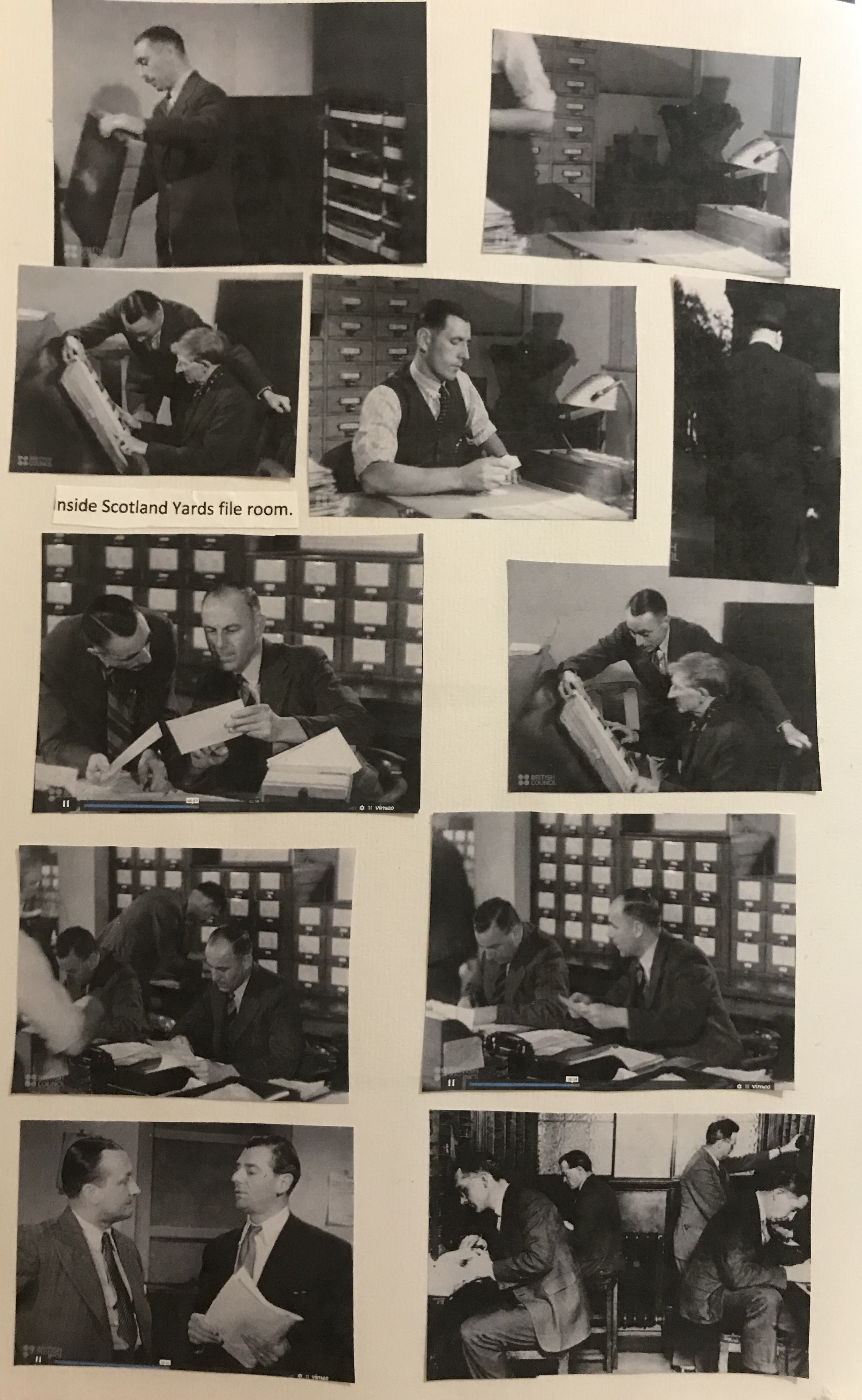
I then found some great films from wartime Britain on the ITV website, one of which was called; ‘Routine Job’. It was about detectives in the Flying Squad, Scotland Yard.1946. I am unsure if any of the characters in this film are real or just based on real characters, as I was unable to find any details on this. However, the locations are real and the costumes or clothes that the characters are wearing our typical of the 1940s, and therefore fit very well with how I imagined my character. This film is very interesting and shows a typical day of a detective from the flying squad. During the film, the file room at Scotland Yard is shown. This was very interesting to me as it is probably where the character in our excerpt would work. However, from the description given this is not at all how I imagined his office, nor how it is described. The rooms I saw in the film are occupied by multiple workers and are not in any way empty. I also included some pictures of Scotland Yard’s buildings as when I read the excerpt and imagined the scene, I imagined more modern windows than they actually were, due to the description given by the writer.
The next task was to explore textual and colouristic visual brainstorming and idea generation.
We were asked to ‘choose a word which we feel captures the mood we would like to convey. Collect and create textures and colours we associate with this word to make a mood board. Start with a broad vision to describe the overall colour or tone of the image, not specific elements of it. Be minimal and selective, and gradually add textures and colours that complement the general impression. ‘
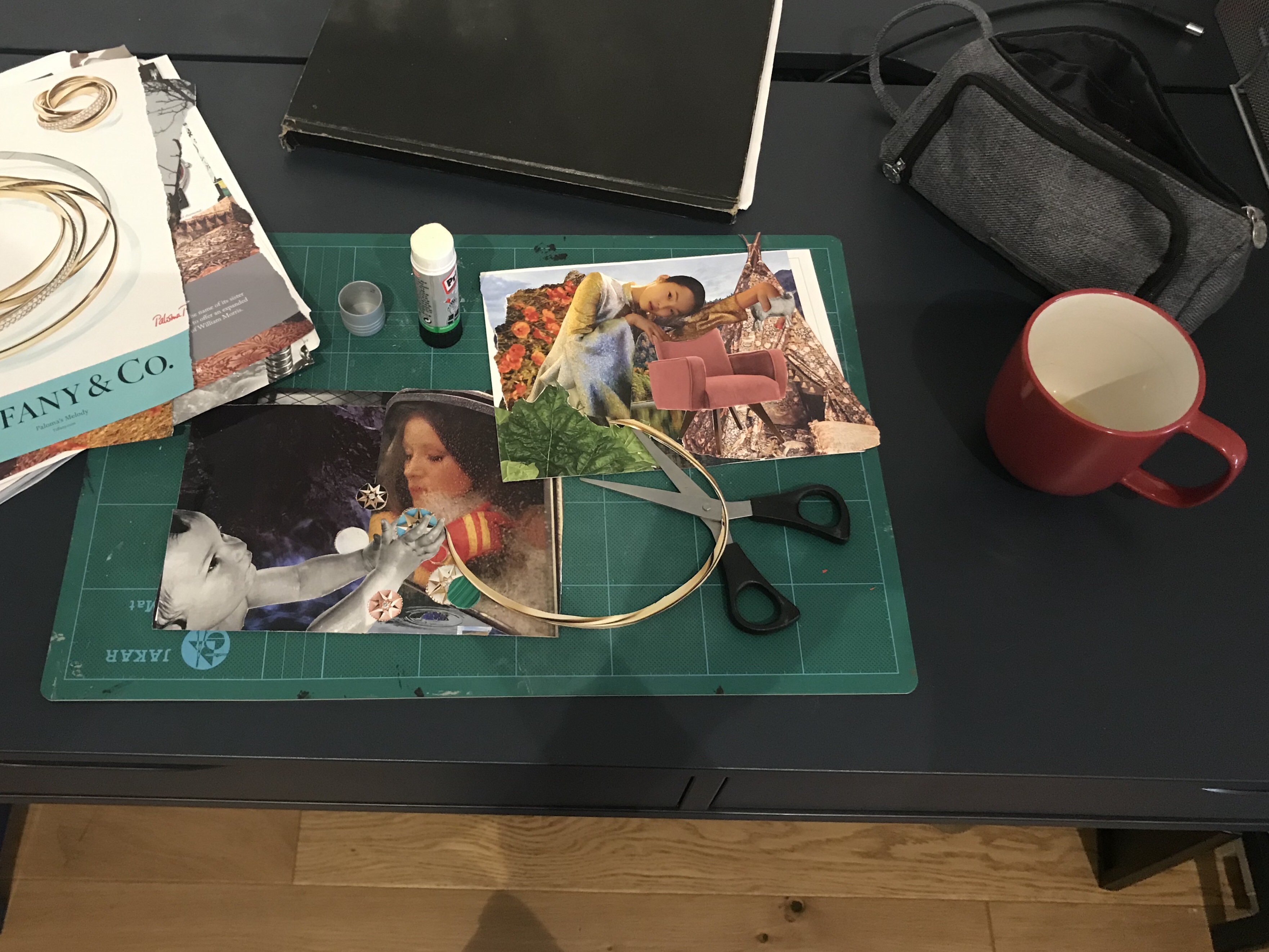
I really enjoyed doing this mood board and had quite a different approach with it, from the ones I have done for previous exercises. My chosen word for my mood board was ‘stark’. I started my mood board by adding colours and textures with gouache paint. I also used patches of colour with metallic pencils and markers, then I went around the house and did some texture rubbings. I had seen my fellow students do these on my Lisbon trip and thought that it would be good to try that in order to add textures to my board. I did rubbings of an Artex wall, the steps of a metal ladder, wooden floorboards, the bottom of a saucepan, a woven basket and a couple of other items I found around the house. I really loved the one of the floorboards, but the one that interested me the most was the one of the metal ladder treads as it reminded me of pinstripe material.
My next task was to ‘create a simple portrait (figure, or head and shoulders) of the character, using the reference you have gathered.‘
‘Use sketchbooks to help you to select and edit from your reference materials and explore where to position your figure within the frame format of the picture make the shape based on any book you have to hand.
Use the colours, textures and qualities you assembled for your mood board to render the portrait. You may literally collage these textures into a drawing, or convey the tonal qualities of the mood bored through the way that use materials and mark making.’
A book I had to hand was this one called Mr Darcy, Vampyr by Amanda Grange. I liked the composition of this book cover and wanted to use this for the composition of my drawing. I did some test sketches of the composition and also some quick sketches to try to put on paper the image of my characters features that I had in my head. This was however quite hard to do.
It was at this point that I realised that it may be interesting to incorporate some of my rubbings directly into my drawing. As you can see from the top thumbnail I tested this out and really liked the result. I went and did some more rubbings of a couple of the textures I liked from before, with varying shades of pressure so that I had some dark for shaded areas and lighter for highlighted areas. I used the steps of the ladder again to create some rubbings for the tie and again for the blazer, but this time by moving the paper in small increments and re-rubbing I created a different looking texture and second type of pinstripe.
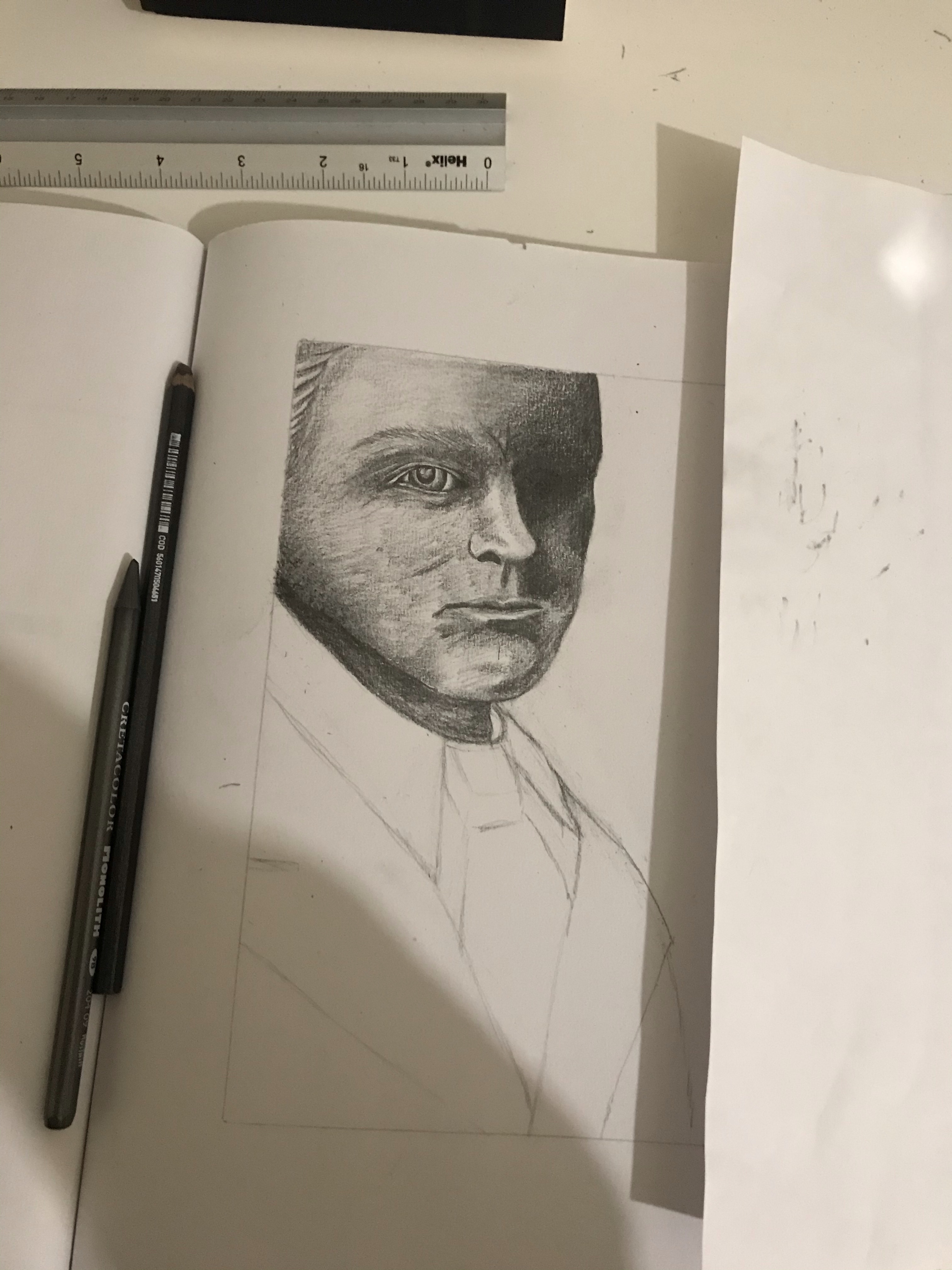
Work in progress…
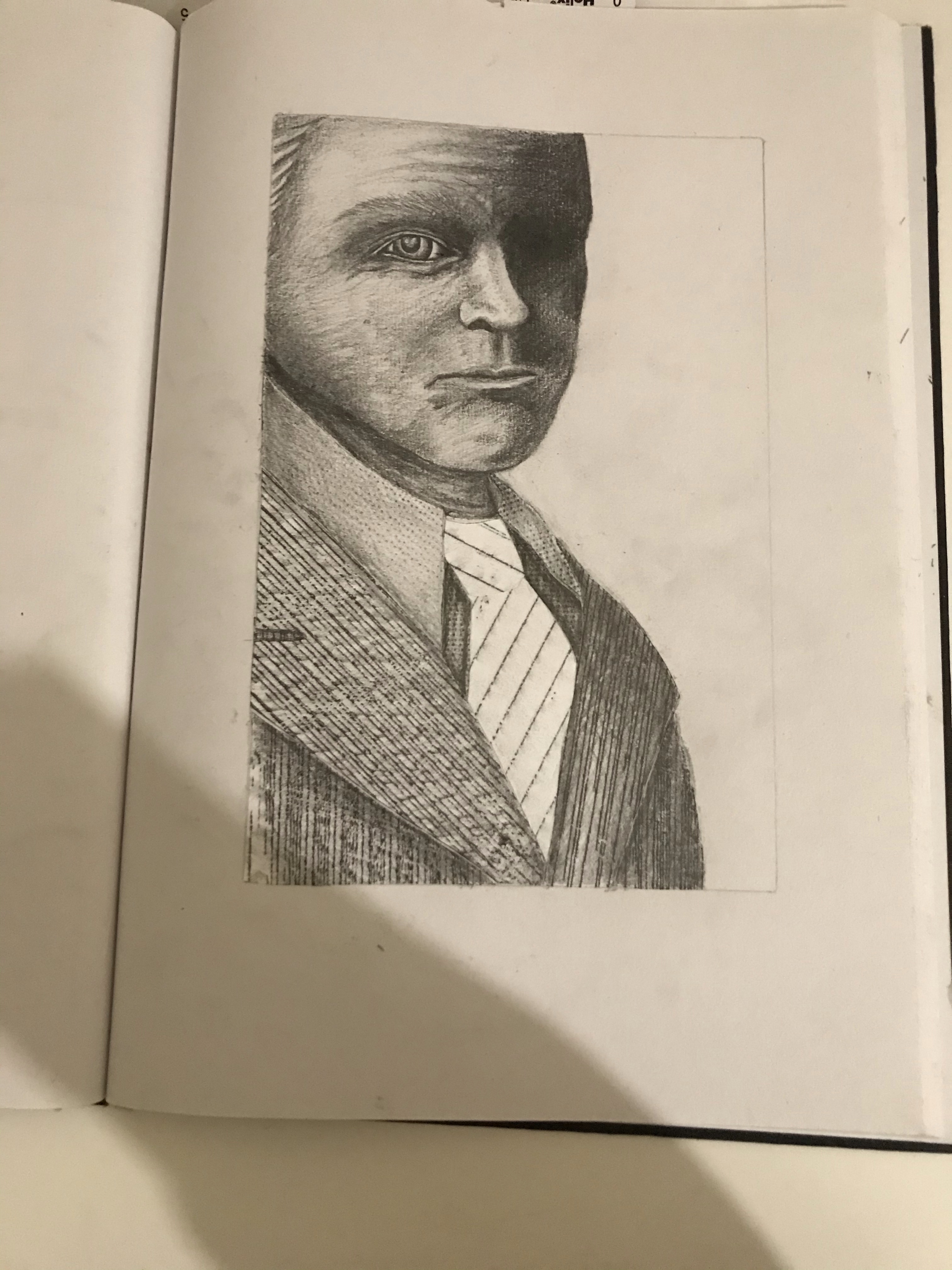
For my final image, I cut out sections of my rubbings and placed them on to my drawing. To create my characters suit. Once I had done this, I added shading with graphite to add a further dimension to the drawing.
My Final Image
Reflection
I am overall very happy with how my final image turned out. With each new exercise and assignment that I do. I am learning something new and this to me is very exciting, as most of the things I am doing, I would never have thought to try or bothered to try without these kind of briefs. Therefore, I am finding that my course is opening my mind up to new techniques and possibilities. Even if some of them I do and I then decide it is something that I would not like to do again, it is still good to try and each time there is something that I learn that I can take on to my next piece of work.
The reference material. I gathered was essential in making this piece seem realistic and fit with the era. Even though I did not need to use most of my references for my final image. It helped me to develop the character, and if I was to go on to draw this character in a room or in a story, I now have all of the visual information that I would need to start this process. I had sufficient reference material to create my image in terms of context. I kept it quite simple and the main focus was the suit in which I used my reference images to make sure that it was of the right cut and style as well as pattern and tone.
I would really like to further explore using rubbings in my illustrations in the way that I did here. I started the drawing of the face before I did the suit and then after thought that actually, I would have really liked to have found a way of perhaps using rubbings to create his face as well. I was quite impressed with how I managed to draw his face so well from memory as I did not use reference for his features, I just tried to picture my character in my mind. He did change and develop quite some bit in my head, as I considered the brief more. The biggest change being that I had originally envisioned him much younger, but later realised he would be a much more interesting character to draw if he was older. I realise that his eye is a little big and the other one I messed up and ended up having to shade out completely, when I had intended on shading it, but leaving some kind of pronunciation to suggest an eye.
This was the most enjoyable exercise so far, as I got to be creative and inventive. Had time permitted, I would have liked to have tried more versions of this character using the same techniques for his suit and seeing what else I could do with his face and also redrawing him in the way that I had intended, as well as experimenting with what rubbing textures I could use to create a human face. I do intend on trying this out again soon.







































 Ashley's OCA Illustration BA Blog